

Bepotastine |
Catalog No.GC39479
 One-Click Copy Product Info
|

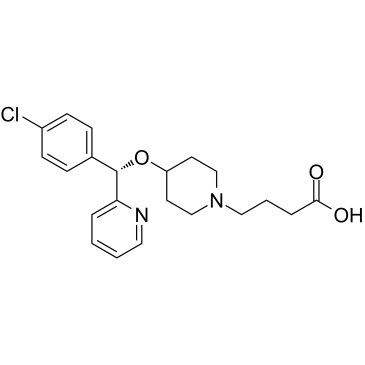
Bepotastine is a non-sedating, orally active second-generation histamine H1 receptor antagonist with higher selectivity than H3 receptors, α1, α2 and β adrenergic receptors, dopamine D2 receptors, serotonin 5-HT2 receptors, vagus nerve acetylcholine receptors, and benzodiazepine receptors.
Products are for research use only. Not for human use. We do not sell to patients.
Cas No.: 125602-71-3
Sample solution is provided at 25 µL, 10mM.
_1-3.$$$39978408@51.jpg');)
_1-9.$$$38538795@65.jpg');)
_1-9.$$$39112701@51.jpg');)
_1-7.$$$37316672@70.jpg');)
_366-372.$$$36198801@70.jpg');)
.$$$38565142@65.jpg');)
_1867-1883.$$$33248023@67.jpg');)
_eads6055.$$$39977546@45.jpg');)
_eadm9805.$$$40080571@45.jpg');)
_eadj3020.$$$39666821@45.jpg');)
_1-20.$$$39757301@28.jpg');)
_1-24.$$$38898113@28.jpg');)
_273-287.$$$36806353@46.jpg');)
_1-16.$$$37156877@44.jpg');)
_1-19.$$$37460805@44.jpg');)
_1291-1307.$$$34518654@46.jpg');)
Bepotastine is a non-sedating, orally active second-generation histamine H1 receptor antagonist with higher selectivity than H3 receptors, α1, α2 and β adrenergic receptors, dopamine D2 receptors, serotonin 5-HT2 receptors, vagus nerve acetylcholine receptors, and benzodiazepine receptors [1]. Bepotastine can inhibit the upregulation of histamine-mediated nerve growth factor (NGF) expression [2]. Bepotastine can be used in studies of allergic rhinitis, allergic conjunctivitis, and urticaria/pruritus [3-4].
In vitro, Bepotastine (10, 100, and 1000μM; 120min) pretreatment reduced histamine release from glomerular mesangial cells (RPMCs) induced by ionizing agent A23187, and could dose-dependently inhibit the chemotaxis of eosinophils induced by leukotriene B4 (LTB4) [5]. Bepotastine (50μM; 1h) treatment significantly reduced the mRNA expression of nerve growth factor (NGF) in human epidermal keratinocytes (NHEKs) mediated by histamine [6].
In vivo, treatment with Bepotastine (10μL 1% (w/v) eye drop) 20, 40 and 60 minutes before platelet-activating factor (PAF) stimulation was able to significantly inhibit the eosinophil infiltration in the conjunctiva of guinea pigs with PAF-induced allergic conjunctivitis model [5]. Bepotastine (3 and 10mg/kg/day; single dose) oral treatment 1 hour later could effectively inhibit scratching behavior induced by histamine in mice, and significantly reduced the serum LTB4 levels in the NC/Nga dermatitis model mice at a dose of 10mg/kg/day [7].
References:
[1] Kato, M., Nishida, A., Aga, Y., et al. Pharmacokinetic and pharmacodynamic evaluation of central effect of the novel antiallergic agent betotastine besilate. Arzneimittelforschung. 47(10), 1116-1124 (1997).
[2] Tamura T, Amano T, Ohmori K, et al. The effects of olopatadine hydrochloride on the number of scratching induced by repeated application of oxazolone in mice[J]. European journal of pharmacology, 2005, 524(1-3): 149-154.
[3] Khilnani G, Khilnani A K, Thaddanee R. Learning pharmacology by metaphors: A tale of antihistamines[J]. National Journal of Physiology, Pharmacy and Pharmacology, 2020, 10(8): 693-693.
[4] Sil A, Rahaman S, Mondal N, et al. An investigator-blind randomized controlled trial comparing effectiveness, safety of levocetirizine and bepotastine in chronic urticaria[J]. Indian Journal of Dermatology, 2021, 66(5): 472-478.
[5] Kida T, Fujii A, Sakai O, et al. Bepotastine besilate, a highly selective histamine H(1) receptor antagonist, suppresses vascular hyperpermeability and eosinophil recruitment in in vitro and in vivo experimental allergic conjunctivitis models. Exp Eye Res. 2010;91(1):85-91.
[6] Kamata Y, Sakaguchi A, Umehara Y, et al. Bepotastine besilate downregulates the expression of nerve elongation factors in normal human epidermal keratinocytes. J Dermatol Sci. Published online April 23, 2018. [7] Tanizaki H, Kambe N, Nakamura Y, Tanaka A, Matsuda H, Miyachi Y. Oral administration of bepotastine besilate suppressed scratching behavior of atopic dermatitis model NC/Nga mice. Int Arch Allergy Immunol. 2008;145(4):277-282.
| Cell experiment [1]: | |
Cell lines | Renal glomerular mesangial cells (RPMCs) |
Preparation Method | For the assay of histamine release, 1mL of RPMC suspension (2 × 10⁴ cells/mL) was mixed with 1mL of Tyrode’s solution containing 0.2% ethanol with or without Bepotastine at final concentrations of 10, 100, or 1000μM, and the mixture was pre-incubated for 120min at 37°C in a humidified atmosphere (5% CO2). After preincubation, 10μL of the calcium ionophore A23187 in dimethylsulfoxide was added to each well to make a final concentration of 0.01μM A23187 and the plates were incubated for 10min. The plates were then placed on ice to terminate the reaction and each cell suspension was centrifuged at 200×g for 8min at 4°C. The supernatant was collected to determine the amount of histamine release from RPMCs. Histamine in the precipitant was determined by adding Tyrode’s solution and homogenizing by sonication. The sonicated samples were centrifuged at 800×g for 10min at 4°C and the supernatant was collected to determine the amount of residual histamine. |
Reaction Conditions | 10, 100 and 1000μM; 120min |
Applications | Bepotastine pretreatment reduced the histamine release from RPMCs induced by the A23187. |
| Animal experiment [1]: | |
Animal models | Guinea pigs (allergic conjunctivitis models) |
Preparation Method | Guinea pigs (6-week-old) topically received 10μL of Bepotastine eye drops (1.0% (w/v)) in one eye 3 times at intervals of 20min. At 20min after the last instillation of Bepotastine, 10μL of platelet-activating factor (PAF) dissolved in saline at a final concentration of 0.1% (w/v) was topically applied into their conjunctiva to induce eosinophil infiltration. Six hours after PAF instillation, the animals were euthanized and each conjunctiva was removed for determination of eosinophil peroxidase (EPO) activity. |
Dosage form | 1.0% (w/v) for 10µL; Eye drop; 3 times at intervals of 20min (in one eye) |
Applications | Treatment with Bepotastine was able to significantly inhibit the PAF-induced eosinophil infiltration in the guinea pig conjunctiva. |
References: | |
| Cas No. | 125602-71-3 | SDF | |
| Canonical SMILES | O=C(O)CCCN1CCC(O[C@@H](C2=CC=C(Cl)C=C2)C3=CC=CC=N3)CC1 | ||
| Formula | C21H25ClN2O3 | M.Wt | 388.89 |
| Solubility | DMSO : 78mg/mL; Water : 30mg/mL (Need ultrasonic) | Storage | Store at -20°C |
| General tips | Please select the appropriate solvent to prepare the stock solution according to the
solubility of the product in different solvents; once the solution is prepared, please store it in
separate packages to avoid product failure caused by repeated freezing and thawing.Storage method
and period of the stock solution: When stored at -80°C, please use it within 6 months; when stored
at -20°C, please use it within 1 month. To increase solubility, heat the tube to 37°C and then oscillate in an ultrasonic bath for some time. |
||
| Shipping Condition | Evaluation sample solution: shipped with blue ice. All other sizes available: with RT, or with Blue Ice upon request. | ||
| Prepare stock solution | |||

|
1 mg | 5 mg | 10 mg |
| 1 mM | 2.5714 mL | 12.8571 mL | 25.7142 mL |
| 5 mM | 514.3 μL | 2.5714 mL | 5.1428 mL |
| 10 mM | 257.1 μL | 1.2857 mL | 2.5714 mL |
Step 1: Enter information below (Recommended: An additional animal making an allowance for loss during the experiment)
 g
μL
g
μL
Step 2: Enter the in vivo formulation (This is only the calculator, not formulation. Please contact us first if there is no in vivo formulation at the solubility Section.)
Calculation results:
Working concentration: mg/ml;
Method for preparing DMSO master liquid: mg drug pre-dissolved in μL DMSO ( Master liquid concentration mg/mL, Please contact us first if the concentration exceeds the DMSO solubility of the batch of drug. )
Method for preparing in vivo formulation: Take μL DMSO master liquid, next addμL PEG300, mix and clarify, next addμL Tween 80, mix and clarify, next add μL saline, mix and clarify.
Method for preparing in vivo formulation: Take μL DMSO master liquid, next add μL Corn oil, mix and clarify.
Note: 1. Please make sure the liquid is clear before adding the next solvent.
2. Be sure to add the solvent(s) in order. You must ensure that the solution obtained, in the previous addition, is a clear solution before proceeding to add the next solvent. Physical methods such as vortex, ultrasound or hot water bath can be used to aid dissolving.
3. All of the above co-solvents are available for purchase on the GlpBio website.
Quality Control & SDS
- View current batch:
- Purity: >98.00% Appearance: A solid
- COA (Certificate of Analysis)
- SDS (Safety Data Sheet)
- Datasheet
Average Rating: 5 (Based on Reviews and 18 reference(s) in Google Scholar.)