

Bicalutamide (Synonyms: ICI 176334, ZD 176334) |
Catalog No.GC12271
 One-Click Copy Product Info
|

Bicalutamide is a non-steroidal antiandrogen that selectively and competitively blocks androgen binding to the androgen receptor (AR), exerting anti-androgenic effects in peripheral tissues.
Products are for research use only. Not for human use. We do not sell to patients.
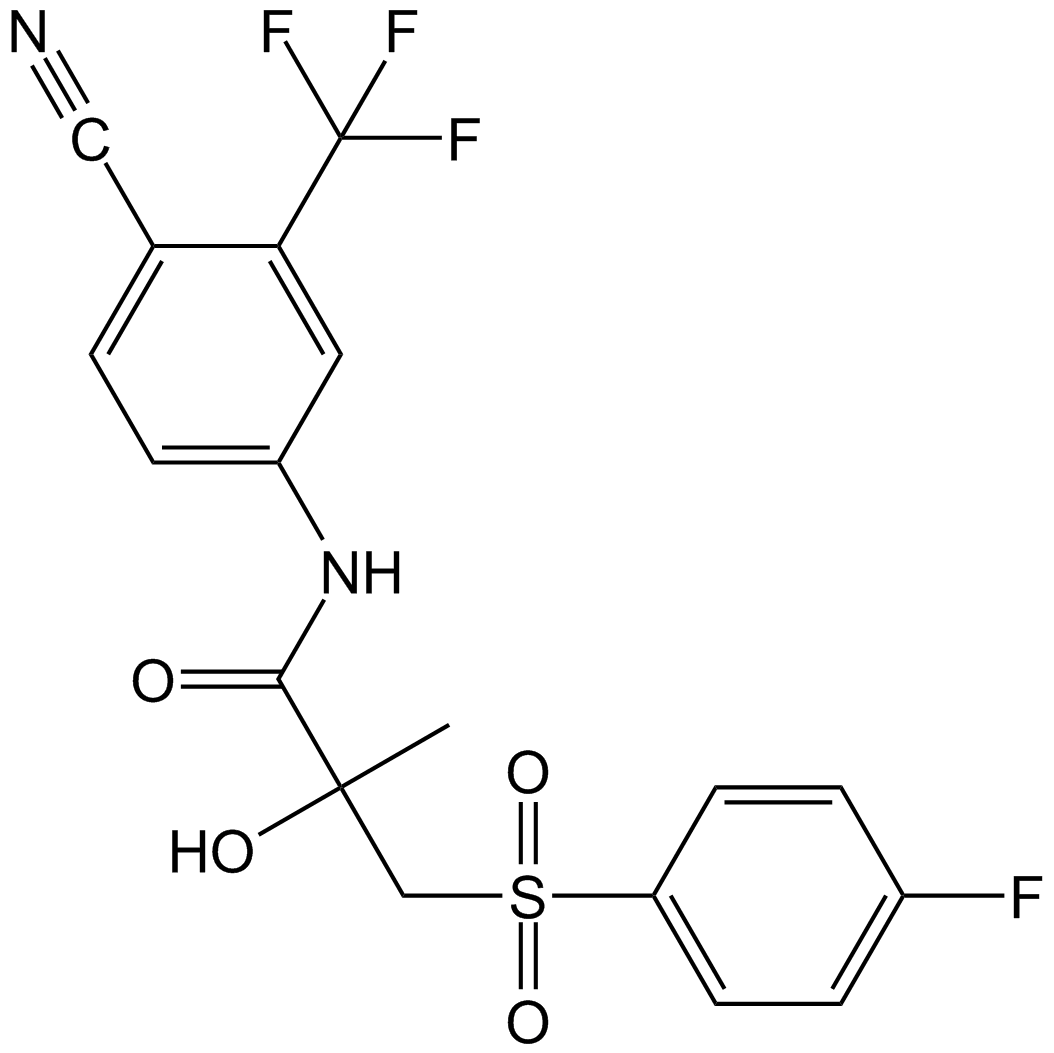
Cas No.: 90357-06-5
Sample solution is provided at 25 µL, 10mM.
_1-3.$$$39978408@51.jpg');)
_1-9.$$$38538795@65.jpg');)
_1-9.$$$39112701@51.jpg');)
_1-7.$$$37316672@70.jpg');)
_366-372.$$$36198801@70.jpg');)
.$$$38565142@65.jpg');)
_1867-1883.$$$33248023@67.jpg');)
_eads6055.$$$39977546@45.jpg');)
_eadm9805.$$$40080571@45.jpg');)
_eadj3020.$$$39666821@45.jpg');)
_1-20.$$$39757301@28.jpg');)
_1-24.$$$38898113@28.jpg');)
_273-287.$$$36806353@46.jpg');)
_1-16.$$$37156877@44.jpg');)
_1-19.$$$37460805@44.jpg');)
_1291-1307.$$$34518654@46.jpg');)
Bicalutamide is a non-steroidal antiandrogen that selectively and competitively blocks androgen binding to the androgen receptor (AR), exerting anti-androgenic effects in peripheral tissues[1-2]. Bicalutamide is used for the treatment of advanced prostate cancer[3].
In vitro, after VCaP cells were treated for 7 days with increasing concentrations of Bicalutamide (10-10-10-5mol/L), Bicalutamide dose-dependently promoted cell proliferation and partially antagonized the effect of the synthetic androgen R1881[4]. Treatment of mature dendritic cells (mDCs) with 20μM Bicalutamide for 24h induced a modest but significant up-regulation of CD86 and HLA-DR, down-regulated CD11c, and markedly reduced both transforming growth factor-β (TGF-β) and interleukin-10 (IL-10) protein levels[5].
In vivo, in male BALB/c mice, daily intraperitoneal injection of 0.02mg Bicalutamide in 0.5ml saline for 7 consecutive days significantly reduced eosinophil infiltration in the nasal mucosa, markedly lowered serum levels of IgE, IL-4, and IL-6, and substantially decreased the surface expression of histamine receptors on mast cells, while also markedly suppressing p-protein kinase B (p-PKB) and mTOR protein levels in these cells[6]. In knock-in spinal and bulbar muscular atrophy (SBMA) (KI AR113Q) mice given twice-weekly subcutaneous Bicalutamide (2mg/kg in 50µL corn oil), the drug reversed muscle AR insoluble aggregate formation, restored autophagic flux, and suppressed apoptosis, yielding partial recovery of muscle morphology and function, improved motor performance, and prolonged survival[7].
References:
[1] Carvalho RM, Santos LDN, Ramos PM, et al. Bicalutamide and the new perspectives for female pattern hair loss treatment: What dermatologists should know. J Cosmet Dermatol. 2022;21(10):4171-4175.
[2] Aulakh S, Mysore V. Bicalutamide: A review. J Cutan Aesthet Surg. 2025;18(2):78-85.
[3] Kolvenbag GJ, Blackledge GR. Worldwide activity and safety of bicalutamide: a summary review. Urology. 1996;47(1A Suppl):70-84.
[4] Clegg NJ, Wongvipat J, Joseph JD, et al. ARN-509: a novel antiandrogen for prostate cancer treatment. Cancer Res. 2012;72(6):1494-1503.
[5] Nourbakhsh NS, Naeimi S, Moghanibashi M, et al. Bicalutamide reveals immunomodulatory effects in prostate cancer by regulating immunogenic dendritic cell maturation. Tissue Cell. 2024;91:102530.
[6] Zhang Y, Zhang Q, Wu X, et al. Bicalutamide, an androgen receptor antagonist, effectively alleviate allergic rhinitis via suppression of PI3K-PKB activity. Eur Arch Otorhinolaryngol. 2023;280(2):703-711.
[7] Galbiati M, Meroni M, Boido M, et al. Bicalutamide and Trehalose Ameliorate Spinal and Bulbar Muscular Atrophy Pathology in Mice. Neurotherapeutics. 2023;20(2):524-545.
| Cell experiment [1]: | |
Cell lines | Mature dendritic cells (mDCs) |
Preparation Method | A total of 3×10⁵ cells were cultured in four wells of a 24-well plate. Cells were exposed to 20μM Bicalutamide. The plate was then incubated at 37°C for 24 hours. After the incubation period, the surface expression of markers associated with mDCs and antigen presentation were assessed to conduct the phenotypic characterization of both mDCs and Bicalutamide-treated mDCs. |
Reaction Conditions | 20μM; 24h |
Applications | Flow cytometry results demonstrated a slightly significant upregulation of CD86 and HLA-DR in the mDC + Bicalutamide group compared to the mDC group. However, CD11c expression was downregulated in mDC + Bicalutamide. Following the treatment of mDCs with Bicalutamide, the expression levels of Transforming growth factor-β (TGF-β) and Interleukin-10 (IL-10) in the Bicalutamide-mDC group exhibited a significant decrease compared to mDCs. |
| Animal experiment [2]: | |
Animal models | Male KI AR113Q mice |
Preparation Method | To analyze the effects of Bicalutamide and trehalose on knock-in spinal and bulbar muscular atrophy (SBMA) (KI AR113Q) mice, we administered: Bicalutamide by subcutaneous injection (50μL, 2mg/kg, dissolved in corn oil) twice a week from 6 weeks of age until death or sacrifice (max 52 weeks). In a second experiment, animals were treated with Bicalutamide from 12 weeks of age and sacrificed at 26 weeks of age. We analyzed: mouse survival curves, motor behavior (once a week), and molecular changes in the spinal cord and gastrocnemius muscle. |
Dosage form | 2mg/kg; subcutaneous injection |
Applications | Bicalutamide achieves much lower concentrations in the central nervous system (CNS) than in plasma. In KI AR113Q mice, Bicalutamide reversed the formation of androgen receptor (AR) insoluble forms in muscle and prevented the blockage of autophagic flux. Bicalutamide also blocked the activation of apoptosis that occurs in KI AR113Q muscle. Bicalutamide led to a partial recovery of muscle morphology and function, improved the motor performance of SBMA mice, and extended their survival. |
References: | |
| Cas No. | 90357-06-5 | SDF | |
| Synonyms | ICI 176334, ZD 176334 | ||
| Chemical Name | N-[4-cyano-3-(trifluoromethyl)phenyl]-3-(4-fluorophenyl)sulfonyl-2-hydroxy-2-methylpropanamide | ||
| Canonical SMILES | CC(CS(=O)(=O)C1=CC=C(C=C1)F)(C(=O)NC2=CC(=C(C=C2)C#N)C(F)(F)F)O | ||
| Formula | C18H14F4N2O4S | M.Wt | 430.37 |
| Solubility | ≥ 21.5mg/mL in DMSO, ≥ 4.3 mg/mL in EtOH with ultrasonic | Storage | Store at RT |
| General tips | Please select the appropriate solvent to prepare the stock solution according to the
solubility of the product in different solvents; once the solution is prepared, please store it in
separate packages to avoid product failure caused by repeated freezing and thawing.Storage method
and period of the stock solution: When stored at -80°C, please use it within 6 months; when stored
at -20°C, please use it within 1 month. To increase solubility, heat the tube to 37°C and then oscillate in an ultrasonic bath for some time. |
||
| Shipping Condition | Evaluation sample solution: shipped with blue ice. All other sizes available: with RT, or with Blue Ice upon request. | ||
| Prepare stock solution | |||

|
1 mg | 5 mg | 10 mg |
| 1 mM | 2.3236 mL | 11.6179 mL | 23.2358 mL |
| 5 mM | 464.7 μL | 2.3236 mL | 4.6472 mL |
| 10 mM | 232.4 μL | 1.1618 mL | 2.3236 mL |
Step 1: Enter information below (Recommended: An additional animal making an allowance for loss during the experiment)
 g
μL
g
μL
Step 2: Enter the in vivo formulation (This is only the calculator, not formulation. Please contact us first if there is no in vivo formulation at the solubility Section.)
Calculation results:
Working concentration: mg/ml;
Method for preparing DMSO master liquid: mg drug pre-dissolved in μL DMSO ( Master liquid concentration mg/mL, Please contact us first if the concentration exceeds the DMSO solubility of the batch of drug. )
Method for preparing in vivo formulation: Take μL DMSO master liquid, next addμL PEG300, mix and clarify, next addμL Tween 80, mix and clarify, next add μL saline, mix and clarify.
Method for preparing in vivo formulation: Take μL DMSO master liquid, next add μL Corn oil, mix and clarify.
Note: 1. Please make sure the liquid is clear before adding the next solvent.
2. Be sure to add the solvent(s) in order. You must ensure that the solution obtained, in the previous addition, is a clear solution before proceeding to add the next solvent. Physical methods such as vortex, ultrasound or hot water bath can be used to aid dissolving.
3. All of the above co-solvents are available for purchase on the GlpBio website.
Quality Control & SDS
- View current batch:
- Purity: >98.00% Appearance: A solid
- COA (Certificate of Analysis)
- SDS (Safety Data Sheet)
- Datasheet
Average Rating: 5 (Based on Reviews and 6 reference(s) in Google Scholar.)