

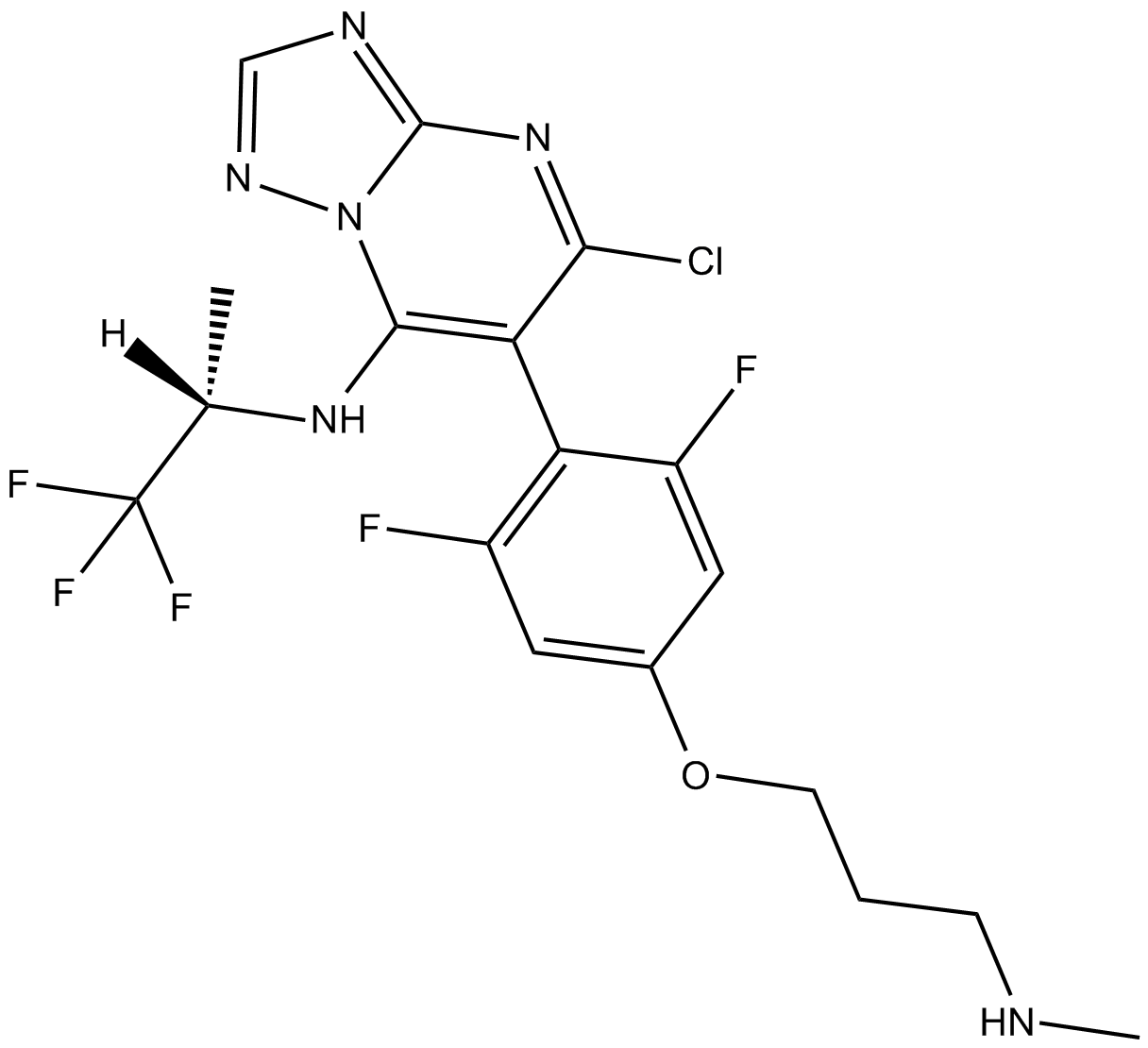
Cevipabulin (Synonyms: TTI-237) |
Catalog No.GC11905
 One-Click Copy Product Info
|

Anti-microtubule agent
Products are for research use only. Not for human use. We do not sell to patients.
Cas No.: 849550-05-6
Sample solution is provided at 25 µL, 10mM.
_1-3.$$$39978408@51.jpg');)
_1-9.$$$38538795@65.jpg');)
_1-9.$$$39112701@51.jpg');)
_1-7.$$$37316672@70.jpg');)
_366-372.$$$36198801@70.jpg');)
.$$$38565142@65.jpg');)
_1867-1883.$$$33248023@67.jpg');)
_eads6055.$$$39977546@45.jpg');)
_eadm9805.$$$40080571@45.jpg');)
_eadj3020.$$$39666821@45.jpg');)
_1-20.$$$39757301@28.jpg');)
_1-24.$$$38898113@28.jpg');)
_273-287.$$$36806353@46.jpg');)
_1-16.$$$37156877@44.jpg');)
_1-19.$$$37460805@44.jpg');)
_1291-1307.$$$34518654@46.jpg');)
Cevipabulin (TTI-237) is a new anti-microtubule agent [1][2][3][4].
Microtubules are a component of the cytoskeleton that participate in many crucial cellular functions, include maintaining the structure of the cell, forming the cytoskeleton and chromosome separation.
Cevipabulin (TTI-237) is a new anti-microtubule agent with antitumor activity. In COLO 205 cells, TTI-237 inhibited cell proliferation with IC50 value of 31 nM [1]. At low ratios of TTI-237: tubulin heterodimer (about 1:30), TTI-237 increased depolymerization kinetics in response to low temperature, but stabilized the aggregates at high ratios (about 1:4). TTI-237 inhibited the exchange of [3H]GTP at the exchangeable nucleotide site of the tubulin heterodimer [2]. Cevipabulin (TTI-237) increased tubulin polymerization. Cevipabulin was stable and water-soluble, and could be administered i.v. or p.o. in saline [3]. TTI-237 inhibited the binding of [3H]vinblastine to tubulin, but significantly increased turbidity development that more closely resembled the effect of docetaxel. In Hela cells, TTI-237 (34 nmol/L) induced multiple spindle poles and multi-nuclear cells. At 20-40 nmol/L, TTI-237 produced sub-G1 nuclei, while at > 50 nmol/L, TTI-237 induced G2-M block.
In athymic mice bearing LoVo human colon adenocarcinoma, TTI-237 exhibited good antitumor activity in a dose-dependent way. In mice bearing U87-MG human glioblastoma, TTI-237 (25 mg/kg) given both i.v. and p.o. were equally effective [4].
References:
[1]. Zhang N, Ayral-Kaloustian S, Nguyen T, et al. 2-cyanoaminopyrimidines as a class of antitumor agents that promote tubulin polymerization. Bioorg Med Chem Lett, 2007, 17(11): 3003-3005.
[2]. Beyer CF, Zhang N, Hernandez R, et al. The microtubule-active antitumor compound TTI-237 has both paclitaxel-like and vincristine-like properties. Cancer Chemother Pharmacol, 2009, 64(4): 681-689.
[3]. Ayral-Kaloustian S, Zhang N, Beyer C. Cevipabulin (TTI-237): preclinical and clinical results for a novel antimicrotubule agent. Methods Find Exp Clin Pharmacol, 2009, 31(7): 443-447.
[4]. Beyer CF, Zhang N, Hernandez R, et al. TTI-237: a novel microtubule-active compound with in vivo antitumor activity. Cancer Res, 2008, 68(7): 2292-2300.
| Cas No. | 849550-05-6 | SDF | |
| Synonyms | TTI-237 | ||
| Chemical Name | (S)-5-chloro-6-(2,6-difluoro-4-(3-(methylamino)propoxy)phenyl)-N-(1,1,1-trifluoropropan-2-yl)-[1,2,4]triazolo[1,5-a]pyrimidin-7-amine | ||
| Canonical SMILES | C[C@@](NC1=C(C(Cl)=NC2=NC=NN12)C3=C(F)C=C(OCCCNC)C=C3F)([H])C(F)(F)F | ||
| Formula | C18H18ClF5N6O | M.Wt | 464.82 |
| Solubility | Soluble in DMSO | Storage | Store at -20°C |
| General tips | Please select the appropriate solvent to prepare the stock solution according to the
solubility of the product in different solvents; once the solution is prepared, please store it in
separate packages to avoid product failure caused by repeated freezing and thawing.Storage method
and period of the stock solution: When stored at -80°C, please use it within 6 months; when stored
at -20°C, please use it within 1 month. To increase solubility, heat the tube to 37°C and then oscillate in an ultrasonic bath for some time. |
||
| Shipping Condition | Evaluation sample solution: shipped with blue ice. All other sizes available: with RT, or with Blue Ice upon request. | ||
| Prepare stock solution | |||

|
1 mg | 5 mg | 10 mg |
| 1 mM | 2.1514 mL | 10.7569 mL | 21.5137 mL |
| 5 mM | 430.3 μL | 2.1514 mL | 4.3027 mL |
| 10 mM | 215.1 μL | 1.0757 mL | 2.1514 mL |
Step 1: Enter information below (Recommended: An additional animal making an allowance for loss during the experiment)
 g
μL
g
μL
Step 2: Enter the in vivo formulation (This is only the calculator, not formulation. Please contact us first if there is no in vivo formulation at the solubility Section.)
Calculation results:
Working concentration: mg/ml;
Method for preparing DMSO master liquid: mg drug pre-dissolved in μL DMSO ( Master liquid concentration mg/mL, Please contact us first if the concentration exceeds the DMSO solubility of the batch of drug. )
Method for preparing in vivo formulation: Take μL DMSO master liquid, next addμL PEG300, mix and clarify, next addμL Tween 80, mix and clarify, next add μL saline, mix and clarify.
Method for preparing in vivo formulation: Take μL DMSO master liquid, next add μL Corn oil, mix and clarify.
Note: 1. Please make sure the liquid is clear before adding the next solvent.
2. Be sure to add the solvent(s) in order. You must ensure that the solution obtained, in the previous addition, is a clear solution before proceeding to add the next solvent. Physical methods such as vortex, ultrasound or hot water bath can be used to aid dissolving.
3. All of the above co-solvents are available for purchase on the GlpBio website.
Quality Control & SDS
- View current batch:
- Purity: >99.50% Appearance: A solid
- COA (Certificate of Analysis)
- SDS (Safety Data Sheet)
- Datasheet
Average Rating: 5 (Based on Reviews and 8 reference(s) in Google Scholar.)