

CGP 52432 |
Catalog No.GC16947
 One-Click Copy Product Info
|

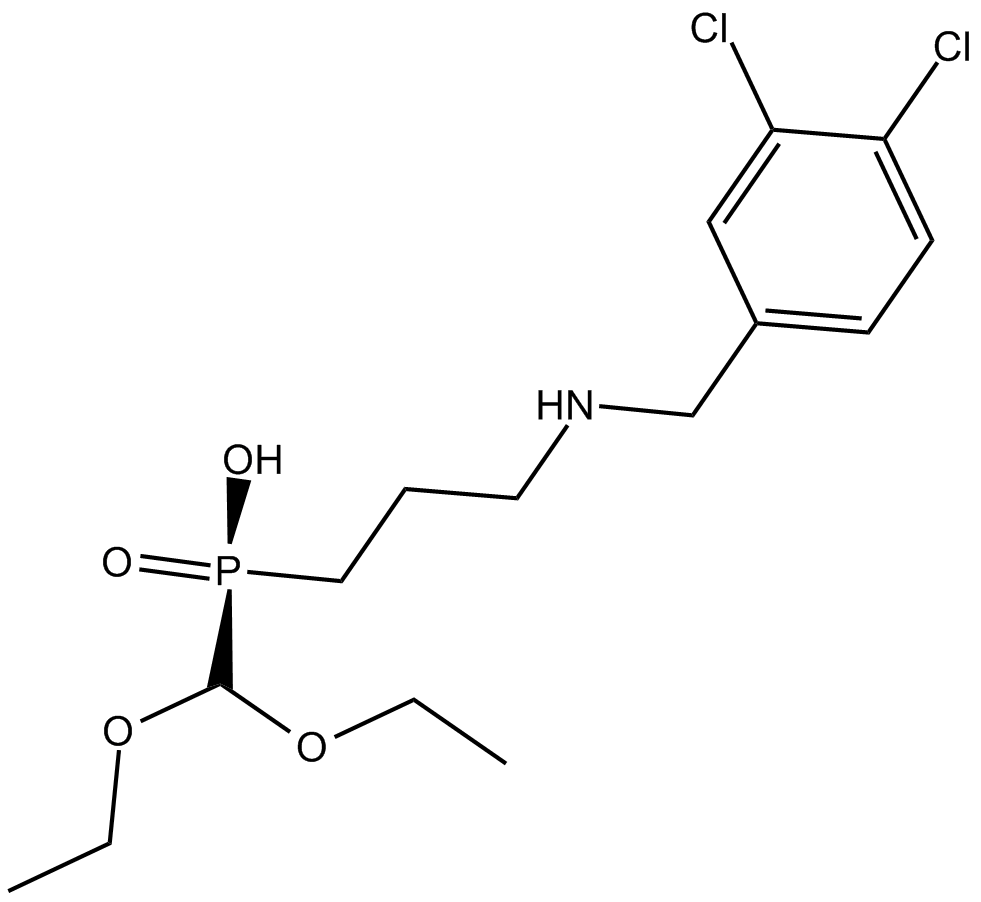
CGP 52432 is a GABAB receptor antagonist with an IC₅₀ of 85nM, which is 35- and 100-fold lower than those at receptors regulating somatostatin and glutamate overflow, respectively.
Products are for research use only. Not for human use. We do not sell to patients.
Cas No.: 139667-74-6
Sample solution is provided at 25 µL, 10mM.
_1-3.$$$39978408@51.jpg');)
_1-9.$$$38538795@65.jpg');)
_1-9.$$$39112701@51.jpg');)
_1-7.$$$37316672@70.jpg');)
_366-372.$$$36198801@70.jpg');)
.$$$38565142@65.jpg');)
_1867-1883.$$$33248023@67.jpg');)
_eads6055.$$$39977546@45.jpg');)
_eadm9805.$$$40080571@45.jpg');)
_eadj3020.$$$39666821@45.jpg');)
_1-20.$$$39757301@28.jpg');)
_1-24.$$$38898113@28.jpg');)
_273-287.$$$36806353@46.jpg');)
_1-16.$$$37156877@44.jpg');)
_1-19.$$$37460805@44.jpg');)
_1291-1307.$$$34518654@46.jpg');)
CGP 52432 is a GABAB receptor antagonist with an IC₅₀ of 85nM, which is 35- and 100-fold lower than those at receptors regulating somatostatin and glutamate overflow, respectively[1].
In vitro, CGP 52432 (0.01–100μM; 8min) concentration-dependently antagonized the inhibitory effect of (-)-baclofen on potassium-evoked overflow of γ-aminobutyric acid (GABA), somatostatin, and glutamate from rat cerebral cortex synaptosomes[1]. CGP 52432 (100nM-10μM; 24h) dose-dependently increased the viability and promoted the proliferation of neural stem cells (NSCs) from SD rats[2]. CGP 52432 (10μM; 30min) blocked the clozapine-induced increase in GSK-3α/β phosphorylation in GABAB receptor-transfected HEK293 cells[3].
In vivo, CGP 52432 (10mg/kg; i.p.; 7d) improved spatial learning and memory impairment in ischemia-reperfusion mice and promoted neurogenesis in the dentate gyrus (DG) of the hippocampus[2].
References:
[1] Lanza, M et al. “CGP 52432: a novel potent and selective GABAB autoreceptor antagonist in rat cerebral cortex.” European journal of pharmacology vol. 237,2-3 (1993): 191-5.
[2] Song, Dan et al. “GABAB receptor antagonist promotes hippocampal neurogenesis and facilitates cognitive function recovery following acute cerebral ischemia in mice.” Stem cell research & therapy vol. 12,1 22. 7 Jan. 2021.
[3] Su P, Jiang AL, Liu F. Clozapine modulates the glycogen synthase kinase-3 signaling partly via GABAB receptors. Ann Biol Sci. 2017;5:14-20.
| Cell experiment [1]: | |
Cell lines | NSCs |
Preparation Method | NSCs were extracted from neonatal 1-3-day-old Sprague-Dawley rats. Cell suspension was plated at a density of 1×10⁶ cells/ml in 25cm2 cell culture flasks using DMEM/F12 medium supplemented with 2% B-27, 20ng/ml bFGF, 20ng/ml EGF, and penicillin and streptomycin. The resultant neurospheres were harvested and dissociated to single cell suspension for replating every 7 days. All experiments were performed during the third passage. In the in vitro cell culture experiment, the experimental group (CGP group) was treated with CGP 52432 for 24h, and the vehicle group was treated with the corresponding volume of PBS. |
Reaction Conditions | 1, 10, 50, 100nM and 1, 10µM; 24h |
Applications | After treatment with different concentrations of CGP 52432 for 24h, the cell viability of the 100nM, 1μM, and 10μM groups was significantly increased compared with the vehicle group. |
| Animal experiment [1]: | |
Animal models | Adult male C57BL/6J mice (6-8 weeks old) |
Preparation Method | Mice were randomly assigned to three groups: the sham group, the vehicle+Cerebral ischemia (CI) group, and the CGP 52432+CI group. CGP 52432 was dissolved in phosphate-buffered saline (PBS, as a vehicle) and diluted to 1.0mg/ml. Mice in the CGP 52432+CI group were subjected to 20min Bilateral Common Carotid Artery Occlusion (BCCAO) and received daily intraperitoneal (i.p.) injection of CGP 52432 (10mg/kg) starting 24h after CI for 7 days or 14 days. The sham group and the vehicle+CI group were intraperitoneally injected with equal volumes of PBS. For neurogenesis analysis, all mice were treated with daily 50mg/kg i.p. injections of 5-bromo-2′-deoxyuridine (BrdU) for 4 consecutive days from days 9 to 12 after surgery. All mice were sacrificed on days 14 and 28, and tissues were collected for further immunofluorescence staining. |
Dosage form | 10mg/kg; i.p.; 7d |
Applications | CGP 52432 improved spatial learning and memory deficits induced by CI. CGP 52432 promoted ischemia-induced neurogenesis in the hippocampal DG region (the number of BrdU+ cells increased; the number of BrdU+/ NeuN+ cells significantly increased). |
References: | |
| Cas No. | 139667-74-6 | SDF | |
| Chemical Name | (S)-(3-((3,4-dichlorobenzyl)amino)propyl)(diethoxymethyl)phosphinic acid | ||
| Canonical SMILES | ClC1=CC(CNCCC[P@](O)(C(OCC)OCC)=O)=CC=C1Cl | ||
| Formula | C15H24Cl2NO4P | M.Wt | 384.24 |
| Solubility | <3.84mg/ml in Water | Storage | Store at -20°C |
| General tips | Please select the appropriate solvent to prepare the stock solution according to the
solubility of the product in different solvents; once the solution is prepared, please store it in
separate packages to avoid product failure caused by repeated freezing and thawing.Storage method
and period of the stock solution: When stored at -80°C, please use it within 6 months; when stored
at -20°C, please use it within 1 month. To increase solubility, heat the tube to 37°C and then oscillate in an ultrasonic bath for some time. |
||
| Shipping Condition | Evaluation sample solution: shipped with blue ice. All other sizes available: with RT, or with Blue Ice upon request. | ||
| Prepare stock solution | |||

|
1 mg | 5 mg | 10 mg |
| 1 mM | 2.6025 mL | 13.0127 mL | 26.0254 mL |
| 5 mM | 520.5 μL | 2.6025 mL | 5.2051 mL |
| 10 mM | 260.3 μL | 1.3013 mL | 2.6025 mL |
Step 1: Enter information below (Recommended: An additional animal making an allowance for loss during the experiment)
 g
μL
g
μL
Step 2: Enter the in vivo formulation (This is only the calculator, not formulation. Please contact us first if there is no in vivo formulation at the solubility Section.)
Calculation results:
Working concentration: mg/ml;
Method for preparing DMSO master liquid: mg drug pre-dissolved in μL DMSO ( Master liquid concentration mg/mL, Please contact us first if the concentration exceeds the DMSO solubility of the batch of drug. )
Method for preparing in vivo formulation: Take μL DMSO master liquid, next addμL PEG300, mix and clarify, next addμL Tween 80, mix and clarify, next add μL saline, mix and clarify.
Method for preparing in vivo formulation: Take μL DMSO master liquid, next add μL Corn oil, mix and clarify.
Note: 1. Please make sure the liquid is clear before adding the next solvent.
2. Be sure to add the solvent(s) in order. You must ensure that the solution obtained, in the previous addition, is a clear solution before proceeding to add the next solvent. Physical methods such as vortex, ultrasound or hot water bath can be used to aid dissolving.
3. All of the above co-solvents are available for purchase on the GlpBio website.
Quality Control & SDS
- View current batch:
- Purity: >98.00% Appearance: A solid
- COA (Certificate of Analysis)
- SDS (Safety Data Sheet)
- Datasheet
Average Rating: 5 (Based on Reviews and 24 reference(s) in Google Scholar.)