

CIL56 (Synonyms: CA3) |
Catalog No.GC32237
 One-Click Copy Product Info
|

An inducer of non-apoptotic cell death; YAP1 (YES related protein 1) targeted inhibitor
Products are for research use only. Not for human use. We do not sell to patients.
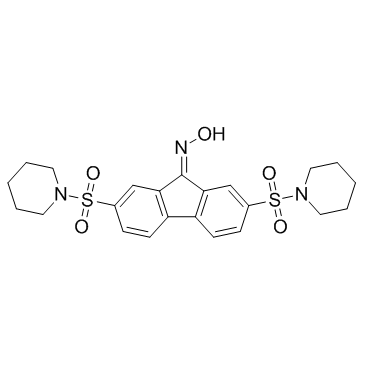
Cas No.: 300802-28-2
Sample solution is provided at 25 µL, 10mM.
_1-3.$$$39978408@51.jpg');)
_1-9.$$$38538795@65.jpg');)
_1-9.$$$39112701@51.jpg');)
_1-7.$$$37316672@70.jpg');)
_366-372.$$$36198801@70.jpg');)
.$$$38565142@65.jpg');)
_1867-1883.$$$33248023@67.jpg');)
_eads6055.$$$39977546@45.jpg');)
_eadm9805.$$$40080571@45.jpg');)
_eadj3020.$$$39666821@45.jpg');)
_1-20.$$$39757301@28.jpg');)
_1-24.$$$38898113@28.jpg');)
_273-287.$$$36806353@46.jpg');)
_1-16.$$$37156877@44.jpg');)
_1-19.$$$37460805@44.jpg');)
_1291-1307.$$$34518654@46.jpg');)
CIL56 is a potent and selective ferroptosis inducer. Ferroptosis is an iron-dependent form of regulated cell death (RCD).
Ferroptosis is a non-apoptotic form of regulated cell death observed in cancer cells, kidney cells and neurons.CIL56 induces iron-dependent reactive oxygen species (ROS). Antioxidants and iron chelators only suppress the lethality of low concentrations of CIL56[1]. CIL56 triggers cell death dependent upon the rate-limiting de novo lipid synthetic enzyme ACC1.Using mass spectrometry, the metabolome of HT-1080 cells treated with CIL56 (6.5 μM)±TOFA (4 μM) is analyzed, compared to vehicle-treated controls. Among the 298 polar and nonpolar metabolites identified in this analysis, the levels of 141 metabolites are significantly altered by CIL56 treatment, with 82 metabolites significantly increased and 59 significantly decreased (FDR q
[1]. Shimada K, et al. Global survey of cell death mechanisms reveals metabolic regulation of ferroptosis. Nat Chem Biol. 2016 Jul;12(7):497-503. [2]. Dixon SJ, et al. Human Haploid Cell Genetics Reveals Roles for Lipid Metabolism Genes in Nonapoptotic Cell Death. ACS Chem Biol. 2015 Jul 17;10(7):1604-9.
| Cas No. | 300802-28-2 | SDF | |
| Synonyms | CA3 | ||
| Canonical SMILES | O=S(C1=CC2=C(C=C1)C3=C(C=C(S(=O)(N4CCCCC4)=O)C=C3)/C2=N\O)(N5CCCCC5)=O | ||
| Formula | C23H27N3O5S2 | M.Wt | 489.61 |
| Solubility | DMSO : 50 mg/mL (102.12 mM);Water : < 0.1 mg/mL (insoluble) | Storage | Store at -20°C |
| General tips | Please select the appropriate solvent to prepare the stock solution according to the
solubility of the product in different solvents; once the solution is prepared, please store it in
separate packages to avoid product failure caused by repeated freezing and thawing.Storage method
and period of the stock solution: When stored at -80°C, please use it within 6 months; when stored
at -20°C, please use it within 1 month. To increase solubility, heat the tube to 37°C and then oscillate in an ultrasonic bath for some time. |
||
| Shipping Condition | Evaluation sample solution: shipped with blue ice. All other sizes available: with RT, or with Blue Ice upon request. | ||
| Prepare stock solution | |||

|
1 mg | 5 mg | 10 mg |
| 1 mM | 2.0424 mL | 10.2122 mL | 20.4244 mL |
| 5 mM | 408.5 μL | 2.0424 mL | 4.0849 mL |
| 10 mM | 204.2 μL | 1.0212 mL | 2.0424 mL |
Step 1: Enter information below (Recommended: An additional animal making an allowance for loss during the experiment)
 g
μL
g
μL
Step 2: Enter the in vivo formulation (This is only the calculator, not formulation. Please contact us first if there is no in vivo formulation at the solubility Section.)
Calculation results:
Working concentration: mg/ml;
Method for preparing DMSO master liquid: mg drug pre-dissolved in μL DMSO ( Master liquid concentration mg/mL, Please contact us first if the concentration exceeds the DMSO solubility of the batch of drug. )
Method for preparing in vivo formulation: Take μL DMSO master liquid, next addμL PEG300, mix and clarify, next addμL Tween 80, mix and clarify, next add μL saline, mix and clarify.
Method for preparing in vivo formulation: Take μL DMSO master liquid, next add μL Corn oil, mix and clarify.
Note: 1. Please make sure the liquid is clear before adding the next solvent.
2. Be sure to add the solvent(s) in order. You must ensure that the solution obtained, in the previous addition, is a clear solution before proceeding to add the next solvent. Physical methods such as vortex, ultrasound or hot water bath can be used to aid dissolving.
3. All of the above co-solvents are available for purchase on the GlpBio website.
Quality Control & SDS
- View current batch:
- Purity: >98.00% Appearance: A solid
- COA (Certificate of Analysis)
- SDS (Safety Data Sheet)
- Datasheet
Average Rating: 5 (Based on Reviews and 8 reference(s) in Google Scholar.)