

Conessine (Synonyms: Neriine, NSC 119994, Roquessine, Wrightine) |
Catalog No.GC12749
 One-Click Copy Product Info
|

Conessine is a steroidal alkaloid and a potent, selective histamine H3 receptor antagonist (pKi=8.27).
Products are for research use only. Not for human use. We do not sell to patients.
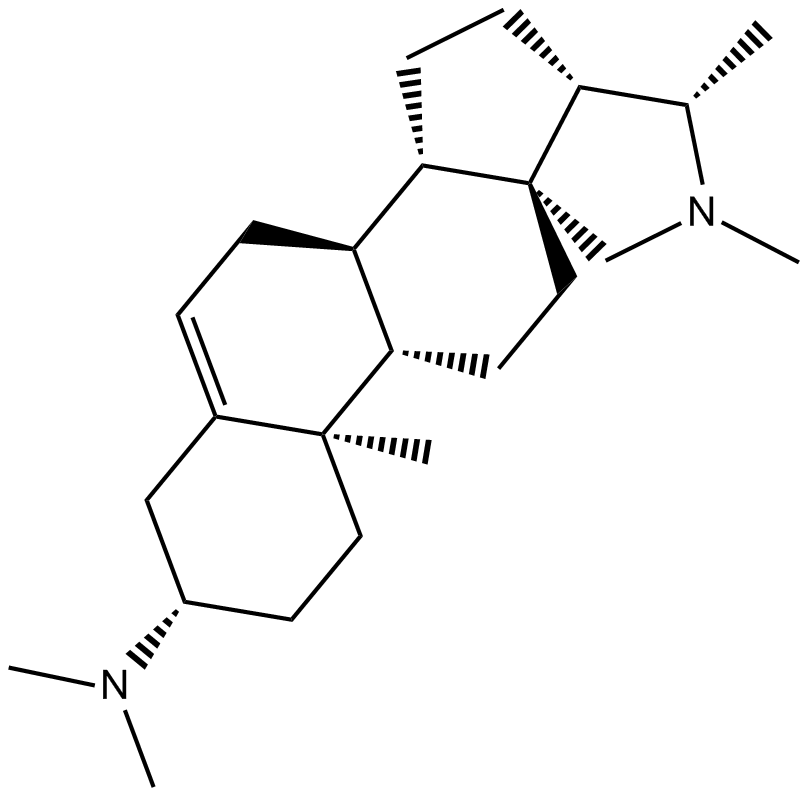
Cas No.: 546-06-5
Sample solution is provided at 25 µL, 10mM.
_1-3.$$$39978408@51.jpg');)
_1-9.$$$38538795@65.jpg');)
_1-9.$$$39112701@51.jpg');)
_1-7.$$$37316672@70.jpg');)
_366-372.$$$36198801@70.jpg');)
.$$$38565142@65.jpg');)
_1867-1883.$$$33248023@67.jpg');)
_eads6055.$$$39977546@45.jpg');)
_eadm9805.$$$40080571@45.jpg');)
_eadj3020.$$$39666821@45.jpg');)
_1-20.$$$39757301@28.jpg');)
_1-24.$$$38898113@28.jpg');)
_273-287.$$$36806353@46.jpg');)
_1-16.$$$37156877@44.jpg');)
_1-19.$$$37460805@44.jpg');)
_1291-1307.$$$34518654@46.jpg');)
Conessine is a steroidal alkaloid and a potent, selective histamine H3 receptor antagonist (pKi=8.27)[1-2]. Conessine is utilized in research areas such as antiviral, antibacterial resistance, and muscle atrophy[3-4].
In vitro, in A549 and RAW 264.7 cells, Conessine (1-40μM; 24h) significantly inhibited influenza A virus-induced cytopathic effects and viral plaque formation, and markedly reduced the expression of viral proteins (M2, NP, HA, NS1, PA, PB1)[5]. Pretreatment of A549, Huh7.5, and BHK21 cells with Conessine (10μM; 1h) upregulated intracellular cholesterol levels, increased the expression of cholesterol synthesis/metabolism-related genes (HMGCR, HMGCS1, INSIG1, MSMO1), and inhibited the replication of intracellular enveloped viruses[6].
In vivo,Swiss mice were treated with Conessine (0.1-10mg/kg; single subcutaneous injection), and 1 hour later, the mice received an intraperitoneal injection of ethanol (2g/kg). Conessine significantly enhanced ethanol-induced psychomotor excitation and prolonged the duration of hyperlocomotion. Conessine blocked ethanol's effects on dopaminergic and noradrenergic neurotransmission in the prefrontal cortex and reduced the levels of dopamine metabolites in the substantia nigra[7]. In ICR male mice treated with methamphetamine (3mg/kg; intraperitoneal injection), administration of Conessine (20mg/kg; single intraperitoneal injection) 30 minutes later significantly inhibited methamphetamine-induced hyperlocomotion. The effect of Conessine was mediated by blocking H3 receptors, thereby releasing histamine, which subsequently activated postsynaptic H1 receptors[8].
References:
[1] Kim H, Jang M, Park R, et al. Conessine treatment reduces dexamethasone-induced muscle atrophy by regulating MuRF1 and atrogin-1 expression. J Microbiol Biotechnol. 2018 Feb 1.
[2] Dua VK, Verma G, Singh B, et al. Anti-malarial property of steroidal alkaloid conessine isolated from the bark of Holarrhena antidysenterica. Malar J. 2013 Jun 10;12:194. doi: 10.1186/1475-2875-12-194.
[3] Kim H, Lee KI, Jang M, et al. Conessine Interferes with Oxidative Stress-Induced C2C12 Myoblast Cell Death through Inhibition of Autophagic Flux. PLoS One. 2016 Jun 3;11(6):e0157096.
[4] Jewboonchu J, Saetang J, Saeloh D, et al. Atomistic insight and modeled elucidation of conessine towards Pseudomonas aeruginosa efflux pump. J Biomol Struct Dyn. 2022 Mar;40(4):1480-1489.
[5] Cho WK, Ma JY. Anti-Viral Activity of Conessine Against Influenza A Virus. Int J Mol Sci. 2025 Aug 5;26(15):7572.
[6] Zhou S, Li J, Ling X, et al. Conessine inhibits enveloped viruses replication through up-regulating cholesterol level. Virus Res. 2023 Dec;338:199234.
[7] Morais-Silva G, Ferreira-Santos M, Marin MT. Conessine, an H3 receptor antagonist, alters behavioral and neurochemical effects of ethanol in mice. Behav Brain Res. 2016 May 15;305:100-7.
[8] Kitanaka J, Kitanaka N, Hall FS, et al. In vivo evaluation of effects of histamine H3 receptor antagonists on methamphetamine-induced hyperlocomotion in mice. Brain Res. 2020 Aug 1;1740:146873.
| Cell experiment [1]: | |
Cell lines | A549 cells (human lung carcinoma epithelial cell line), Huh7.5 cells (human hepatoma cell line), BHK21 cells (baby hamster kidney cell line) |
Preparation Method | A549, Huh7.5, and BHK21 cells were maintained in Dulbecco's Modified Eagle's Medium (DMEM) supplemented with 10% fetal bovine serum (FBS) at 37°C with 5% CO₂. A549, Huh7.5, and BHK21 cells were treated with Conessine at 0-200µM for 24 hours to assess cytotoxicity, or pretreated with Conessine (10µM) 1 hour before infection in antiviral assays. |
Reaction Conditions | Cytotoxicity assay: 0-200µM; 24h. Antiviral assay: 10µM; treatment from 1h pre-infection to 24h post-infection. |
Applications | Conessine exhibited low cytotoxicity with CC50 values of 76.11µM (A549), 60.81µM (Huh7.5), and 85.76µM (BHK21). Pre-treatment with Conessine (10µM) significantly inhibited the replication of several enveloped viruses, including DENV, ZIKV, VSV, and HSV, in a dose-dependent manner. Conessine inhibits virus replication by upregulating cellular cholesterol levels, as evidenced by increased intracellular cholesterol, upregulation of cholesterol biosynthesis genes (HMGCR, HMGCS1, INSIG1, MSMO1), and loss of antiviral activity in cholesterol-depleted cells. |
| Animal experiment [2]: | |
Animal models | Swiss male mice |
Preparation Method | Mice were subcutaneously administered Conessine (0.1, 1.0, or 10.0mg/kg) one hour before an intraperitoneal injection of ethanol (2.0g/kg). Locomotor activity in an open field was then measured for 30 minutes. In separate experiments, mice were pretreated with Conessine (1.0 or 10.0mg/kg; s.c.) one hour before ethanol (1.0g/kg; i.p.) during the conditioning phase for conditioned place preference (CPP) assessment. For neurochemical analysis, mice were sacrificed 30 minutes after ethanol injection, and brain regions (PFC, NAc, VTA, CPu, SN) were dissected for HPLC quantification of monoamines and metabolites. |
Dosage form | 0.1, 1.0, 10.0mg/kg; s.c.; single injection |
Applications | Conessine significantly exacerbated and prolonged ethanol-induced psychostimulation. Conessine itself induced conditioned place preference, but did not alter the acquisition of ethanol-induced CPP. Neurochemical analysis showed that Conessine blocked ethanol's effects on dopaminergic and noradrenergic neurotransmission in the prefrontal cortex. Furthermore, the combination of Conessine and ethanol decreased dopamine metabolite (DOPAC+HVA) concentrations in the substantia nigra. |
References: | |
| Cas No. | 546-06-5 | SDF | |
| Synonyms | Neriine, NSC 119994, Roquessine, Wrightine | ||
| Chemical Name | (3S,3aS,5aS,5bR,9S,11aR,11bS,13aR)-N,N,2,3,11a-pentamethyl-2,3,3a,4,5,5a,5b,6,8,9,10,11,11a,11b,12,13-hexadecahydro-1H-naphtho[2',1':4,5]indeno[1,7a-c]pyrrol-9-amine | ||
| Canonical SMILES | C[C@@H]1N(C)C[C@@]2([C@@H]1CC3)[C@@H]3[C@H]4[C@@H]([C@](CC[C@@H]5N(C)C)(C)C(C5)=CC4)CC2 | ||
| Formula | C24H40N2 | M.Wt | 356.59 |
| Solubility | ≥ 19.65mg/mL in Ethanol | Storage | Store at RT |
| General tips | Please select the appropriate solvent to prepare the stock solution according to the
solubility of the product in different solvents; once the solution is prepared, please store it in
separate packages to avoid product failure caused by repeated freezing and thawing.Storage method
and period of the stock solution: When stored at -80°C, please use it within 6 months; when stored
at -20°C, please use it within 1 month. To increase solubility, heat the tube to 37°C and then oscillate in an ultrasonic bath for some time. |
||
| Shipping Condition | Evaluation sample solution: shipped with blue ice. All other sizes available: with RT, or with Blue Ice upon request. | ||
| Prepare stock solution | |||

|
1 mg | 5 mg | 10 mg |
| 1 mM | 2.8043 mL | 14.0217 mL | 28.0434 mL |
| 5 mM | 560.9 μL | 2.8043 mL | 5.6087 mL |
| 10 mM | 280.4 μL | 1.4022 mL | 2.8043 mL |
Step 1: Enter information below (Recommended: An additional animal making an allowance for loss during the experiment)
 g
μL
g
μL
Step 2: Enter the in vivo formulation (This is only the calculator, not formulation. Please contact us first if there is no in vivo formulation at the solubility Section.)
Calculation results:
Working concentration: mg/ml;
Method for preparing DMSO master liquid: mg drug pre-dissolved in μL DMSO ( Master liquid concentration mg/mL, Please contact us first if the concentration exceeds the DMSO solubility of the batch of drug. )
Method for preparing in vivo formulation: Take μL DMSO master liquid, next addμL PEG300, mix and clarify, next addμL Tween 80, mix and clarify, next add μL saline, mix and clarify.
Method for preparing in vivo formulation: Take μL DMSO master liquid, next add μL Corn oil, mix and clarify.
Note: 1. Please make sure the liquid is clear before adding the next solvent.
2. Be sure to add the solvent(s) in order. You must ensure that the solution obtained, in the previous addition, is a clear solution before proceeding to add the next solvent. Physical methods such as vortex, ultrasound or hot water bath can be used to aid dissolving.
3. All of the above co-solvents are available for purchase on the GlpBio website.
Quality Control & SDS
- View current batch:
- Purity: >98.00% Appearance: A solid
- COA (Certificate of Analysis)
- SDS (Safety Data Sheet)
- Datasheet
Average Rating: 5 (Based on Reviews and 23 reference(s) in Google Scholar.)