

Cycloguanil (hydrochloride) (Synonyms: Chloroguanide Triazine,NSC 3074) |
Catalog No.GC16333
 One-Click Copy Product Info
|

inhibitor of dihydrofolate reductase (DHFR)
Products are for research use only. Not for human use. We do not sell to patients.
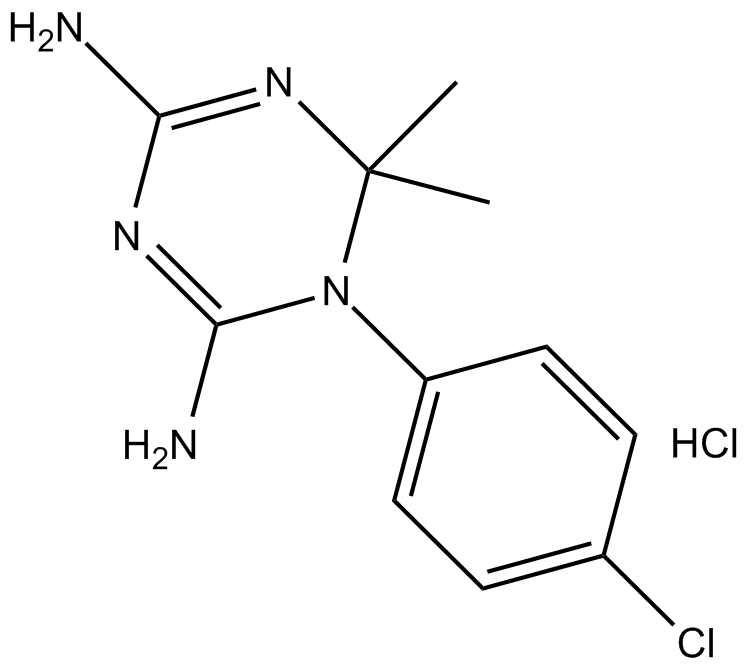
Cas No.: 152-53-4
Sample solution is provided at 25 µL, 10mM.
_1-3.$$$39978408@51.jpg');)
_1-9.$$$38538795@65.jpg');)
_1-9.$$$39112701@51.jpg');)
_1-7.$$$37316672@70.jpg');)
_366-372.$$$36198801@70.jpg');)
.$$$38565142@65.jpg');)
_1867-1883.$$$33248023@67.jpg');)
_eads6055.$$$39977546@45.jpg');)
_eadm9805.$$$40080571@45.jpg');)
_eadj3020.$$$39666821@45.jpg');)
_1-20.$$$39757301@28.jpg');)
_1-24.$$$38898113@28.jpg');)
_273-287.$$$36806353@46.jpg');)
_1-16.$$$37156877@44.jpg');)
_1-19.$$$37460805@44.jpg');)
_1291-1307.$$$34518654@46.jpg');)
Cycloguanil is an inhibitor of dihydrofolate reductase (DHFR)[1].
Dihydrofolate reductase (DHFR) is an enzyme that involved in reducing dihydrofolic acid to tetrahydrofolic acid. DHFR plays a critical role in regulating the amount of tetrahydrofolate in the cell, which are essential for purine and thymidylate synthesis important for cell proliferation and cell growth. DHFR also plays a central role in the synthesis of nucleic acid precursors and salvage of tetrahydrobiopterin from dihydrobiopterin [2].
Cycloguanil is the active metabolite of proguanil produced by the cytochrome P450 (CYP) [3]. Cycloguanil showed activity against P. falciparu. Cycloguanil inhibited the activity of dihydrofolate reductase (DHFR) with the Ki values of 0.3 and 1.5 nM for Plasmodium and human forms, respectively., Cycloguanil prevented the production of tetrahydrofolic acid, an essential coenzyme involved in DNA and RNA synthesis, by blocking DHFR activity.
References:
[1] Foote S J, Galatis D, Cowman A F. Amino acids in the dihydrofolate reductase-thymidylate synthase gene of Plasmodium falciparum involved in cycloguanil resistance differ from those involved in pyrimethamine resistance[J]. Proceedings of the National Academy of Sciences, 1990, 87(8): 3014-3017.
[2] Blakley R L. Dihydrofolate reductase[J]. Encyclopedia Of Molecular Medicine, 1984.
[3] Birkett D J, Rees D, Andersson T, et al. In vitro proguanil activation to cycloguanil by human liver microsomes is mediated by CYP3A isoforms as well as by S‐mephenytoin hydroxylase[J]. British journal of clinical pharmacology, 1994, 37(5): 413-420.
| Cas No. | 152-53-4 | SDF | |
| Synonyms | Chloroguanide Triazine,NSC 3074 | ||
| Chemical Name | 1-(4-chlorophenyl)-1,6-dihydro-6,6-dimethyl-1,3,5-triazine-2,4-diamine, monohydrochloride | ||
| Canonical SMILES | ClC1=CC=C(N2C(N)=NC(N)=NC2(C)C)C=C1.Cl | ||
| Formula | C11H14ClN5 • HCl | M.Wt | 288.2 |
| Solubility | ≤5mg/ml in ethanol;20mg/ml in DMSO;5mg/ml in dimethyl formamide | Storage | Store at -20°C |
| General tips | Please select the appropriate solvent to prepare the stock solution according to the
solubility of the product in different solvents; once the solution is prepared, please store it in
separate packages to avoid product failure caused by repeated freezing and thawing.Storage method
and period of the stock solution: When stored at -80°C, please use it within 6 months; when stored
at -20°C, please use it within 1 month. To increase solubility, heat the tube to 37°C and then oscillate in an ultrasonic bath for some time. |
||
| Shipping Condition | Evaluation sample solution: shipped with blue ice. All other sizes available: with RT, or with Blue Ice upon request. | ||
| Prepare stock solution | |||

|
1 mg | 5 mg | 10 mg |
| 1 mM | 3.4698 mL | 17.3491 mL | 34.6981 mL |
| 5 mM | 694 μL | 3.4698 mL | 6.9396 mL |
| 10 mM | 347 μL | 1.7349 mL | 3.4698 mL |
Step 1: Enter information below (Recommended: An additional animal making an allowance for loss during the experiment)
 g
μL
g
μL
Step 2: Enter the in vivo formulation (This is only the calculator, not formulation. Please contact us first if there is no in vivo formulation at the solubility Section.)
Calculation results:
Working concentration: mg/ml;
Method for preparing DMSO master liquid: mg drug pre-dissolved in μL DMSO ( Master liquid concentration mg/mL, Please contact us first if the concentration exceeds the DMSO solubility of the batch of drug. )
Method for preparing in vivo formulation: Take μL DMSO master liquid, next addμL PEG300, mix and clarify, next addμL Tween 80, mix and clarify, next add μL saline, mix and clarify.
Method for preparing in vivo formulation: Take μL DMSO master liquid, next add μL Corn oil, mix and clarify.
Note: 1. Please make sure the liquid is clear before adding the next solvent.
2. Be sure to add the solvent(s) in order. You must ensure that the solution obtained, in the previous addition, is a clear solution before proceeding to add the next solvent. Physical methods such as vortex, ultrasound or hot water bath can be used to aid dissolving.
3. All of the above co-solvents are available for purchase on the GlpBio website.
Quality Control & SDS
- View current batch:
- Purity: >99.50% Appearance: A solid
- COA (Certificate of Analysis)
- SDS (Safety Data Sheet)
- Datasheet
Average Rating: 5 (Based on Reviews and 38 reference(s) in Google Scholar.)