

CYM50358 |
Catalog No.GC63345
 One-Click Copy Product Info
|

CYM50358 is a potent and selective sphingosine-1-phosphate receptor 4 (S1P4) antagonist, functioning by blocking the S1P₄ receptor.
Products are for research use only. Not for human use. We do not sell to patients.
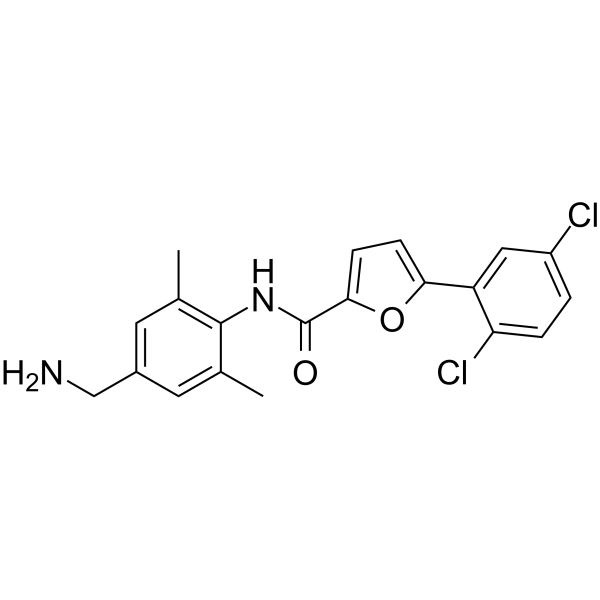
Cas No.: 1314212-39-9
Sample solution is provided at 25 µL, 10mM.
_1-3.$$$39978408@51.jpg');)
_1-9.$$$38538795@65.jpg');)
_1-9.$$$39112701@51.jpg');)
_1-7.$$$37316672@70.jpg');)
_366-372.$$$36198801@70.jpg');)
.$$$38565142@65.jpg');)
_1867-1883.$$$33248023@67.jpg');)
_eads6055.$$$39977546@45.jpg');)
_eadm9805.$$$40080571@45.jpg');)
_eadj3020.$$$39666821@45.jpg');)
_1-20.$$$39757301@28.jpg');)
_1-24.$$$38898113@28.jpg');)
_273-287.$$$36806353@46.jpg');)
_1-16.$$$37156877@44.jpg');)
_1-19.$$$37460805@44.jpg');)
_1291-1307.$$$34518654@46.jpg');)
CYM50358 is a potent and selective sphingosine-1-phosphate receptor 4 (S1P4) antagonist, functioning by blocking the S1P₄ receptor. CYM50358 can be employed for research on immunomodulatory mechanisms[1-2].
In vitro, CYM50358 (10µM) was used to pretreat human platelets for 15 minutes, followed by stimulation with collagen (1µg/ml) for 4 minutes. CYM50358 did not significantly affect collagen-induced HSP27 phosphorylation but reversed sphingosine-1-phosphate (S1P)-induced inhibition of HSP27 phosphorylation[3]. CYM50358 (1µM) was used to pretreat murine C2C12 myoblasts for 30 minutes, followed by treatment with TGFβ1 (5ng/ml) for 18-24 hours. CYM50358 significantly attenuated TGFβ1-induced caspase-3 activation and PARP cleavage[4].
In vivo, CYM50358 (5mg/kg) was administered via intraperitoneal injection 30 minutes before OVA sensitization or 30 minutes after OVA challenge in female BALB/c mice. CYM50358 significantly inhibited the increase of eosinophils and lymphocytes in bronchoalveolar lavage fluid, reduced lung inflammation scores, suppressed mucin secretion, and lowered serum IgE and IL-4 levels[5]. CYM50358 (2.5mg/kg) was administered via intraperitoneal injection every two days starting from day 3 after rhesus rotavirus (RRV) injection until day 14 in neonatal Balb/c mice. CYM50358 significantly improved RRV-induced biliary atresia, reduced the incidence of extrahepatic biliary obstruction, alleviated liver inflammation and fibrosis, improved liver function, and increased survival rates[6].
References:
[1] Podolak I, Janeczko Z, Galanty A, et al. A triterpene saponin from Lysimachia thyrsiflora L. Acta Pol Pharm. 2007 Jan-Feb;64(1):39-43.
[2] Kitada Y, Kajita K, Taguchi K, et al. Blockade of Sphingosine 1-Phosphate Receptor 2 Signaling Attenuates High-Fat Diet-Induced Adipocyte Hypertrophy and Systemic Glucose Intolerance in Mice. Endocrinology. 2016 May;157(5):1839-51.
[3] Onuma T, Tanabe K, Kito Y, et al. Sphingosine 1-phosphate (S1P) suppresses the collagen-induced activation of human platelets via S1P4 receptor. Thromb Res. 2017 Aug;156:91-100.
[4] J Cencetti F, Bernacchioni C, Tonelli F, et al. TGFβ1 evokes myoblast apoptotic response via a novel signaling pathway involving S1P4 transactivation upstream of Rho-kinase-2 activation. FASEB J. 2013 Nov;27(11):4532-46.
[5] Jeon WJ, Chung KW, Lee JH, et al. Suppressive Effect of CYM50358 S1P4 Antagonist on Mast Cell Degranulation and Allergic Asthma in Mice. Biomol Ther (Seoul). 2021 Sep 1;29(5):492-497.
[6] Sun D, Wang D, Jia L, et al. S1P/S1PR4 promotes the differentiation of CD8+ tissue-resident memory T cells aggravating bile duct injury in biliary atresia. J Hepatol. 2026 Feb;84(2):385-398.
| Cell experiment [1]: | |
Cell lines | C2C12 myoblasts (mouse skeletal muscle cell line) |
Preparation Method | C2C12 myoblasts were serum-starved and then treated with TGFβ1 (5ng/ml) 30 min and 18 h after starvation. CYM50358 (1μM) was incubated 30 min before the first agonist addition. |
Reaction Conditions | 1μM; 30min pretreatment before TGFβ1 stimulation for 24h. |
Applications | CYM50358 pretreatment appreciably reduced the stimulation of caspase-3 activity and the cleavage of PARP elicited by TGFβ1. CYM50358 also enhanced the extent of Akt phosphorylation in response to S1P treatment in TGFβ1-treated myoblasts. |
| Animal experiment [2]: | |
Animal models | BALB/c mice |
Preparation Method | Female 6-week-old BALB/c mice were randomly assigned to an OVA-induced allergic asthma model. CYM50358 (5mg/kg) was administered via intraperitoneal injection 30 minutes before OVA sensitization (on day 0 and 14) or 30 minutes before OVA challenge (on days 28, 29, and 30). Bronchoalveolar lavage fluid (BALF) and lung tissues were collected on day 32 for analysis. |
Dosage form | 5mg/kg; i.p.; administered 30min before sensitization or challenge. |
Applications | CYM50358 administration significantly inhibited the OVA-induced increase of total cells, eosinophils, and lymphocytes in BALF, reduced lung inflammation scores, suppressed mucin production (PAS-positive cells), and decreased serum IgE and BALF IL-4 levels. |
References: | |
| Cas No. | 1314212-39-9 | SDF | |
| Formula | C20H18Cl2N2O2 | M.Wt | 389.28 |
| Solubility | DMSO : 125 mg/mL (321.11 mM; Need ultrasonic) | Storage | Store at -20°C |
| General tips | Please select the appropriate solvent to prepare the stock solution according to the
solubility of the product in different solvents; once the solution is prepared, please store it in
separate packages to avoid product failure caused by repeated freezing and thawing.Storage method
and period of the stock solution: When stored at -80°C, please use it within 6 months; when stored
at -20°C, please use it within 1 month. To increase solubility, heat the tube to 37°C and then oscillate in an ultrasonic bath for some time. |
||
| Shipping Condition | Evaluation sample solution: shipped with blue ice. All other sizes available: with RT, or with Blue Ice upon request. | ||
| Prepare stock solution | |||

|
1 mg | 5 mg | 10 mg |
| 1 mM | 2.5688 mL | 12.8442 mL | 25.6885 mL |
| 5 mM | 513.8 μL | 2.5688 mL | 5.1377 mL |
| 10 mM | 256.9 μL | 1.2844 mL | 2.5688 mL |
Step 1: Enter information below (Recommended: An additional animal making an allowance for loss during the experiment)
 g
μL
g
μL
Step 2: Enter the in vivo formulation (This is only the calculator, not formulation. Please contact us first if there is no in vivo formulation at the solubility Section.)
Calculation results:
Working concentration: mg/ml;
Method for preparing DMSO master liquid: mg drug pre-dissolved in μL DMSO ( Master liquid concentration mg/mL, Please contact us first if the concentration exceeds the DMSO solubility of the batch of drug. )
Method for preparing in vivo formulation: Take μL DMSO master liquid, next addμL PEG300, mix and clarify, next addμL Tween 80, mix and clarify, next add μL saline, mix and clarify.
Method for preparing in vivo formulation: Take μL DMSO master liquid, next add μL Corn oil, mix and clarify.
Note: 1. Please make sure the liquid is clear before adding the next solvent.
2. Be sure to add the solvent(s) in order. You must ensure that the solution obtained, in the previous addition, is a clear solution before proceeding to add the next solvent. Physical methods such as vortex, ultrasound or hot water bath can be used to aid dissolving.
3. All of the above co-solvents are available for purchase on the GlpBio website.
Quality Control & SDS
- View current batch:
- Purity: >98.00% Appearance: A solid
- COA (Certificate of Analysis)
- SDS (Safety Data Sheet)
- Datasheet
Average Rating: 5 (Based on Reviews and 6 reference(s) in Google Scholar.)