

Dexmedetomidine |
Catalog No.GC17494
 One-Click Copy Product Info
|

Dexmedetomidine is a highly selective α2-adrenergic receptor agonist that exerts sympatholytic effects in specific brain regions, providing analgesic, sedative, and anxiolytic actions.
Products are for research use only. Not for human use. We do not sell to patients.
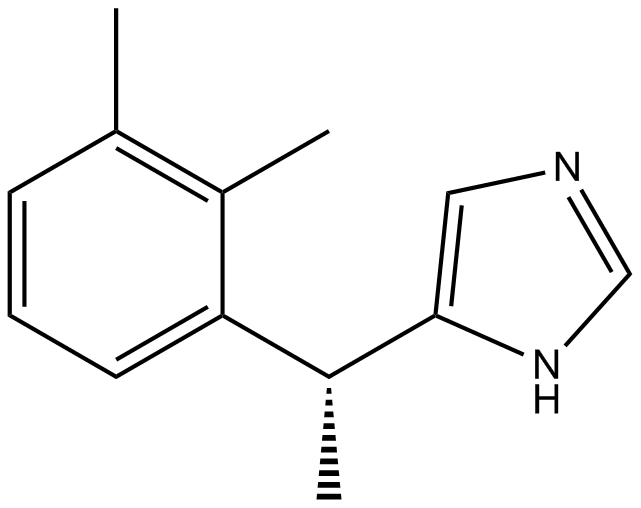
Cas No.: 113775-47-6
Sample solution is provided at 25 µL, 10mM.
Dexmedetomidine is a highly selective α2-adrenergic receptor agonist that exerts sympatholytic effects in specific brain regions, providing analgesic, sedative, and anxiolytic actions[1-2]. In addition, Dexmedetomidine preconditioning effectively shields the heart against ischemia-reperfusion injury[3].
In vitro, after 3 days of treatment with graded Dexmedetomidine concentrations (0.05μM, 0.1μM, 1μM, 2.5μM, 5μM, or 10μM), cortical neurons showed unchanged viability below 10μM but a significant drop in viability and increased cell death at 10μM[4]. Exposure of PC12 cells to Dexmedetomidine at 50ng/ml, 200ng/ml, or 800ng/ml for 12 or 24h enhanced cell viability in both a time- and dose-dependent manner[5].
In vivo, in acute liver injury (ALI) C57BL/6 mice, a single intraperitoneal dose of Dexmedetomidine (200mg/kg) markedly blunted the rises in ALT and AST and suppressed the ALI-induced elevations of serum IL-6, IL-8, IL-1β, and TNF-α[6]. In male C57BL/6 mice, a single intraperitoneal dose of Dexmedetomidine (40μg/kg) suppresses lipopolysaccharide (LPS)-induced inflammatory factor expression and protects renal cells from apoptosis[7]. Administering Dexmedetomidine (10 or 20μg/kg; i.p.) to Sprague-Dawley rats dose-dependently reduces mortality and suppresses pulmonary inflammation by inhibiting the Toll-like receptor 4 (TLR4)/myeloid differentiation factor 88 (MyD88)/NF-κB pathway[8].
References:
[1] Hou M, Chen F, He Y, et al. Dexmedetomidine against intestinal ischemia/reperfusion injury: A systematic review and meta-analysis of preclinical studies. Eur J Pharmacol. 2023;959:176090.
[2] Dardalas I, Stamoula E, Rigopoulos P, et al. Dexmedetomidine effects in different experimental sepsis in vivo models. Eur J Pharmacol. 2019;856:172401.
[3] Takahashi K, Yoshikawa Y, Kanda M, et al. Dexmedetomidine as a cardioprotective drug: a narrative review. J Anesth. 2023;37(6):961-970.
[4] Jimenez-Tellez N, Iqbal F, Pehar M, et al. Dexmedetomidine does not compromise neuronal viability, synaptic connectivity, learning and memory in a rodent model. Sci Rep. 2021;11(1):16153.
[5] Guo Q, Ma M, Yu H, et al. Dexmedetomidine enables copper homeostasis in cerebral ischemia/reperfusion via ferredoxin 1. Ann Med. 2023;55(1):2209735.
[6] Zhang C, Fan Y, Qin Z, et al. Network pharmacology and experimental validation reveal dexmedetomidine's protective mechanisms against acute liver injury in mice. Sci Rep. 2025;15(1):9044.
[7] Kang K, Gao Y, Wang SC, et al. Dexmedetomidine protects against lipopolysaccharide-induced sepsis-associated acute kidney injury via an α7 nAChR-dependent pathway. Biomed Pharmacother. 2018;106:210-216.
[8] Wu Y, Liu Y, Huang H, et al. Dexmedetomidine inhibits inflammatory reaction in lung tissues of septic rats by suppressing TLR4/NF-κB pathway. Mediators Inflamm. 2013;2013:562154.
| Cell experiment [1]: | |
Cell lines | Cortical neurons |
Preparation Method | Sprague-Dawley rat frontal cortices were isolated and cultured. Some cultures were treated with various concentrations of Dexmedetomidine (0.05μM, 0.1μM, 1μM, 2.5μM, 5μM, or 10μM) dissolved in culture media, whereas controls only had culture media. The cells were cultured for 3 or 7 days. |
Reaction Conditions | 0.05μM, 0.1μM, 1μM, 2.5μM, 5μM, or 10μM; 3 or 7 days |
Applications | On days 3 and 7 after Dexmedetomidine exposure, no significant effect on cell viability was observed at concentrations below 10μM. However, at 10μM, Dexmedetomidine markedly reduced cell viability, resulting in increased cell death: the percentage of viable cells on day 3 was significantly lower than that of controls. By day 7, none of the tested concentrations exerted any additional effect on viability. |
| Animal experiment [2]: | |
Animal models | C57BL/6 mice |
Preparation Method | C57BL/6 mice (eight-week-old, male, 22-25g) were housed at an ambient temperature of 22±2°C under a fixed 12h light/dark cycle. Prior to experimentation, animals were randomly assigned into three groups (n=6 per group): Control (Con), acute liver injury (ALI) model, and ALI+Dexmedetomidine: 200mg/kg. The ALI model was induced by intraperitoneally injecting lipopolysaccharide (LPS)/D-galactose (D-Gal) (200μL; 30μg/kg; 600mg/kg) dissolved in PBS. Dexmedetomidine was administered intraperitoneally 1h prior to the LPS/D-Gal challenge. At 6h after LPS/D-Gal treatment, the mice were then anesthetized with isoflurane and subjected to enucleation for exsanguination. Subsequently, the liver tissues were harvested, fixed with formalin, and embedded in paraffin. |
Dosage form | 200mg/kg; administered intraperitoneally |
Applications | Dexmedetomidine treatment significantly suppressed the increases in ALT and AST levels, as well as the elevations of serum IL-6, IL-8, IL-1β, and TNF-α in the ALI model group. |
References: | |
| Cas No. | 113775-47-6 | SDF | |
| Chemical Name | 5-[(1S)-1-(2,3-dimethylphenyl)ethyl]-1H-imidazole | ||
| Canonical SMILES | CC1=C(C(=CC=C1)C(C)C2=CN=CN2)C | ||
| Formula | C13H16N2 | M.Wt | 200.28 |
| Solubility | ≥ 9.95mg/mL in DMSO | Storage | Store at -20°C |
| General tips | Please select the appropriate solvent to prepare the stock solution according to the
solubility of the product in different solvents; once the solution is prepared, please store it in
separate packages to avoid product failure caused by repeated freezing and thawing.Storage method
and period of the stock solution: When stored at -80°C, please use it within 6 months; when stored
at -20°C, please use it within 1 month. To increase solubility, heat the tube to 37°C and then oscillate in an ultrasonic bath for some time. |
||
| Shipping Condition | Evaluation sample solution: shipped with blue ice. All other sizes available: with RT, or with Blue Ice upon request. | ||
| Prepare stock solution | |||

|
1 mg | 5 mg | 10 mg |
| 1 mM | 4.993 mL | 24.965 mL | 49.9301 mL |
| 5 mM | 998.6 μL | 4.993 mL | 9.986 mL |
| 10 mM | 499.3 μL | 2.4965 mL | 4.993 mL |
Step 1: Enter information below (Recommended: An additional animal making an allowance for loss during the experiment)
 g
μL
g
μL
Step 2: Enter the in vivo formulation (This is only the calculator, not formulation. Please contact us first if there is no in vivo formulation at the solubility Section.)
Calculation results:
Working concentration: mg/ml;
Method for preparing DMSO master liquid: mg drug pre-dissolved in μL DMSO ( Master liquid concentration mg/mL, Please contact us first if the concentration exceeds the DMSO solubility of the batch of drug. )
Method for preparing in vivo formulation: Take μL DMSO master liquid, next addμL PEG300, mix and clarify, next addμL Tween 80, mix and clarify, next add μL saline, mix and clarify.
Method for preparing in vivo formulation: Take μL DMSO master liquid, next add μL Corn oil, mix and clarify.
Note: 1. Please make sure the liquid is clear before adding the next solvent.
2. Be sure to add the solvent(s) in order. You must ensure that the solution obtained, in the previous addition, is a clear solution before proceeding to add the next solvent. Physical methods such as vortex, ultrasound or hot water bath can be used to aid dissolving.
3. All of the above co-solvents are available for purchase on the GlpBio website.
Quality Control & SDS
- View current batch:
- Purity: >98.00% Appearance: A solid
- COA (Certificate of Analysis)
- SDS (Safety Data Sheet)
- NMR
- Datasheet
Average Rating: 5 (Based on Reviews and 33 reference(s) in Google Scholar.)