

Epalrestat (Synonyms: ONO2235) |
Catalog No.GC10001
 One-Click Copy Product Info
|

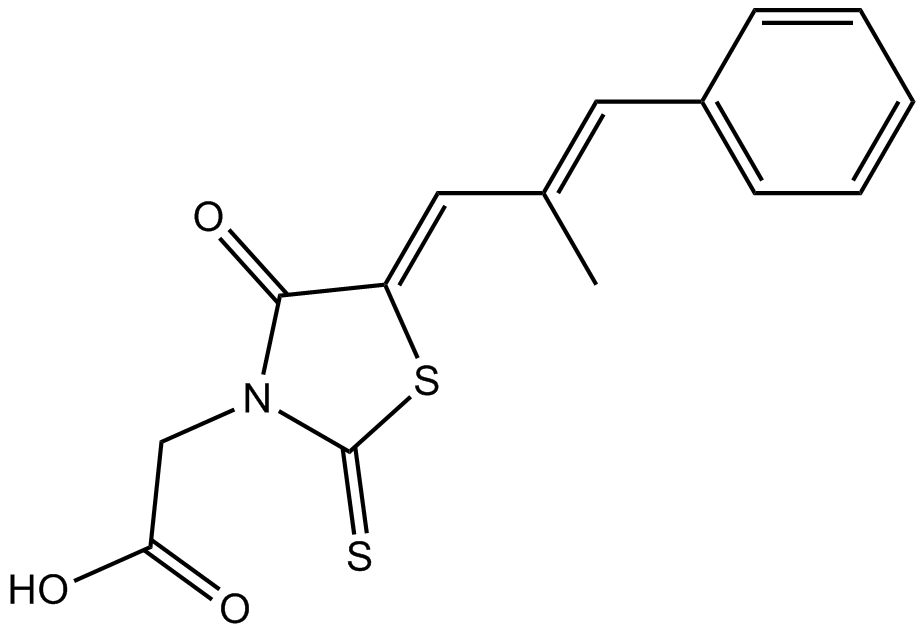
Epalrestat is an orally active inhibitor of aldose reductases AKR1B1 and AKR1B10, with IC50 values of 0.1µM and 0.33µM, respectively.
Products are for research use only. Not for human use. We do not sell to patients.
Cas No.: 82159-09-9
Sample solution is provided at 25 µL, 10mM.
_1-3.$$$39978408@51.jpg');)
_1-9.$$$38538795@65.jpg');)
_1-9.$$$39112701@51.jpg');)
_1-7.$$$37316672@70.jpg');)
_366-372.$$$36198801@70.jpg');)
.$$$38565142@65.jpg');)
_1867-1883.$$$33248023@67.jpg');)
_eads6055.$$$39977546@45.jpg');)
_eadm9805.$$$40080571@45.jpg');)
_eadj3020.$$$39666821@45.jpg');)
_1-20.$$$39757301@28.jpg');)
_1-24.$$$38898113@28.jpg');)
_273-287.$$$36806353@46.jpg');)
_1-16.$$$37156877@44.jpg');)
_1-19.$$$37460805@44.jpg');)
_1291-1307.$$$34518654@46.jpg');)
Epalrestat is an orally active inhibitor of aldose reductases AKR1B1 and AKR1B10, with IC50 values of 0.1µM and 0.33µM, respectively[1]. Epalrestat could protect against diabetic peripheral neuropathy by relieving oxidative stress and suppressing the polyol pathway[2]. Epalrestat has been widely used as an anti-cancer agent to inhibit the proliferation of various cancer cells[3].
In vitro, Epalrestat treatment for 24 hours significantly inhibited the accumulation of galactitol in IMS32 cells exposed to galactoseemia conditions with an IC50 value of 20nM, and reduced ROS production without affecting mitochondrial function[4]. Treatment with 100μM Epalrestat for 48 hours significantly inhibited the proliferation, migration and invasion of HeLa cells[5]. Treatment of bovine aortic endothelial cells (BAECs) with 100μM Epalrestat for 24 hours increased the level of Nrf2 in the cell nucleus and stimulated the expression of thioredoxin and heme oxygenase-1[6].
In vivo, Epalrestat treatment via daily oral administration of 35mg/kg for 10 weeks can improve the metabolic disorders and renal damage in a diabetic nephropathy rat model[7]. Oral administration of 50mg/kg/day of Epalrestat for 10 consecutive days significantly inhibited tumor growth in a xenograft mouse model of MDA-MB-231 cells[8].
References:
[1] Bailly C. Moving toward a new horizon for the aldose reductase inhibitor epalrestat to treat drug-resistant cancer[J]. European Journal of Pharmacology, 2022, 931: 175191.
[2] Li Q, Wang Z, Zhou W, et al. Epalrestat protects against diabetic peripheral neuropathy by alleviating oxidative stress and inhibiting polyol pathway[J]. Neural regeneration research, 2016, 11(2): 345-351.
[3] Wang C, Yan R, Luo D, et al. Aldo-keto reductase family 1 member B10 promotes cell survival by regulating lipid synthesis and eliminating carbonyls[J]. Journal of Biological Chemistry, 2009, 284(39): 26742-26748.
[4] Yako H, Niimi N, Takaku S, et al. Epalrestat Alleviates Reactive Oxygen Species and Endoplasmic Reticulum Stress by Maintaining Glycosylation in IMS32 Schwann Cells Under Exposure to Galactosemic Conditions[J]. International Journal of Molecular Sciences, 2025, 26(4): 1529.
[5] Ji J, Xu M X, Qian T Y, et al. The AKR1B1 inhibitor epalrestat suppresses the progression of cervical cancer[J]. Molecular Biology Reports, 2020, 47(8): 6091-6103.
[6] Yama K, Sato K, Abe N, et al. Epalrestat increases glutathione, thioredoxin, and heme oxygenase-1 by stimulating Nrf2 pathway in endothelial cells[J]. Redox Biology, 2014, 4: 87.
[7] Song T, Wang R, Zhou X, et al. Metabolomics and molecular dynamics unveil the therapeutic potential of epalrestat in diabetic nephropathy[J]. International Immunopharmacology, 2024, 140: 112812.
[8] Wu X, Li X, Fu Q, et al. AKR1B1 promotes basal-like breast cancer progression by a positive feedback loop that activates the EMT program[J]. Journal of Experimental Medicine, 2017, 214(4): 1065-1079.
| Cell experiment [1]: | |
Cell lines | HeLa cells |
Preparation Method | The HeLa cells were cultured in Dulbecco Modified Eagle Medium (DMEM) supplemented with 10% fetal bovine serum (FBS) and 1% penicillin-streptomycin. The cells were seeded at a density of 5×10³ cells per well in a 96-well plate and treated with different concentrations of Epalrestat (0, 20, 40, 60, 80, 100, and 120μM) or DMSO (as a control) in the culture medium for 48 hours. The CCK8 reagent was added, and the cells were cultured in the incubator for 1 hour, and the absorbance value was measured at a wavelength of 450nm. |
Reaction Conditions | 0, 20, 40, 60, 80, 100, and 120μM; 48h |
Applications | Epalrestat treatment significantly inhibited the viability of HeLa cells in a dose-dependent manner. |
| Animal experiment [2]: | |
Animal models | Male Sprague-Dawley rats |
Preparation Method | Eight-week-old male Sprague-Dawley rats were all housed in a barrier system. The temperature was maintained at 21±2°C, the humidity at 50±5%, and the light/dark cycle was 12 hours per day. The animals had free access to food and water. All rats were randomly divided into three groups: the healthy control group, the diabetic nephropathy (DN) group, and the Epalrestat group. After the DN group and the Epalrestat group rats were fed a high-fat diet (HFD) for 8 weeks, rats were intraperitoneally injected with streptozotocin (35mg/kg, dissolved in pH 4.5 citrate buffer) while the healthy control group rats were intraperitoneally injected with citrate buffer. Rats with blood glucose levels higher than 16.7mM were identified as diabetic rats. The rats in the Epalrestat group were orally administered Epalrestat (35mg/kg) daily for 10 weeks. The renal function-related parameters of each group were tested. |
Dosage form | 35mg/kg/day for 10 weeks; p.o. |
Applications | Epalrestat treatment regulated the dyslipidemia of DN rats and reduced the levels of serum creatinine, blood urea nitrogen, and urinary albumin excretion rate. |
References: | |
| Cas No. | 82159-09-9 | SDF | |
| Synonyms | ONO2235 | ||
| Chemical Name | 2-[(5Z)-5-[(E)-2-methyl-3-phenylprop-2-enylidene]-4-oxo-2-sulfanylidene-1,3-thiazolidin-3-yl]acetic acid | ||
| Canonical SMILES | CC(=CC1=CC=CC=C1)C=C2C(=O)N(C(=S)S2)CC(=O)O | ||
| Formula | C15H13NO3S2 | M.Wt | 319.4 |
| Solubility | ≥ 6.375mg/mL in DMSO with gentle warming | Storage | Store at -20°C |
| General tips | Please select the appropriate solvent to prepare the stock solution according to the
solubility of the product in different solvents; once the solution is prepared, please store it in
separate packages to avoid product failure caused by repeated freezing and thawing.Storage method
and period of the stock solution: When stored at -80°C, please use it within 6 months; when stored
at -20°C, please use it within 1 month. To increase solubility, heat the tube to 37°C and then oscillate in an ultrasonic bath for some time. |
||
| Shipping Condition | Evaluation sample solution: shipped with blue ice. All other sizes available: with RT, or with Blue Ice upon request. | ||
| Prepare stock solution | |||

|
1 mg | 5 mg | 10 mg |
| 1 mM | 3.1309 mL | 15.6544 mL | 31.3087 mL |
| 5 mM | 626.2 μL | 3.1309 mL | 6.2617 mL |
| 10 mM | 313.1 μL | 1.5654 mL | 3.1309 mL |
Step 1: Enter information below (Recommended: An additional animal making an allowance for loss during the experiment)
 g
μL
g
μL
Step 2: Enter the in vivo formulation (This is only the calculator, not formulation. Please contact us first if there is no in vivo formulation at the solubility Section.)
Calculation results:
Working concentration: mg/ml;
Method for preparing DMSO master liquid: mg drug pre-dissolved in μL DMSO ( Master liquid concentration mg/mL, Please contact us first if the concentration exceeds the DMSO solubility of the batch of drug. )
Method for preparing in vivo formulation: Take μL DMSO master liquid, next addμL PEG300, mix and clarify, next addμL Tween 80, mix and clarify, next add μL saline, mix and clarify.
Method for preparing in vivo formulation: Take μL DMSO master liquid, next add μL Corn oil, mix and clarify.
Note: 1. Please make sure the liquid is clear before adding the next solvent.
2. Be sure to add the solvent(s) in order. You must ensure that the solution obtained, in the previous addition, is a clear solution before proceeding to add the next solvent. Physical methods such as vortex, ultrasound or hot water bath can be used to aid dissolving.
3. All of the above co-solvents are available for purchase on the GlpBio website.
Quality Control & SDS
- View current batch:
- Purity: >99.50% Appearance: A solid
- COA (Certificate of Analysis)
- SDS (Safety Data Sheet)
- Datasheet
Average Rating: 5 (Based on Reviews and 1 reference(s) in Google Scholar.)