

Ertiprotafib (PTP 112) (Synonyms: PTP 112) |
Catalog No.GC33816
 One-Click Copy Product Info
|

Ertiprotafib (PTP 112) is an inhibitor of PTP1B, IkB kinase β (IKK-β), and a dual PPARα and PPARβ agonist, with an IC50 of 1.6 μM for PTP1B, 400 nM for IKK-β, an EC50 of ~1 μM for PPARα/PPARβ.
Products are for research use only. Not for human use. We do not sell to patients.
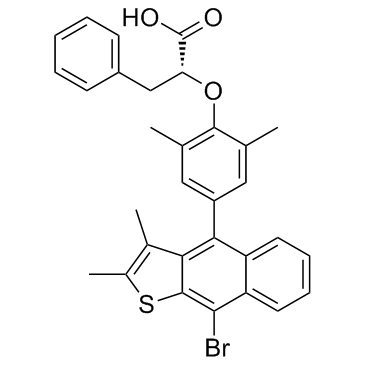
Cas No.: 251303-04-5
Sample solution is provided at 25 µL, 10mM.
_1-3.$$$39978408@51.jpg');)
_1-9.$$$38538795@65.jpg');)
_1-9.$$$39112701@51.jpg');)
_1-7.$$$37316672@70.jpg');)
_366-372.$$$36198801@70.jpg');)
.$$$38565142@65.jpg');)
_1867-1883.$$$33248023@67.jpg');)
_eads6055.$$$39977546@45.jpg');)
_eadm9805.$$$40080571@45.jpg');)
_eadj3020.$$$39666821@45.jpg');)
_1-20.$$$39757301@28.jpg');)
_1-24.$$$38898113@28.jpg');)
_273-287.$$$36806353@46.jpg');)
_1-16.$$$37156877@44.jpg');)
_1-19.$$$37460805@44.jpg');)
_1291-1307.$$$34518654@46.jpg');)
Ertiprotafib is an inhibitor of PTP1B, IkB kinase β (IKK-β), and a dual PPARα and PPARβ agonist, with an IC50 of 1.6 μM for PTP1B, 400 nM for IKK-β, an EC50 of ~1 μM for PPARα/PPARβ.
Ertiprotafib is a potent inhibitor of IKK-β, with an IC50 value of 400±40 nM, which is much lower than that required for the half-maximal inhibition of the p-nitrophenyl phosphatase activity of PTP1B. The reported IC50 value of Ertiprotafib against PTP1B ranges from 1.6 to 29 μM depending on the assay conditions[2]. Ertiprotafib is at least a dual PPARα and PPARβ agonist with EC50 values for transactivation of 1 μM. Such activities readily explain the observations with suprapharmacologic doses of these[1].
As seen with treatment of ob/ob mice, both Ertiprotafib and compound 3 seem to significantly improve glucose metabolism in rats. At 25 mg/kg/day, these compounds decrease both fasting blood glucose and insulin levels compared with vehicle treated rats. Furthermore, both Ertiprotafib and compound 3 increase glucose disposal after an oral challenge. It is noteworthy that lipid levels are also reduced in treated animals. Both triglyceride and free fatty acid levels are substantially reduced in rats treated with 25 mg/kg/day of either compound. To summarize, both Ertiprotafib and compound 3 seem to be robust agents in improving glucose utilization in fa/fa rats while also decreasing lipid levels in these animals. Decreased lipid levels may be unexpected for a pure PTP1b inhibitor. It is more telling, as mentioned above, that rats treated with suprapharmacologic doses of Ertiprotafib show signs of PPAR family activation[2].
[1]. Shrestha S, et al. PTP1B inhibitor Ertiprotafib is also a potent inhibitor of IkappaB kinase beta (IKK-beta). Bioorg Med Chem Lett. 2007 May 15;17(10):2728-30. Epub 2007 Mar 3. [2]. Erbe DV, et al. Ertiprotafib improves glycemic control and lowers lipids via multiple mechanisms. Mol Pharmacol. 2005 Jan;67(1):69-77.
Animal experiment: | Mice, Rats[2]Male Ob/ob mice and Zucker fa/fa rats are used. They are kept on a 12-h/12-h light/dark cycle and fed Rodent Diet 5001 (for mice and rats) from Purina Mills. Compounds are dosed orally by gavage in an aqueous suspension of 2% Tween 80 and 0.5% methylcellulose. Whole blood (5 μL) is used for glucose readings via tail nick for measurement using the Ascensia Elite XL glucometer and glucose strips by preloading a strip into the meter and touching the end to a small drop of blood on each tail. Insulin levels are quantified by enzyme-linked immunosorbent assay[2]. |
References: [1]. Shrestha S, et al. PTP1B inhibitor Ertiprotafib is also a potent inhibitor of IkappaB kinase beta (IKK-beta). Bioorg Med Chem Lett. 2007 May 15;17(10):2728-30. Epub 2007 Mar 3. | |
| Cas No. | 251303-04-5 | SDF | |
| Synonyms | PTP 112 | ||
| Canonical SMILES | OC([C@@H](CC1=CC=CC=C1)OC2=C(C)C=C(C3=C(C(C)=C(C)S4)C4=C(Br)C5=CC=CC=C53)C=C2C)=O | ||
| Formula | C31H27BrO3S | M.Wt | 559.51 |
| Solubility | Soluble in DMSO | Storage | Store at -20°C |
| General tips | Please select the appropriate solvent to prepare the stock solution according to the
solubility of the product in different solvents; once the solution is prepared, please store it in
separate packages to avoid product failure caused by repeated freezing and thawing.Storage method
and period of the stock solution: When stored at -80°C, please use it within 6 months; when stored
at -20°C, please use it within 1 month. To increase solubility, heat the tube to 37°C and then oscillate in an ultrasonic bath for some time. |
||
| Shipping Condition | Evaluation sample solution: shipped with blue ice. All other sizes available: with RT, or with Blue Ice upon request. | ||
| Prepare stock solution | |||

|
1 mg | 5 mg | 10 mg |
| 1 mM | 1.7873 mL | 8.9364 mL | 17.8728 mL |
| 5 mM | 357.5 μL | 1.7873 mL | 3.5746 mL |
| 10 mM | 178.7 μL | 893.6 μL | 1.7873 mL |
Step 1: Enter information below (Recommended: An additional animal making an allowance for loss during the experiment)
 g
μL
g
μL
Step 2: Enter the in vivo formulation (This is only the calculator, not formulation. Please contact us first if there is no in vivo formulation at the solubility Section.)
Calculation results:
Working concentration: mg/ml;
Method for preparing DMSO master liquid: mg drug pre-dissolved in μL DMSO ( Master liquid concentration mg/mL, Please contact us first if the concentration exceeds the DMSO solubility of the batch of drug. )
Method for preparing in vivo formulation: Take μL DMSO master liquid, next addμL PEG300, mix and clarify, next addμL Tween 80, mix and clarify, next add μL saline, mix and clarify.
Method for preparing in vivo formulation: Take μL DMSO master liquid, next add μL Corn oil, mix and clarify.
Note: 1. Please make sure the liquid is clear before adding the next solvent.
2. Be sure to add the solvent(s) in order. You must ensure that the solution obtained, in the previous addition, is a clear solution before proceeding to add the next solvent. Physical methods such as vortex, ultrasound or hot water bath can be used to aid dissolving.
3. All of the above co-solvents are available for purchase on the GlpBio website.
Quality Control & SDS
- View current batch:
- Purity: >98.00% Appearance: A solid
- COA (Certificate of Analysis)
- SDS (Safety Data Sheet)
- Datasheet
Average Rating: 5 (Based on Reviews and 38 reference(s) in Google Scholar.)