

Exendin-4 |
Catalog No.GC13391
 One-Click Copy Product Info
|

Exendin-4 is a 39-amino-acid polypeptide (48-86) and a long-acting glucagon-like peptide-1 (GLP-1) receptor agonist with an IC50 of 3.22 nM.
Products are for research use only. Not for human use. We do not sell to patients.
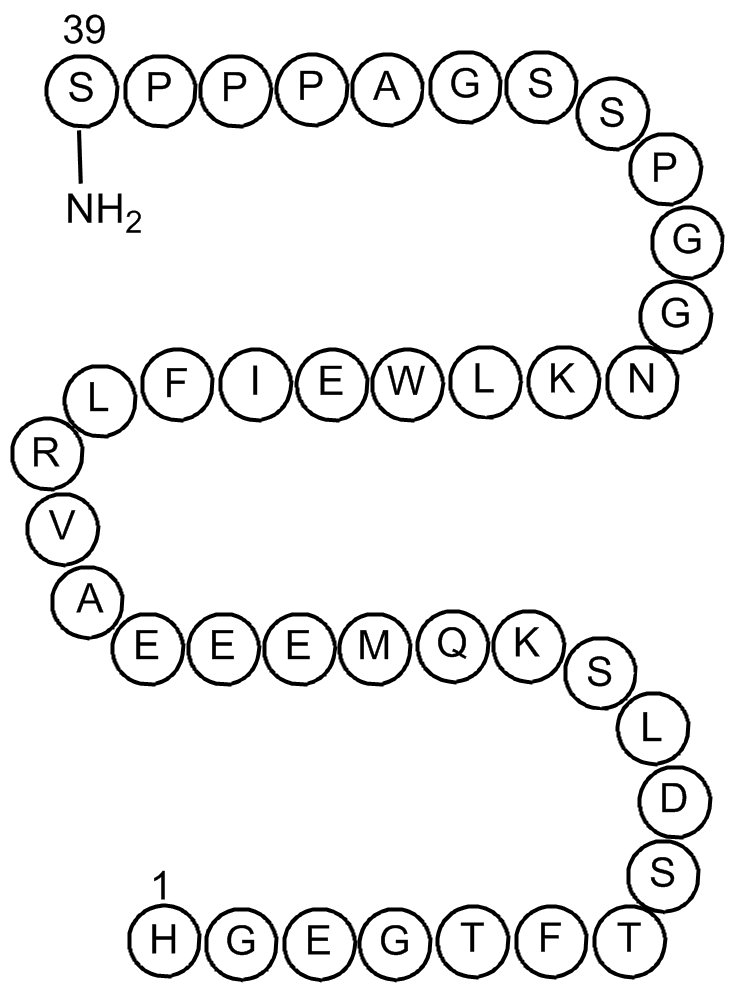
Cas No.: 141758-74-9
Sample solution is provided at 25 µL, 10mM.
Exendin-4 is a 39-amino-acid polypeptide (48-86) and a long-acting glucagon-like peptide-1 (GLP-1) receptor agonist with an IC50 of 3.22 nM[1]. The mechanism of action of Exendin-4 is by binding to the GLP-1 receptor, activating adenylyl cyclase, increasing intracellular cAMP levels, and ultimately promoting insulin secretion while inhibiting glucagon secretion [2]. Exendin-4 has the effect of lowering blood pressure and inducing aortic vasodilation [3].
In vitro, Exendin-4 (0-20nM) incubated HUVEC cells for 15 minutes, which induced a dose-dependent increase in intracellular cAMP concentration, and Exendin-4 (20nM) increased the production of NO in HUVEC cells and increased p-eNOS and GTPCH1 levels [4]. Exendin-4 (0-10μM) treated MCF-7 cells for 48 hours, which had a significant cytotoxic effect with an IC50 of 5μM and reduced the expression of caspase-9, Akt and MMP2 in the cells [5].
In vivo, exendin-4 (10μg/kg or 20μg/kg) was used to treat obese mice via subcutaneous injection for 60 days, which improved serum ALT, reduced serum glucose and insulin levels, and mice in the low-dose group lost weight. 7%, and the body weight of mice in the high-dose group decreased by 14%[6]. Exendin-4 (10 μg/kg) treated SD rats by subcutaneous injection for 75 days, reduced body weight by approximately 30%, significantly reduced insulin, adiponectin, and leptin levels, but caused pancreatic acinar inflammation and pus toxicosis[7].
References:
[1] Doyle M E, Theodorakis M J, Holloway H W, et al. The importance of the nine-amino acid C-terminal sequence of exendin-4 for binding to the GLP-1 receptor and for biological activity[J]. Regulatory peptides, 2003, 114(2-3): 153-158.
[2] Doyle M E, Egan J M. Mechanisms of action of glucagon-like peptide 1 in the pancreas[J]. Pharmacology & therapeutics, 2007, 113(3): 546-593.
[3] Sélley E, Kun S, Szijártó I A, et al. Exenatide induces aortic vasodilation increasing hydrogen sulphide, carbon monoxide and nitric oxide production[J]. Cardiovascular Diabetology, 2014, 13: 1-9.
[4]Wei R, Ma S, Wang C, et al. Exenatide exerts direct protective effects on endothelial cells through the AMPK/Akt/eNOS pathway in a GLP-1 receptor-dependent manner[J]. American Journal of Physiology-Endocrinology and Metabolism, 2016, 310(11): E947-E957.
[5]Fidan-Yaylalı G, Dodurga Y, Seçme M, et al. Antidiabetic exendin-4 activates apoptotic pathway and inhibits growth of breast cancer cells[J]. Tumor Biology, 2016, 37: 2647-2653.
[6]Ding X, Saxena N K, Lin S, et al. Exendin‐4, a glucagon‐like protein‐1 (GLP‐1) receptor agonist, reverses hepatic steatosis in ob/ob mice[J]. Hepatology, 2006, 43(1): 173-181.
[7]Nachnani J S, Bulchandani D G, Nookala A, et al. Biochemical and histological effects of exendin-4 (exenatide) on the rat pancreas[J]. Diabetologia, 2010, 53: 153-159.
|
Cell experiment [1]: |
|
|
Cell lines |
HUVEC cell lines |
|
Preparation method |
HUVECs were seeded at a density of 106/dish and incubated overnight for attachment. The cells were incubated with Exendin-4 at various concentrations (0–50nM) for 15 min. |
|
Reaction Conditions |
0-50 nM ; 15 min |
|
Applications |
Incubation with exendin-4 (≤20nM) for 15 minutes induced a dose-dependent increase in intracellular cAMP concentration. |
|
Animal experiment [2]: |
|
|
Animal models |
ob/ob mice |
|
Preparation method |
The Exendin-4 treated group received 10 μg/kg every 24 hours for the first 14 days. This treatment was the induction phase. After 14 days, the mice treated with Exendin-4 were randomly divided into two groups: one group received a high dose of Exendin-4 (20 μg/kg) every 12 hours; the second group continued to receive a low dose of Exendin-4 (10 μg/kg) every 12 hours. The mice were weighed every day during the 60-day treatment period. |
|
Dosage form |
10μg/kg、20μg/kg; s.c. |
|
Applications |
Low-dose Exendin-4 treated ob/ob mice sustained a reduction of 7% body weight; high-dose treated animals sustained a net weight reduction of 14%. |
|
References: [1]Wei R, Ma S, Wang C, et al. Exenatide exerts direct protective effects on endothelial cells through the AMPK/Akt/eNOS pathway in a GLP-1 receptor-dependent manner[J]. American Journal of Physiology-Endocrinology and Metabolism, 2016, 310(11): E947-E957. [2] Ding X, Saxena N K, Lin S, et al. Exendin‐4, a glucagon‐like protein‐1 (GLP‐1) receptor agonist, reverses hepatic steatosis in ob/ob mice[J]. Hepatology, 2006, 43(1): 173-181. |
|
| Cas No. | 141758-74-9 | SDF | |
| Canonical SMILES | CCC(C)C(C(=O)NC(CCC(=O)O)C(=O)NC(CC1=CNC2=CC=CC=C21)C(=O)NC(CC(C)C)C(=O)NC(CCCCN)C(=O)NC(CC(=O)N)C(=O)NCC(=O)NCC(=O)N3CCCC3C(=O)NC(CO)C(=O)NC(CO)C(=O)NCC(=O)NC(C)C(=O)N4CCCC4C(=O)N5CCCC5C(=O)N6CCCC6C(=O)NC(CO)C(=O)N)NC(=O)C(CC7=CC=CC=C7)NC(=O)C(CC(C)C)NC( | ||
| Formula | C184H282N50O60S | M.Wt | 4186.57 |
| Solubility | ≥ 145 mg/mL in DMSO, ≥ 52 mg/mL in Water with gentle warming | Storage | Store at -20°C,protect from light |
| General tips | Please select the appropriate solvent to prepare the stock solution according to the
solubility of the product in different solvents; once the solution is prepared, please store it in
separate packages to avoid product failure caused by repeated freezing and thawing.Storage method
and period of the stock solution: When stored at -80°C, please use it within 6 months; when stored
at -20°C, please use it within 1 month. To increase solubility, heat the tube to 37°C and then oscillate in an ultrasonic bath for some time. |
||
| Shipping Condition | Evaluation sample solution: shipped with blue ice. All other sizes available: with RT, or with Blue Ice upon request. | ||
| Prepare stock solution | |||

|
1 mg | 5 mg | 10 mg |
| 1 mM | 238.9 μL | 1.1943 mL | 2.3886 mL |
| 5 mM | 47.8 μL | 238.9 μL | 477.7 μL |
| 10 mM | 23.9 μL | 119.4 μL | 238.9 μL |
Step 1: Enter information below (Recommended: An additional animal making an allowance for loss during the experiment)
 g
μL
g
μL
Step 2: Enter the in vivo formulation (This is only the calculator, not formulation. Please contact us first if there is no in vivo formulation at the solubility Section.)
Calculation results:
Working concentration: mg/ml;
Method for preparing DMSO master liquid: mg drug pre-dissolved in μL DMSO ( Master liquid concentration mg/mL, Please contact us first if the concentration exceeds the DMSO solubility of the batch of drug. )
Method for preparing in vivo formulation: Take μL DMSO master liquid, next addμL PEG300, mix and clarify, next addμL Tween 80, mix and clarify, next add μL saline, mix and clarify.
Method for preparing in vivo formulation: Take μL DMSO master liquid, next add μL Corn oil, mix and clarify.
Note: 1. Please make sure the liquid is clear before adding the next solvent.
2. Be sure to add the solvent(s) in order. You must ensure that the solution obtained, in the previous addition, is a clear solution before proceeding to add the next solvent. Physical methods such as vortex, ultrasound or hot water bath can be used to aid dissolving.
3. All of the above co-solvents are available for purchase on the GlpBio website.
Quality Control & SDS
- View current batch:
- Purity: >99.00% Appearance: A solid
- COA (Certificate of Analysis)
- SDS (Safety Data Sheet)
- Datasheet
Average Rating: 5 (Based on Reviews and 30 reference(s) in Google Scholar.)