

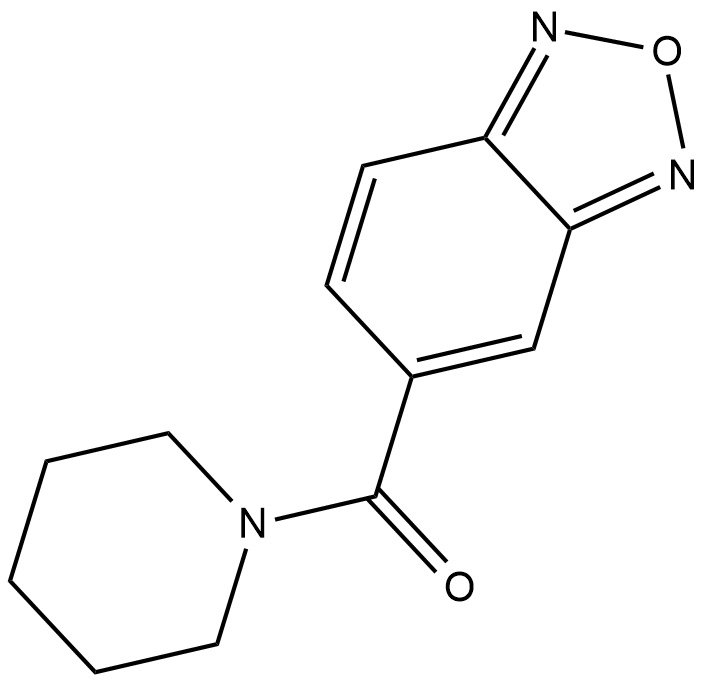
Farampator (Synonyms: CX-691) |
Catalog No.GC18223
 One-Click Copy Product Info
|

Farampator is a positive allosteric modulator of AMPA receptors that has an EC50 value greater than 32 uM for evoking glutamate currents in isolated pyramidal neurons.
Products are for research use only. Not for human use. We do not sell to patients.
Cas No.: 211735-76-1
Sample solution is provided at 25 µL, 10mM.
_1-3.$$$39978408@51.jpg');)
_1-9.$$$38538795@65.jpg');)
_1-9.$$$39112701@51.jpg');)
_1-7.$$$37316672@70.jpg');)
_366-372.$$$36198801@70.jpg');)
.$$$38565142@65.jpg');)
_1867-1883.$$$33248023@67.jpg');)
_eads6055.$$$39977546@45.jpg');)
_eadm9805.$$$40080571@45.jpg');)
_eadj3020.$$$39666821@45.jpg');)
_1-20.$$$39757301@28.jpg');)
_1-24.$$$38898113@28.jpg');)
_273-287.$$$36806353@46.jpg');)
_1-16.$$$37156877@44.jpg');)
_1-19.$$$37460805@44.jpg');)
_1291-1307.$$$34518654@46.jpg');)
Farampator (CX-691;Org24448) is an AMPA receptor positive modulator.
Farampator has potential in treating disorders characterised by cognitive deficits such as Alzheimer's disease and schizophrenia. CX691 attenuates a scopolamine-induced impairment of cued fear conditioning following acute administration (0.1 mg/kg p.o.) and a temporally induced deficit in novel object recognition following both acute (0.1 and 1.0 mg/kg p.o.) and sub-chronic (bi-daily for 7 days) administration (0.01, 0.03, 0.1 mg/kg p.o.). It also improves attentional set-shifting following sub-chronic administration (0.3 mg/kg p.o.)[1]. Farampator (500 mg) unequivocally improves short-term memory but appeares to impair episodic memory. Furthermore, it tends to decrease the number of switching errors in the CTMT. Drug-induced side effects (SEs) included headache, somnolence and nausea. Subjects with SEs has significantly higher plasma levels of farampator than subjects without SEs[2].
References:
[1]. Woolley ML, et al. Evaluation of the pro-cognitive effects of the AMPA receptor positive modulator, 5-(1-piperidinylcarbonyl)-2,1,3-benzoxadiazole (CX691), in the rat. Psychopharmacology (Berl). 2009 Jan;202(1-3):343-54.
[2]. Wezenberg E, et al. Acute effects of the ampakine farampator on memory and information processing in healthy elderly volunteers. Neuropsychopharmacology. 2007 Jun;32(6):1272-83.
Animal experiment: | Rats: Rats are dosed acutely with CX691 (0.1, 0.3 and 1.0; 2 ml/kg; p.o.) or vehicle (1% methylcellulose; 1 ml/kg; p.o.), and microdialysate samples are collected every 30 min for 4 h post dose. At the end of each experimental day, animals are returned to their home cage and re-used in a randomised cross-over design, allowing at least 7 days drug ishout before subsequent use. After the completion of the final microdialysis experiment, animals are killed, and brains are removed and stored in formalin solution for probe placement verification[1]. |
References: [1]. Woolley ML, et al. Evaluation of the pro-cognitive effects of the AMPA receptor positive modulator, 5-(1-piperidinylcarbonyl)-2,1,3-benzoxadiazole (CX691), in the rat. Psychopharmacology (Berl). 2009 Jan;202(1-3):343-54. | |
| Cas No. | 211735-76-1 | SDF | |
| Synonyms | CX-691 | ||
| Chemical Name | 2,1,3-benzoxadiazol-5-yl-1-piperidinyl-methanone | ||
| Canonical SMILES | O=C(C1=CC2=NON=C2C=C1)N3CCCCC3 | ||
| Formula | C12H13N3O2 | M.Wt | 231.3 |
| Solubility | DMF: 30 mg/ml,DMF:PBS (pH7.2) (1:40): 25µ g/ml,DMSO: 20 mg/ml | Storage | Store at -20°C |
| General tips | Please select the appropriate solvent to prepare the stock solution according to the
solubility of the product in different solvents; once the solution is prepared, please store it in
separate packages to avoid product failure caused by repeated freezing and thawing.Storage method
and period of the stock solution: When stored at -80°C, please use it within 6 months; when stored
at -20°C, please use it within 1 month. To increase solubility, heat the tube to 37°C and then oscillate in an ultrasonic bath for some time. |
||
| Shipping Condition | Evaluation sample solution: shipped with blue ice. All other sizes available: with RT, or with Blue Ice upon request. | ||
| Prepare stock solution | |||

|
1 mg | 5 mg | 10 mg |
| 1 mM | 4.3234 mL | 21.6169 mL | 43.2339 mL |
| 5 mM | 864.7 μL | 4.3234 mL | 8.6468 mL |
| 10 mM | 432.3 μL | 2.1617 mL | 4.3234 mL |
Step 1: Enter information below (Recommended: An additional animal making an allowance for loss during the experiment)
 g
μL
g
μL
Step 2: Enter the in vivo formulation (This is only the calculator, not formulation. Please contact us first if there is no in vivo formulation at the solubility Section.)
Calculation results:
Working concentration: mg/ml;
Method for preparing DMSO master liquid: mg drug pre-dissolved in μL DMSO ( Master liquid concentration mg/mL, Please contact us first if the concentration exceeds the DMSO solubility of the batch of drug. )
Method for preparing in vivo formulation: Take μL DMSO master liquid, next addμL PEG300, mix and clarify, next addμL Tween 80, mix and clarify, next add μL saline, mix and clarify.
Method for preparing in vivo formulation: Take μL DMSO master liquid, next add μL Corn oil, mix and clarify.
Note: 1. Please make sure the liquid is clear before adding the next solvent.
2. Be sure to add the solvent(s) in order. You must ensure that the solution obtained, in the previous addition, is a clear solution before proceeding to add the next solvent. Physical methods such as vortex, ultrasound or hot water bath can be used to aid dissolving.
3. All of the above co-solvents are available for purchase on the GlpBio website.
Quality Control & SDS
- View current batch:
- Purity: >99.50% Appearance: A solid
- COA (Certificate of Analysis)
- SDS (Safety Data Sheet)
- Datasheet
Average Rating: 5 (Based on Reviews and 18 reference(s) in Google Scholar.)