

Forskolin (Synonyms: Coleonol, HL 362, L 751362B, NSC 357088, NSC 375489) |
Catalog No.GC11920
 One-Click Copy Product Info
|

Forskolin is a potent adenylate cyclase activator with an IC50 value of 41nM and an EC50 value of 0.5μM for type I adenylyl cyclase.
Products are for research use only. Not for human use. We do not sell to patients.
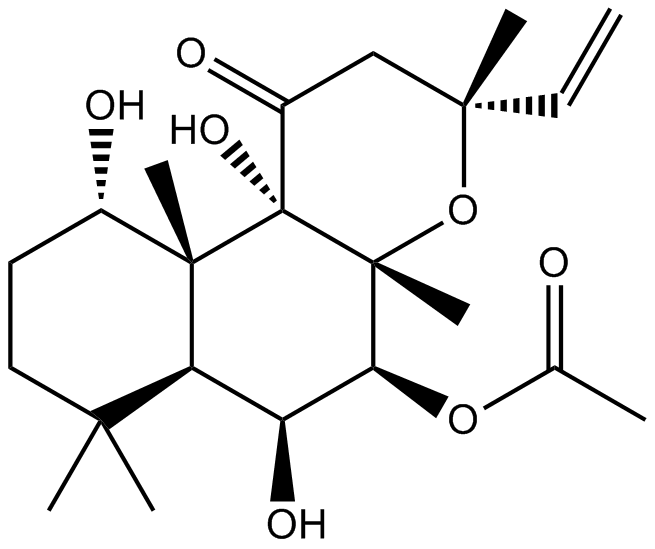
Cas No.: 66575-29-9
Sample solution is provided at 25 µL, 10mM.
Forskolin is a potent adenylate cyclase activator with an IC50 value of 41nM and an EC50 value of 0.5μM for type I adenylyl cyclase[1]. Forskolin can penetrate the cell membrane and stimulate the activity of adenylate cyclase, thereby stimulating the activation of adenosine monophosphate in the ciliary epithelial cells, which in turn, reduces the inflow of aqueous humor and lowers intraocular pressure (IOP)[2]. Forskolin has been widely used for vasodilation and increasing the total blood volume of the circulatory system[3].
In vitro, Forskolin treatment for 48 hours significantly inhibited the viability of Toledo and NK-92 cells, with IC50 values of 40µM for both[4]. Treatment with 10µM Forskolin for 24 hours significantly inhibited the migration of H1299 cells induced by serum, slowed down the division of H1299 cells, and increased the proportion of cells in the G0/G1 phase[5]. Treatment with 100µM Forskolin for 48 hours significantly reduced the Gli1 mRNA level in NB19 cells and promoted cell apoptosis[6].
In vivo, Forskolin treatment via intraperitoneal injection at a dose of 15mg/kg twice weekly for 4 weeks significantly reduced body weight and blood lipids, and improved metabolic status in high-fat diet (HFD)-induced obese mice[7]. Daily intraperitoneal injection of Forskolin at a dose of 2mg/kg for 4 weeks significantly improved the cardiac diastolic dysfunction and myocardial fibrosis of diabetic mice, and reduced oxidative stress[8].
References:
[1] Robbins J D, Boring D L, Tang W J, et al. Forskolin carbamates: binding and activation studies with type I adenylyl cyclase[J]. Journal of medicinal chemistry, 1996, 39(14): 2745-2752.
[2] Wagh V D, Patil P N, Surana S J, et al. Forskolin: upcoming antiglaucoma molecule[J]. Journal of postgraduate medicine, 2012, 58(3): 199-202.
[3] Salehi B, Staniak M, Czopek K, et al. The therapeutic potential of the labdane diterpenoid forskolin[J]. Applied sciences, 2019, 9(19): 4089.
[4] Wang H, Lou C, Ma N. Forskolin exerts anticancer roles in non-Hodgkin’s lymphomas via regulating Axin/β-catenin signaling pathway[J]. Cancer Management and Research, 2019: 1685-1696.
[5] Salzillo A, Ragone A, Spina A, et al. Forskolin affects proliferation, migration and Paclitaxel-mediated cytotoxicity in non-small-cell lung cancer cell lines via adenylyl cyclase/cAMP axis[J]. European Journal of Cell Biology, 2023, 102(2): 151292.
[6] Yamanaka H, Oue T, Uehara S, et al. Forskolin, a Hedgehog signal inhibitor, inhibits cell proliferation and induces apoptosis in pediatric tumor cell lines[J]. Molecular medicine reports, 2010, 3(1): 133-139.
[7] Mehrnaz A, Zhou F, Kim L N, et al. Anti-obesity and metabolic effects of forskolin in obese C57BL/6J mice[J]. International journal of molecular sciences, 2025, 26(14): 6607.
[8] Zhang X, Ke P X, Yuan X, et al. Forskolin Protected against Streptozotocin‐Induced Diabetic Cardiomyopathy via Inhibition of Oxidative Stress and Cardiac Fibrosis in Mice[J]. BioMed Research International, 2021, 2021(1): 8881843.
| Cell experiment [1]: | |
|
Cell lines |
NK-92 cells |
|
Preparation Method |
NK-92 cells were cultured in Alpha Minimum Essential Medium with ribonucleosides and deoxyribonucleosides free, with 2mM L-glutamine and 1.5g/l sodium bicarbonate, 0.2mM inositol, 0.1mM 2-mercaptoethanol, 0.02mM folic acid, 100-200U/ml recombinant IL-2, 12.5% horse serum, and 12.5% heat-inactivated fetal bovine serum (FBS) at 37°C in an incubator with 5% CO2. Cells were seeded in a 96-well plate at a density of 3×10³ cells/well for 24h, with three replicates for each treatment. Cells were treated with Forskolin at a range of concentrations (0, 10, 20, 40, 80, and 160μM). After 48h of treatment, the cell viability was determined. |
|
Reaction Conditions |
0, 10, 20, 40, 80, and 160μM; 48h |
|
Applications |
Forskolin treatment inhibited the cell viability of NK-92 cells in a dose-dependent manner. |
| Animal experiment [2]: | |
|
Animal models |
Male C57BL/6 wild-type mice |
|
Preparation Method |
Male C57BL/6 wild-type mice (6 weeks old; 18-22g) were maintained in a controlled environment at 22±3°C and 60% relative humidity under a 12h light/dark cycle, and were given free access to standard rodent nutrition and water. Diabetes was induced in mice by intraperitoneal injection of streptozotocin (60mg/kg/day) for six consecutive days, while the control mice received equivalent volumes of citrate buffer. Mice with fasting blood glucose concentrations>16.7mM seven days after streptozotocin injection were considered to have diabetes. Eight weeks after the establishment of diabetes, mice were randomly assigned to three groups (n=8 in each group): (1) control group (Con), (2) diabetes group in which diabetic mice were treated with vehicle, and (3) Forskolin group in which diabetic mice were treated with Forskolin (2mg/kg/day; i.p.) for four weeks. All mice were then anesthetized with isoflurane and sacrificed through cervical dislocation. Hearts were rapidly excised and placed into phosphate buffer saline for analysis. |
|
Dosage form |
2mg/kg/day; 4 weeks; i.p. |
|
Applications |
Forskolin treatment significantly improved the cardiac diastolic dysfunction and myocardial fibrosis in diabetic mice. |
References: [1] Wang H, Lou C, Ma N. Forskolin exerts anticancer roles in non-Hodgkin’s lymphomas via regulating Axin/β-catenin signaling pathway[J]. Cancer Management and Research, 2019: 1685-1696. [2] Zhang X, Ke P X, Yuan X, et al. Forskolin Protected against Streptozotocin‐Induced Diabetic Cardiomyopathy via Inhibition of Oxidative Stress and Cardiac Fibrosis in Mice[J]. BioMed Research International, 2021, 2021(1): 8881843. | |
| Cas No. | 66575-29-9 | SDF | |
| Synonyms | Coleonol, HL 362, L 751362B, NSC 357088, NSC 375489 | ||
| Chemical Name | [(3R,4aR,5S,6S,6aS,10S,10aR,10bS)-3-ethenyl-6,10,10b-trihydroxy-3,4a,7,7,10a-pentamethyl-1-oxo-5,6,6a,8,9,10-hexahydro-2H-benzo[f]chromen-5-yl] acetate | ||
| Canonical SMILES | CC(=O)OC1C(C2C(CCC(C2(C3(C1(OC(CC3=O)(C)C=C)C)O)C)O)(C)C)O | ||
| Formula | C22H34O7 | M.Wt | 410.5 |
| Solubility | ≥ 20.525mg/mL in DMSO | Storage | -20°C, protect from light |
| General tips | Please select the appropriate solvent to prepare the stock solution according to the
solubility of the product in different solvents; once the solution is prepared, please store it in
separate packages to avoid product failure caused by repeated freezing and thawing.Storage method
and period of the stock solution: When stored at -80°C, please use it within 6 months; when stored
at -20°C, please use it within 1 month. To increase solubility, heat the tube to 37°C and then oscillate in an ultrasonic bath for some time. |
||
| Shipping Condition | Evaluation sample solution: shipped with blue ice. All other sizes available: with RT, or with Blue Ice upon request. | ||
| Prepare stock solution | |||

|
1 mg | 5 mg | 10 mg |
| 1 mM | 2.4361 mL | 12.1803 mL | 24.3605 mL |
| 5 mM | 487.2 μL | 2.4361 mL | 4.8721 mL |
| 10 mM | 243.6 μL | 1.218 mL | 2.4361 mL |
Step 1: Enter information below (Recommended: An additional animal making an allowance for loss during the experiment)
 g
μL
g
μL
Step 2: Enter the in vivo formulation (This is only the calculator, not formulation. Please contact us first if there is no in vivo formulation at the solubility Section.)
Calculation results:
Working concentration: mg/ml;
Method for preparing DMSO master liquid: mg drug pre-dissolved in μL DMSO ( Master liquid concentration mg/mL, Please contact us first if the concentration exceeds the DMSO solubility of the batch of drug. )
Method for preparing in vivo formulation: Take μL DMSO master liquid, next addμL PEG300, mix and clarify, next addμL Tween 80, mix and clarify, next add μL saline, mix and clarify.
Method for preparing in vivo formulation: Take μL DMSO master liquid, next add μL Corn oil, mix and clarify.
Note: 1. Please make sure the liquid is clear before adding the next solvent.
2. Be sure to add the solvent(s) in order. You must ensure that the solution obtained, in the previous addition, is a clear solution before proceeding to add the next solvent. Physical methods such as vortex, ultrasound or hot water bath can be used to aid dissolving.
3. All of the above co-solvents are available for purchase on the GlpBio website.
Quality Control & SDS
- View current batch:
- Purity: >98.00% Appearance: A solid
- COA (Certificate of Analysis)
- SDS (Safety Data Sheet)
- Datasheet
Average Rating: 5 (Based on Reviews and 29 reference(s) in Google Scholar.)