

Fusicoccin (Synonyms: NSC 113500) |
Catalog No.GC18611
 One-Click Copy Product Info
|

Fusicoccin is a diterpene glycoside phytotoxin extracted from the fungus Phomopsis amygdaliand. Fusicoccin a stabilizer of 14-3-3 protein interactions.
Products are for research use only. Not for human use. We do not sell to patients.
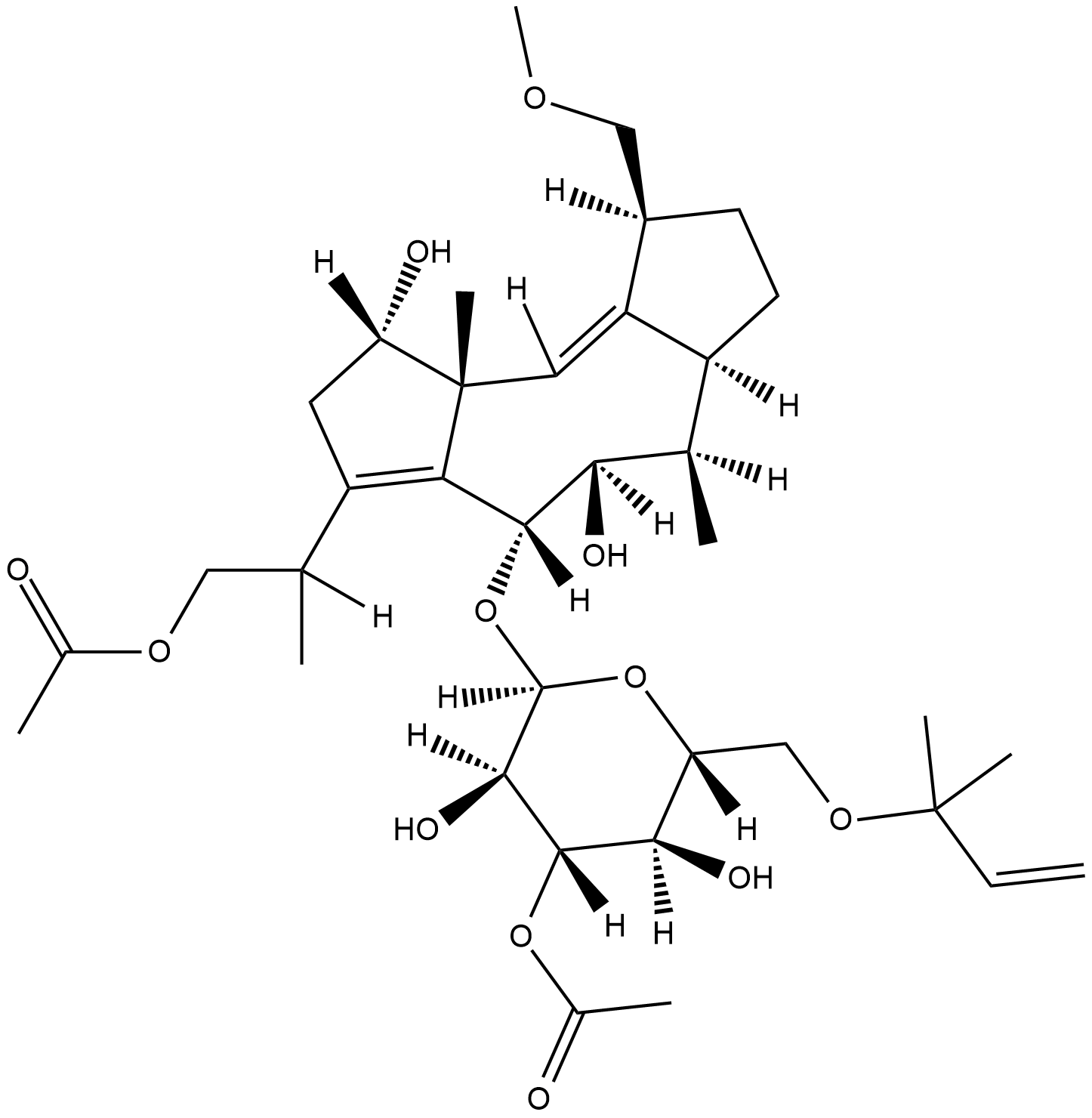
Cas No.: 20108-30-9
Sample solution is provided at 25 µL, 10mM.
_1-3.$$$39978408@51.jpg');)
_1-9.$$$38538795@65.jpg');)
_1-9.$$$39112701@51.jpg');)
_1-7.$$$37316672@70.jpg');)
_366-372.$$$36198801@70.jpg');)
.$$$38565142@65.jpg');)
_1867-1883.$$$33248023@67.jpg');)
_eads6055.$$$39977546@45.jpg');)
_eadm9805.$$$40080571@45.jpg');)
_eadj3020.$$$39666821@45.jpg');)
_1-20.$$$39757301@28.jpg');)
_1-24.$$$38898113@28.jpg');)
_273-287.$$$36806353@46.jpg');)
_1-16.$$$37156877@44.jpg');)
_1-19.$$$37460805@44.jpg');)
_1291-1307.$$$34518654@46.jpg');)
Fusicoccin is a diterpene glycoside phytotoxin extracted from the fungus Phomopsis amygdaliand. Fusicoccin a stabilizer of 14-3-3 protein interactions. Fusicoccin activates the plasma membrane H⁺-ATPase by stabilizing its binding to 14-3-3 proteins, leading to proton efflux and membrane hyperpolarization. Fusicoccin regulates multiple cellular signaling pathways by stabilizing the interactions between 14-3-3 proteins and client proteins containing a C-terminal recognition motif, such as ERα, GPIbα, TASK3, CFTR, and p53. Fusicoccin can be used in research related to plant physiology, cancer therapy, and neural regeneration[1-4].
In vitro, HEK293T cells were treated with Fusicoccin (5μM) for 60–90 minutes. Fusicoccin induced nuclear export of mCherry-CT52M1 and nuclear import of mCherry-p65-CT52M1. By stabilizing the interaction between 14-3-3 proteins and CT52M1, Fusicoccin regulated the subcellular localization of NF-κB and induced IL-8 secretion[5]. OVCAR-3 cells were co-treated with Fusicoccin (30μM) and IFNα (200U/mL) for 6 days. Fusicoccin A and IFNα synergistically reduced cell viability and induced apoptosis[6].
In vivo, adult mice with spinal cord contusion and T10 hemisection models were intraperitoneally administered Fusicoccin (15mg/kg; every other day) for 42 days. Fusicoccin promoted motor function recovery and neural regeneration[7]. Fusicoccin (5mg/kg; every two days) was administered intraperitoneally to Alzheimer's disease model C57BL6JRccHsd mice for 12 days. Fusicoccin protected the cell bodies of dopaminergic neurons in the substantia nigr[8].
References:
[1] Camoni L, Visconti S, Aducci P. The phytotoxin fusicoccin, a selective stabilizer of 14-3-3 interactions? IUBMB Life. 2013 Jun;65(6):513-7.
[2] Doveston RG, Kuusk A, Andrei SA, et al. Small-molecule stabilization of the p53 - 14-3-3 protein-protein interaction. FEBS Lett. 2017 Aug;591(16):2449-2457.
[3] Kaplan A, Morquette B, Kroner A, et al. Small-Molecule Stabilization of 14-3-3 Protein-Protein Interactions Stimulates Axon Regeneration. Neuron. 2017 Mar 8;93(5):1082-1093.e5.
[4] Bury M, Andolfi A, Rogister B, et al. Fusicoccin a, a phytotoxic carbotricyclic diterpene glucoside of fungal origin, reduces proliferation and invasion of glioblastoma cells by targeting multiple tyrosine kinases. Transl Oncol. 2013 Apr;6(2):112-23.
[5] Skwarczynska M, Molzan M, Ottmann C. Activation of NF-κB signalling by fusicoccin-induced dimerization. Proc Natl Acad Sci U S A. 2013 Jan 29;110(5):E377-86.
[6] Andlovic B, Heilmann G, Ninck S, et al. IFNα primes cancer cells for Fusicoccin-induced cell death via 14-3-3 PPI stabilization. Cell Chem Biol. 2023 Jun 15;30(6):573-590.e6.
[7] Liu Q, Yang H, Luo J, et al. 14-3-3 protein augments the protein stability of phosphorylated spastin and promotes the recovery of spinal cord injury through its agonist intervention. Elife. 2024 Jan 17;12:RP90184.
[8] Vinueza-Gavilanes R, Bravo-González JJ, Basurco L, et al. Stabilization of 14-3-3 protein-protein interactions with Fusicoccin-A decreases alpha-synuclein dependent cell-autonomous death in neuronal and mouse models. Neurobiol Dis. 2023 Jul;183:106166.
| Cell experiment [1]: | |
Cell lines | OVCAR-3 cells (high-grade ovarian serous adenocarcinoma cell line) |
Preparation Method | OVCAR-3 cells were seeded in 384-well plates. After 24 hours, cells were treated with Fusicoccin (30μM), IFNα, or their combination. |
Reaction Conditions | 30μM; 6 days |
Applications | Fusicoccin and IFNα synergistically reduced cell viability and induced apoptosis in OVCAR-3 cells. The combination treatment led to rapid growth arrest and a significant increase in the number of apoptotic cells, peaking at approximately 72 hours. Pre-treatment with IFNα for 48 hours further sensitized cells to Fusicoccin-induced apoptosis. |
| Animal experiment [2]: | |
Animal models | 3-month-old male and female C57BL6JRccHsd mice |
Preparation Method | On the second day of simulating Alzheimer's disease in mice, the mice were intraperitoneally injected with fusikosin every 48 hours for 12 days. |
Dosage form | 5mg/kg; i.p.; every 2 days for 12 days |
Applications | Fusicoccin protected dopaminergic neuronal somas in the substantia nigra. |
References: | |
| Cas No. | 20108-30-9 | SDF | |
| Synonyms | NSC 113500 | ||
| Chemical Name | (1S,4R,5R,6R,6aS,9S,10aR)-3-[(1S)-2-(acetyloxy)-1-methylethyl]-1,2,4,5,6,6a,7,8,9,10a-decahydro-1,5-dihydroxy-9-(methoxymethyl)-6,10a-dimethyldicyclopenta[a,d]cycloocten-4-yl 6-O-(1,1-dimethyl-2-propen-1-yl)-α-D-glucopyranoside, 3-acetate | ||
| Canonical SMILES | O[C@H]1[C@H](O[C@@]2([H])O[C@H](COC(C)(C)C=C)[C@@H](O)[C@H](OC(C)=O)[C@H]2O)C3=C([C@@H](COC(C)=O)C)C[C@H](O)[C@]3(C)/C=C4[C@](CC[C@@H]\4COC)([H])[C@H]1C | ||
| Formula | C36H56O12 | M.Wt | 680.8 |
| Solubility | Soluble in DMSO | Storage | Store at -20°C,protect from light |
| General tips | Please select the appropriate solvent to prepare the stock solution according to the
solubility of the product in different solvents; once the solution is prepared, please store it in
separate packages to avoid product failure caused by repeated freezing and thawing.Storage method
and period of the stock solution: When stored at -80°C, please use it within 6 months; when stored
at -20°C, please use it within 1 month. To increase solubility, heat the tube to 37°C and then oscillate in an ultrasonic bath for some time. |
||
| Shipping Condition | Evaluation sample solution: shipped with blue ice. All other sizes available: with RT, or with Blue Ice upon request. | ||
| Prepare stock solution | |||

|
1 mg | 5 mg | 10 mg |
| 1 mM | 1.4689 mL | 7.3443 mL | 14.6886 mL |
| 5 mM | 293.8 μL | 1.4689 mL | 2.9377 mL |
| 10 mM | 146.9 μL | 734.4 μL | 1.4689 mL |
Step 1: Enter information below (Recommended: An additional animal making an allowance for loss during the experiment)
 g
μL
g
μL
Step 2: Enter the in vivo formulation (This is only the calculator, not formulation. Please contact us first if there is no in vivo formulation at the solubility Section.)
Calculation results:
Working concentration: mg/ml;
Method for preparing DMSO master liquid: mg drug pre-dissolved in μL DMSO ( Master liquid concentration mg/mL, Please contact us first if the concentration exceeds the DMSO solubility of the batch of drug. )
Method for preparing in vivo formulation: Take μL DMSO master liquid, next addμL PEG300, mix and clarify, next addμL Tween 80, mix and clarify, next add μL saline, mix and clarify.
Method for preparing in vivo formulation: Take μL DMSO master liquid, next add μL Corn oil, mix and clarify.
Note: 1. Please make sure the liquid is clear before adding the next solvent.
2. Be sure to add the solvent(s) in order. You must ensure that the solution obtained, in the previous addition, is a clear solution before proceeding to add the next solvent. Physical methods such as vortex, ultrasound or hot water bath can be used to aid dissolving.
3. All of the above co-solvents are available for purchase on the GlpBio website.
Quality Control & SDS
- View current batch:
- Purity: >90.00% Appearance: A solid
- COA (Certificate of Analysis)
- SDS (Safety Data Sheet)
- Datasheet
Average Rating: 5 (Based on Reviews and 28 reference(s) in Google Scholar.)