

Ganciclovir (Synonyms: BW 759, 2'Nor2'deoxyguanosine) |
Catalog No.GC11331
 One-Click Copy Product Info
|

Ganciclovir is a nucleoside antiviral drug.
Products are for research use only. Not for human use. We do not sell to patients.
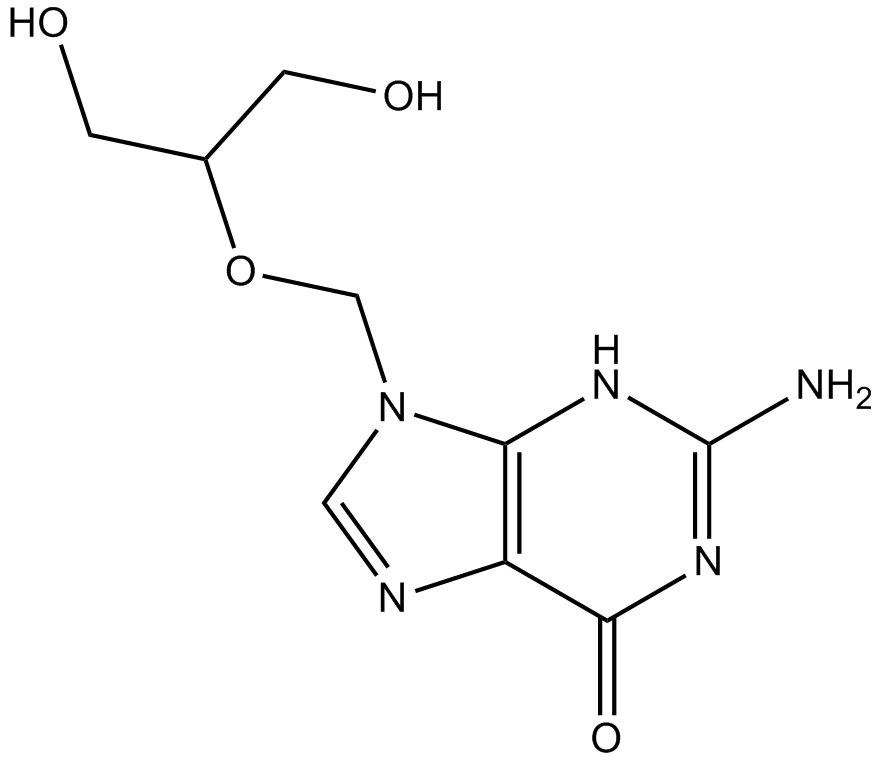
Cas No.: 82410-32-0
Sample solution is provided at 25 µL, 10mM.
_1-3.$$$39978408@51.jpg');)
_1-9.$$$38538795@65.jpg');)
_1-9.$$$39112701@51.jpg');)
_1-7.$$$37316672@70.jpg');)
_366-372.$$$36198801@70.jpg');)
.$$$38565142@65.jpg');)
_1867-1883.$$$33248023@67.jpg');)
_eads6055.$$$39977546@45.jpg');)
_eadm9805.$$$40080571@45.jpg');)
_eadj3020.$$$39666821@45.jpg');)
_1-20.$$$39757301@28.jpg');)
_1-24.$$$38898113@28.jpg');)
_273-287.$$$36806353@46.jpg');)
_1-16.$$$37156877@44.jpg');)
_1-19.$$$37460805@44.jpg');)
_1291-1307.$$$34518654@46.jpg');)
Ganciclovir is a nucleoside antiviral drug. Ganciclovir enters cells and is phosphorylated to a triphosphate compound, which competitively inhibits DNA polymerase and incorporates into viral DNA, thereby inhibiting DNA synthesis. Ganciclovir can be used for the treatment of cytomegalovirus retinitis in immunocompromised patients (including AIDS patients) and for the prevention of cytomegalovirus infection in organ transplant recipients[1-4].
In vitro, B lymphoblastoid cells were treated with Ganciclovir (1-20μg/ml) for 1-14 days. When the exposure duration exceeded 2 days, the dose of Ganciclovir was positively correlated with cytotoxicity, and the cytotoxic concentration significantly decreased with prolonged exposure time[5]. Microglial cells were treated with Ganciclovir (0.05–1mM) for 48 hours. In the presence or absence of LPS (100ng/ml), Ganciclovir did not significantly affect cell proliferation or viability[6].
In vivo, BALB/c mice were intraperitoneally injected daily with Ganciclovir (25–40mg/kg/day), starting from day 1 after infection with murine cytomegalovirus (MCMV) and continuing until day 7. Ganciclovir significantly reduced the occurrence of acute-phase myocarditis in mice[7]. BALB/c mice infected with MCMV on postnatal day 3 were intraperitoneally injected twice daily with Ganciclovir (10mg/kg) for 14 days. Ganciclovir significantly reduced the viral load in the temporal bones of mice, alleviated MCMV-induced sensorineural hearing loss, and partially protected against outer hair cell loss[8].
References:
[1] Crumpacker CS. Ganciclovir. N Engl J Med. 1996 Sep 5;335(10):721-9.
[2] Al-Badr AA, Ajarim TDS. Ganciclovir. Profiles Drug Subst Excip Relat Methodol. 2018;43:1-208.
[3] Ernst ME, Franey RJ. Acyclovir- and ganciclovir-induced neurotoxicity. Ann Pharmacother. 1998 Jan;32(1):111-3.
[4] McGavin JK, Goa KL. Ganciclovir: an update of its use in the prevention of cytomegalovirus infection and disease in transplant recipients. Drugs. 2001;61(8):1153-83.
[5] Janoly-Dumenil A, Rouvet I, Bleyzac N, et al. Effect of duration and intensity of ganciclovir exposure on lymphoblastoid cell toxicity. Antivir Chem Chemother. 2009;19(6):257-62.
[6] Skripuletz T, Salinas Tejedor L, Prajeeth CK, et al. The antiviral drug ganciclovir does not inhibit microglial proliferation and activation. Sci Rep. 2015 Oct 8;5:14935.
[7] Lenzo JC, Shellam GR, Lawson CM. Ganciclovir and cidofovir treatment of cytomegalovirus-induced myocarditis in mice. Antimicrob Agents Chemother. 2001 May;45(5):1444-9.
[8] Haller TJ, Price MS, Lindsay SR, et al. Effects of ganciclovir treatment in a murine model of cytomegalovirus-induced hearing loss. Laryngoscope. 2020 Apr;130(4):1064-1069.
| Cell experiment [1]: | |
Cell lines | B lymphoblastoid cells (BLCLs) by infection with Epstein-Barr virus. |
Preparation Method | BLCLs were grown as suspension cultures in RPMI 1640 medium supplemented with 12% fetal bovine serum, penicillin (120UI/ml), streptomycin (120μg/ml) and amphotericin B (1μg/ml) at 37°C in a humidified atmosphere of 5% CO₂. BLCLs were treated with Ganciclovir (1-20μg/ml). |
Reaction Conditions | 1-20μg/ml; 1-14 days. |
Applications | Ganciclovir exposure was associated with cell toxicity and decreased growth at days 7 and 14 for all concentrations and incubation periods. The 50% cytotoxic concentrations (CC₅₀) markedly decreased with the duration of Ganciclovir exposure from 374μg/ml (for 1-day exposure) to 3.0μg/ml (for 14-day exposure). Microscopic examination indicated an alteration and decrease in cell clusters associated with high Ganciclovir concentration (20μg/ml). |
| Animal experiment [2]: | |
Animal models | BALB/c mice (6 to 8 weeks old) |
Preparation Method | Mice were infected intraperitoneally with 105 PFU of MCMV (K181 strain) on day 0. Ganciclovir treatment commenced on day 1 postinfection and continued daily. |
Dosage form | 25-40mg/kg/day; i.p.; daily injection for 7 days. |
Applications | Ganciclovir treatment significantly reduced the acute phase of myocarditis (6.2-fold reduction) on day 7 postinfection in MCMV-infected mice. |
References: | |
| Cas No. | 82410-32-0 | SDF | |
| Synonyms | BW 759, 2'Nor2'deoxyguanosine | ||
| Chemical Name | 2-amino-9-(1,3-dihydroxypropan-2-yloxymethyl)-3H-purin-6-one | ||
| Canonical SMILES | C1=NC2=C(N1COC(CO)CO)NC(=NC2=O)N | ||
| Formula | C9H13N5O4 | M.Wt | 255.23 |
| Solubility | >50mg/mL in DMSO (Need ultrasonic) | Storage | Store at 2-8°C |
| General tips | Please select the appropriate solvent to prepare the stock solution according to the
solubility of the product in different solvents; once the solution is prepared, please store it in
separate packages to avoid product failure caused by repeated freezing and thawing.Storage method
and period of the stock solution: When stored at -80°C, please use it within 6 months; when stored
at -20°C, please use it within 1 month. To increase solubility, heat the tube to 37°C and then oscillate in an ultrasonic bath for some time. |
||
| Shipping Condition | Evaluation sample solution: shipped with blue ice. All other sizes available: with RT, or with Blue Ice upon request. | ||
| Prepare stock solution | |||

|
1 mg | 5 mg | 10 mg |
| 1 mM | 3.918 mL | 19.5902 mL | 39.1803 mL |
| 5 mM | 783.6 μL | 3.918 mL | 7.8361 mL |
| 10 mM | 391.8 μL | 1.959 mL | 3.918 mL |
Step 1: Enter information below (Recommended: An additional animal making an allowance for loss during the experiment)
 g
μL
g
μL
Step 2: Enter the in vivo formulation (This is only the calculator, not formulation. Please contact us first if there is no in vivo formulation at the solubility Section.)
Calculation results:
Working concentration: mg/ml;
Method for preparing DMSO master liquid: mg drug pre-dissolved in μL DMSO ( Master liquid concentration mg/mL, Please contact us first if the concentration exceeds the DMSO solubility of the batch of drug. )
Method for preparing in vivo formulation: Take μL DMSO master liquid, next addμL PEG300, mix and clarify, next addμL Tween 80, mix and clarify, next add μL saline, mix and clarify.
Method for preparing in vivo formulation: Take μL DMSO master liquid, next add μL Corn oil, mix and clarify.
Note: 1. Please make sure the liquid is clear before adding the next solvent.
2. Be sure to add the solvent(s) in order. You must ensure that the solution obtained, in the previous addition, is a clear solution before proceeding to add the next solvent. Physical methods such as vortex, ultrasound or hot water bath can be used to aid dissolving.
3. All of the above co-solvents are available for purchase on the GlpBio website.
Quality Control & SDS
- View current batch:
- Purity: >99.00% Appearance: A solid
- COA (Certificate of Analysis)
- SDS (Safety Data Sheet)
- Datasheet
Average Rating: 5 (Based on Reviews and 24 reference(s) in Google Scholar.)