

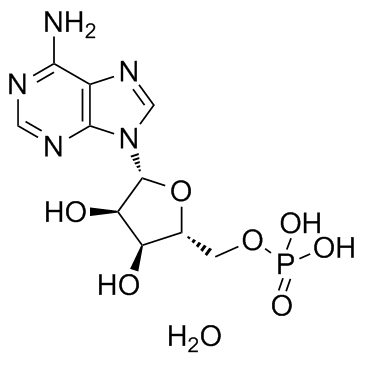
Adenosine 5'-monophosphate monohydrate |
Catalog No.GC35248
 One-Click Copy Product Info
|

Adenosine 5'-monophosphate monohydrate is an adenosine A1 receptor agonist.
Products are for research use only. Not for human use. We do not sell to patients.
Cas No.: 18422-05-4
Sample solution is provided at 25 µL, 10mM.
_1-3.$$$39978408@51.jpg');)
_1-9.$$$38538795@65.jpg');)
_1-9.$$$39112701@51.jpg');)
_1-7.$$$37316672@70.jpg');)
_366-372.$$$36198801@70.jpg');)
.$$$38565142@65.jpg');)
_1867-1883.$$$33248023@67.jpg');)
_eads6055.$$$39977546@45.jpg');)
_eadm9805.$$$40080571@45.jpg');)
_eadj3020.$$$39666821@45.jpg');)
_1-20.$$$39757301@28.jpg');)
_1-24.$$$38898113@28.jpg');)
_273-287.$$$36806353@46.jpg');)
_1-16.$$$37156877@44.jpg');)
_1-19.$$$37460805@44.jpg');)
_1291-1307.$$$34518654@46.jpg');)
Adenosine 5'-monophosphate monohydrate is an adenosine A1 receptor agonist. Adenosine A1 receptor[1]
Adenosine 5'-monophosphate monohydrate is an adenosine A1 receptor agonist[1]. Adenosine 5'-monophosphate monohydrate (5′-AMP)-induced cell toxicity is negligible at concentrations of 25 to 400 μM in RAW264.7 cells. Adenosine 5'-monophosphate monohydrate significantly attenuates the mRNA expression of tumor necrosis factor-α (TNF-α) and interleukin (IL)-6 in RAW264.7 cells. The dose-dependence of TNF-α and IL-6 mRNA show that at concentration of 400 μM, Adenosine 5'-monophosphate monohydrate exhibits the maximum inhibition. Exposure of cells to Adenosine 5'-monophosphate monohydrate significantly reduces recruitment of NF-κB p65 to TNF-α, IL-6, and IL-1β gene promoters[2].
C57BL/6J mice treated with Adenosine 5'-monophosphate monohydrate (5′-AMP) markedly increases hepatic adenosine level. Survival rate in PBS-treated mice (n=15) is 60% (8 h) and 33.3% (24 h), whereas survival rate in Adenosine 5'-monophosphate monohydrate-treated mice (n=15) is 100% (8 h) and 93.3% (24 h). Serum aspartate transaminase (AST) and alanine transaminase (ALT) levels are significantly lowered in the Adenosine 5'-monophosphate monohydrate group than in the vehicle group. The area and extent of necrosis is attenuated and the infiltration of inflammatory cells is reduced in the Adenosine 5'-monophosphate monohydrate group[2].
[1]. Rittiner JE, et al. AMP is an adenosine A1 receptor agonist. J Biol Chem. 2012 Feb 17;287(8):5301-9. [2]. Zhan Y, et al. Adenosine 5'-monophosphate ameliorates D-galactosamine/lipopolysaccharide-induced liver injury through an adenosine receptor-independent mechanism in mice. Cell Death Dis. 2014 Jan 9;5:e985.
Kinase experiment: | RAW264.7 cells are plated in 100-mm dishes and stimulated with lipopolysaccharide (LPS) for 1?h. Cross-linked chromatin are sonicated into DNA fragment of 0.5 to 1.0?kb. For in vitro biochemical experiments, the sonicated cell lysates are incubated with Adenosine 5'-monophosphate monohydrate (5′-AMP) (400?μM) at 37°C for 30?min. Then chromatin is precleared with 50% salmon sperm DNA-saturated protein A agarose beads and immunoprecipitated with 5?μg of antibody[2]. |
Cell experiment: | The RAW264.7 cells (a murine macrophage cell line) are maintained in supplemented RPMI 1640 in an atmosphere at 90% humidity containing 5% CO2 at 37°C. At the end of the pre-incubated period, cells are rinsed with PBS and the medium is supplemented with RPMI 1640 without fetal bovine serum. The cells are pretreated with Adenosine 5'-monophosphate monohydrate (5′-AMP) (400?μM) for 30?min[2]. |
Animal experiment: | Male WT C57BL/6J mice are used at 8 to 10 weeks of age with a body weight of 20 to 25?g in this work. For Adenosine 5'-monophosphate monohydrate (5′-AMP)-pretreated survival experiment, WT mice are randomly divided into two groups (n=15 in each group). Adenosine 5'-monophosphate monohydrate (5mg/20?g body weight i.p.) or PBS is administered to mice. For general experiment, WT mice are randomly divided into different groups (n=5 in each group): (1) vehicle/vehicle group; (2) Adenosine 5'-monophosphate monohydrate/vehicle group. Mice are killed and the blood is collected from the carotid artery. The liver of each mouse is removed immediately and then is kept at -80°C until analyzed[2]. |
References: [1]. Rittiner JE, et al. AMP is an adenosine A1 receptor agonist. J Biol Chem. 2012 Feb 17;287(8):5301-9. | |
| Cas No. | 18422-05-4 | SDF | |
| Canonical SMILES | O=P(O)(OC[C@@H]1[C@H]([C@H]([C@H](N2C=NC3=C2N=CN=C3N)O1)O)O)O.O | ||
| Formula | C10H16N5O8P | M.Wt | 365.24 |
| Solubility | Water: 5 mg/mL (13.69 mM and warming) | Storage | Store at -20°C |
| General tips | Please select the appropriate solvent to prepare the stock solution according to the
solubility of the product in different solvents; once the solution is prepared, please store it in
separate packages to avoid product failure caused by repeated freezing and thawing.Storage method
and period of the stock solution: When stored at -80°C, please use it within 6 months; when stored
at -20°C, please use it within 1 month. To increase solubility, heat the tube to 37°C and then oscillate in an ultrasonic bath for some time. |
||
| Shipping Condition | Evaluation sample solution: shipped with blue ice. All other sizes available: with RT, or with Blue Ice upon request. | ||
| Prepare stock solution | |||

|
1 mg | 5 mg | 10 mg |
| 1 mM | 2.7379 mL | 13.6896 mL | 27.3793 mL |
| 5 mM | 547.6 μL | 2.7379 mL | 5.4759 mL |
| 10 mM | 273.8 μL | 1.369 mL | 2.7379 mL |
Step 1: Enter information below (Recommended: An additional animal making an allowance for loss during the experiment)
 g
μL
g
μL
Step 2: Enter the in vivo formulation (This is only the calculator, not formulation. Please contact us first if there is no in vivo formulation at the solubility Section.)
Calculation results:
Working concentration: mg/ml;
Method for preparing DMSO master liquid: mg drug pre-dissolved in μL DMSO ( Master liquid concentration mg/mL, Please contact us first if the concentration exceeds the DMSO solubility of the batch of drug. )
Method for preparing in vivo formulation: Take μL DMSO master liquid, next addμL PEG300, mix and clarify, next addμL Tween 80, mix and clarify, next add μL saline, mix and clarify.
Method for preparing in vivo formulation: Take μL DMSO master liquid, next add μL Corn oil, mix and clarify.
Note: 1. Please make sure the liquid is clear before adding the next solvent.
2. Be sure to add the solvent(s) in order. You must ensure that the solution obtained, in the previous addition, is a clear solution before proceeding to add the next solvent. Physical methods such as vortex, ultrasound or hot water bath can be used to aid dissolving.
3. All of the above co-solvents are available for purchase on the GlpBio website.
Quality Control & SDS
- View current batch:
- Purity: >98.00% Appearance: A solid
- COA (Certificate of Analysis)
- SDS (Safety Data Sheet)
- Datasheet
Average Rating: 5 (Based on Reviews and 30 reference(s) in Google Scholar.)