

AZD1208 (Synonyms: AZD 1208;AZD-1208) |
Catalog No.GC12660
 One-Click Copy Product Info
|

AZD1208 is a highly selective and orally available pan-Pim kinase inhibitor, with IC50 values of 0.4nM, 5.0nM, and 1.9nM for Pim-1, Pim-2, and Pim-3, respectively.
Products are for research use only. Not for human use. We do not sell to patients.
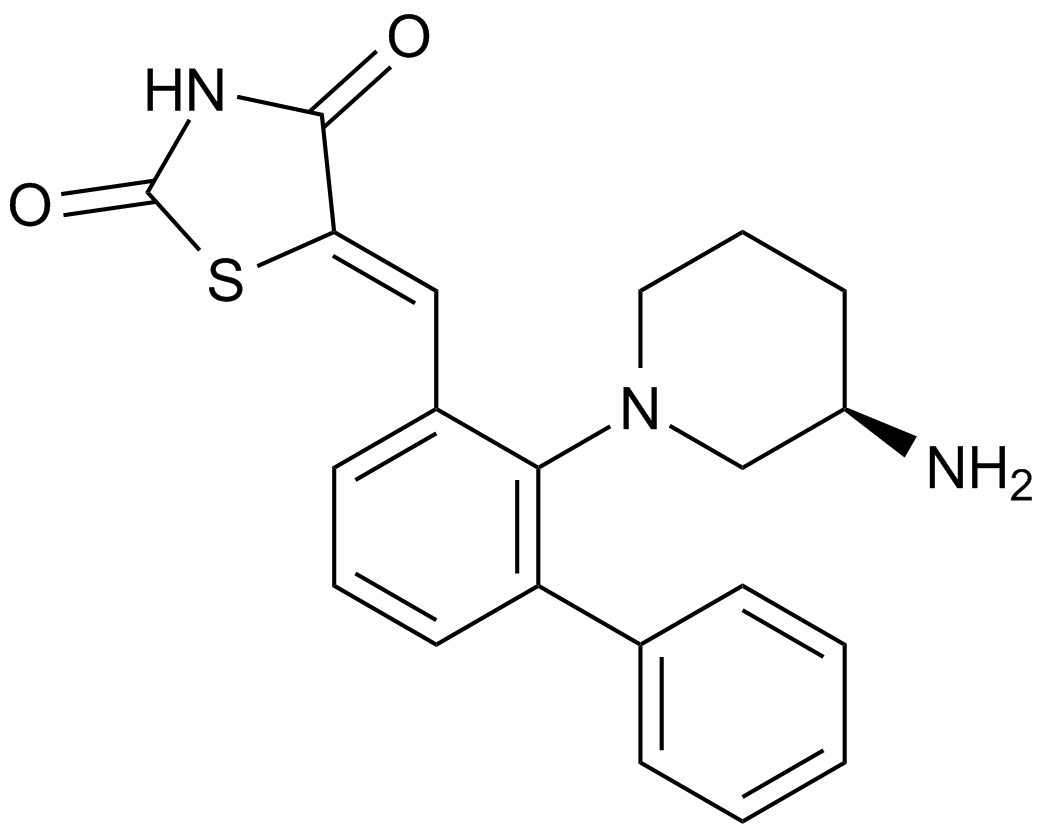
Cas No.: 1204144-28-4
Sample solution is provided at 25 µL, 10mM.
AZD1208 is a highly selective and orally available pan-Pim kinase inhibitor, with IC50 values of 0.4nM, 5.0nM, and 1.9nM for Pim-1, Pim-2, and Pim-3, respectively[1]. AZD1208 suppresses protein translation by decreasing phosphorylation levels of 4E-binding protein 1 (4E-BP1), and induces autophagy by blocking the mTOR/4E-BP1 pathway[2]. AZD1208 has been widely used in tumor research to inhibit the progression of MYC-driven prostate cancer and to down-regulate the p53 pathway[3].
In vitro, AZD1208 treatment for 120 hours significantly inhibited the proliferation of SNU-484, SNU-638 and MKN-45 cells, with IC50 values of 3.36µM, 1.47µM, and 4.69µM, respectively[4]. Treatment with 40µM AZD1208 for 8 days markedly reduced lipid accumulation in differentiating 3T3-L1 cells and decreased triglyceride levels[5]. Treatment with 20µM AZD1208 for 24 hours substantially induced cell death in 93T449 cells and quelled the phosphorylation level of STAT-3 and ATP content[6].
In vivo, AZD1208 treatment via oral administration of 30mg/kg/day of AZD1208 for 14 days significantly restrained tumor growth in the PC3-LN4 xenograft mouse model and reduced the protein levels of HIF-1α and HIF-2α in the tumors[7]. Daily intragastric administration of AZD1208 at a dose of 45mg/kg for 3 weeks significantly inhibited the 22Rv1 tumor volume in mice and led to the downregulation of the ribosome pathway in tumor tissues[8].
References:
[1] Keeton E K, McEachern K, Dillman K S, et al. AZD1208, a potent and selective pan-Pim kinase inhibitor, demonstrates efficacy in preclinical models of acute myeloid leukemia[J]. Blood, The Journal of the American Society of Hematology, 2014, 123(6): 905-913.
[2] Cervantes-Gomez F, Stellrecht C M, Ayres M L, et al. PIM kinase inhibitor, AZD1208, inhibits protein translation and induces autophagy in primary chronic lymphocytic leukemia cells[J]. Oncotarget, 2019, 10(29): 2793.
[3] Kirschner A N, Wang J, van der Meer R, et al. PIM kinase inhibitor AZD1208 for treatment of MYC-driven prostate cancer[J]. Journal of the National Cancer Institute, 2015, 107(2): dju407.
[4] Lee M, Lee K H, Min A, et al. Pan-Pim kinase inhibitor AZD1208 suppresses tumor growth and synergistically interacts with Akt inhibition in gastric cancer cells[J]. Cancer Research and Treatment: Official Journal of Korean Cancer Association, 2019, 51(2): 451-463.
[5] Park Y K, Obiang‐Obounou B W, Lee K B, et al. AZD1208, a pan‐Pim kinase inhibitor, inhibits adipogenesis and induces lipolysis in 3T3‐L1 adipocytes[J]. Journal of cellular and molecular medicine, 2018, 22(4): 2488-2497.
[6] Yadav A K, Kumar V, Bailey D B, et al. AZD1208, a Pan-Pim kinase inhibitor, has anti-growth effect on 93T449 human liposarcoma cells via control of the expression and phosphorylation of Pim-3, mTOR, 4EBP-1, S6, STAT-3 and AMPK[J]. International journal of molecular sciences, 2019, 20(2): 363.
[7] Warfel N A, Sainz A G, Song J H, et al. PIM kinase inhibitors kill hypoxic tumor cells by reducing Nrf2 signaling and increasing reactive oxygen species[J]. Molecular cancer therapeutics, 2016, 15(7): 1637-1647.
[8] Rajkumar-Calkins A, Sagar V, Wang J, et al. PIM kinase inhibition counters resistance to radiotherapy and chemotherapy in human prostate cancer[J]. Radiotherapy and Oncology, 2025, 206: 110794.
| Cell experiment [1]: | |
|
Cell lines |
93T449 cells |
|
Preparation Method |
93T449 cells were cultured in RPMI 1640 medium supplemented with 10% fetal bovine serum and 1% penicillin/streptomycin in a humidified incubator containing 5% CO2 at 37°C. 93T449 cells were seeded in a 24-well plate at a density of 5×10⁴ cells/well overnight. Cells were treated with different concentrations of AZD1208 (0, 1, 5, 10, and 20μM). After a different period of treatment (24, 48, and 72h), the cell viability was determined. |
|
Reaction Conditions |
0, 1, 5, 10, and 20μM; 24, 48, and 72h |
|
Applications |
AZD1208 treatment inhibited the cell viability of 93T449 cells in a dose and time-dependent manner. |
| Animal experiment [2]: | |
|
Animal models |
Male NOD/SCID mice |
|
Preparation Method |
Male NOD/SCID mice were maintained in a controlled environment at 21±1°C and 60% relative humidity under a 12h light/dark cycle, and were given free access to food and water. PC3-LN4 cells were injected subcutaneously into the rear flanks of mice, at a density of 2×10⁶ cells per injection in PBS/Matrigel (v:v=1:1) in 200μl total volume. Once tumors reached a volume of approximately 250mm3, the mice were separated into groups for treatment with vehicle (30% propylene glycol; 5% Tween-80; 65% of 5% dextrose in water; pH 4-5) or AZD1208 (30mg/kg/day) by oral gavage once daily for 14 days. Tumor volumes were monitored over time by caliper measurement. |
|
Dosage form |
30mg/kg/day; 14 days; p.o. |
|
Applications |
AZD1208 treatment suppressed tumor growth in mice with PC3-LN4 xenografts. |
References: [1] Yadav A K, Kumar V, Bailey D B, et al. AZD1208, a Pan-Pim kinase inhibitor, has anti-growth effect on 93T449 human liposarcoma cells via control of the expression and phosphorylation of Pim-3, mTOR, 4EBP-1, S6, STAT-3 and AMPK[J]. International journal of molecular sciences, 2019, 20(2): 363. [2] Warfel N A, Sainz A G, Song J H, et al. PIM kinase inhibitors kill hypoxic tumor cells by reducing Nrf2 signaling and increasing reactive oxygen species[J]. Molecular cancer therapeutics, 2016, 15(7): 1637-1647. | |
| Cas No. | 1204144-28-4 | SDF | |
| Synonyms | AZD 1208;AZD-1208 | ||
| Chemical Name | (5E)-5-[[2-[(3R)-3-aminopiperidin-1-yl]-3-phenylphenyl]methylidene]-1,3-thiazolidine-2,4-dione | ||
| Canonical SMILES | C1CC(CN(C1)C2=C(C=CC=C2C=C3C(=O)NC(=O)S3)C4=CC=CC=C4)N | ||
| Formula | C21H21N3O2S | M.Wt | 379.48 |
| Solubility | ≥ 18.95 mg/mL in DMSO | Storage | Store at -20°C |
| Shipping Condition | Evaluation sample solution: shipped with blue ice. All other sizes available: with RT, or with Blue Ice upon request. | ||
| Prepare stock solution | |||

|
1 mg | 5 mg | 10 mg |
| 1 mM | 2.6352 mL | 13.1759 mL | 26.3518 mL |
| 5 mM | 527 μL | 2.6352 mL | 5.2704 mL |
| 10 mM | 263.5 μL | 1.3176 mL | 2.6352 mL |
Step 1: Enter information below (Recommended: An additional animal making an allowance for loss during the experiment)
 g
μL
g
μL
Step 2: Enter the in vivo formulation (This is only the calculator, not formulation. Please contact us first if there is no in vivo formulation at the solubility Section.)
Calculation results:
Working concentration: mg/ml;
Method for preparing DMSO master liquid: mg drug pre-dissolved in μL DMSO ( Master liquid concentration mg/mL, Please contact us first if the concentration exceeds the DMSO solubility of the batch of drug. )
Method for preparing in vivo formulation: Take μL DMSO master liquid, next addμL PEG300, mix and clarify, next addμL Tween 80, mix and clarify, next add μL saline, mix and clarify.
Method for preparing in vivo formulation: Take μL DMSO master liquid, next add μL Corn oil, mix and clarify.
Note: 1. Please make sure the liquid is clear before adding the next solvent.
2. Be sure to add the solvent(s) in order. You must ensure that the solution obtained, in the previous addition, is a clear solution before proceeding to add the next solvent. Physical methods such as vortex, ultrasound or hot water bath can be used to aid dissolving.
3. All of the above co-solvents are available for purchase on the GlpBio website.
Quality Control & SDS
- View current batch:
- Purity: >98.00% Appearance: A solid
- COA (Certificate of Analysis)
- SDS (Safety Data Sheet)
- Datasheet
Average Rating: 5 (Based on Reviews and 30 reference(s) in Google Scholar.)