

Cortistatin-14 TFA |
Catalog No.GC35730
 One-Click Copy Product Info
|

Cortistatin-14 TFA, a neuropeptide, is present primarily in the cortex and hippocampus, which inhibits neuronal firing of hippocampal CA1 neurons.
Products are for research use only. Not for human use. We do not sell to patients.
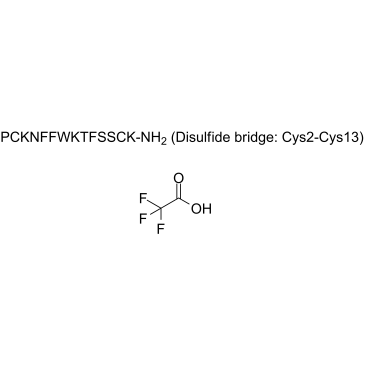
Cas No.: 186901-48-4
Sample solution is provided at 25 µL, 10mM.
_1-3.$$$39978408@51.jpg');)
_1-9.$$$38538795@65.jpg');)
_1-9.$$$39112701@51.jpg');)
_1-7.$$$37316672@70.jpg');)
_366-372.$$$36198801@70.jpg');)
.$$$38565142@65.jpg');)
_1867-1883.$$$33248023@67.jpg');)
_eads6055.$$$39977546@45.jpg');)
_eadm9805.$$$40080571@45.jpg');)
_eadj3020.$$$39666821@45.jpg');)
_1-20.$$$39757301@28.jpg');)
_1-24.$$$38898113@28.jpg');)
_273-287.$$$36806353@46.jpg');)
_1-16.$$$37156877@44.jpg');)
_1-19.$$$37460805@44.jpg');)
_1291-1307.$$$34518654@46.jpg');)
Cortistatin-14 TFA, a neuropeptide, is present primarily in the cortex and hippocampus, which inhibits neuronal firing of hippocampal CA1 neurons [1]. Cortistatin-14 TFA inhibits the proliferation of Th1 cells and release of pro-inflammatory cytokines (IL-2 and IFN-γ), while increasing anti-inflammatory signals (IL-10) [2]. Cortistatin-14 TFA has been widely used to regulate the central nervous function of mice and to modulate the sleep/wake rhythm[3].
In vitro, Cortistatin-14 TFA (1µM) treatment for 48 hours significantly inhibited the proliferation of WRO cells[4].
In vivo, Cortistatin-14 TFA treatment via a single intraperitoneal injection at a dose of 500µg/kg significantly increased the survival rate of septic mice within one week and improved cognitive and emotional dysfunction[5]. Ten minutes before intraperitoneal injection of 10mg/kg kainate, 5µl of 10nmol Cortistatin-14 TFA was intracerebroventricularly injected, which significantly reduced the epileptic seizures in rats and inhibited the significant reduction of cortical and hippocampal neurons in rats[6]. A single intraperitoneal injection of 1mg/kg dose of Cortistatin-14 TFA significantly inhibited gastrointestinal transit, microsphere excretion, and fecal particle excretion in mice with colitis[7]. Intracerebroventricular injection of a single dose of 5µg Cortistatin-14 TFA can alleviate depressive-like behaviors in mice and reduce the time spent in inactivity by the mice within 10 minutes[8].
References:
[1] Flood J F, Uezu K, Morley J E. The cortical neuropeptide, cortistatin-14, impairs post-training memory processing[J]. Brain research, 1997, 775(1-2): 250-252.
[2] Markovics A, Szőke É, Sándor K, et al. Comparison of the anti-inflammatory and anti-nociceptive effects of cortistatin-14 and somatostatin-14 in distinct in vitro and in vivo model systems[J]. Journal of Molecular Neuroscience, 2012, 46(1): 40-50.
[3] de Lecea L. Cortistatin—functions in the central nervous system[J]. Molecular and cellular endocrinology, 2008, 286(1-2): 88-95.
[4] Cassoni P, Muccioli G, Marrocco T, et al. Cortistatin-14 inhibits cell proliferation of human thyroid carcinoma cell lines of both follicular and parafollicular origin[J]. Journal of endocrinological investigation, 2002, 25(4): 362-368.
[5] Wen Q, Ding Q, Wang J, et al. Cortistatin‐14 Exerts Neuroprotective Effect Against Microglial Activation, Blood‐brain Barrier Disruption, and Cognitive Impairment in Sepsis‐associated Encephalopathy[J]. Journal of immunology research, 2022, 2022(1): 3334145.
[6] Braun H, Schulz S, Becker A, et al. Protective effects of cortistatin (CST-14) against kainate-induced neurotoxicity in rat brain[J]. Brain research, 1998, 803(1-2): 54-60.
[7] Jiang J H, Jin W D, Peng Y L, et al. The role of Cortistatin-14 in the gastrointestinal motility in mice[J]. Pharmacological Reports, 2018, 70(2): 355-363.
[8] Jiang J H, Peng Y L, Liang X Y, et al. Centrally administered cortistation-14 induces antidepressant-like effects in mice via mediating ghrelin and GABAA receptor signaling pathway[J]. Frontiers in Pharmacology, 2018, 9: 767.
| Cell experiment [1]: | |
|
Cell lines |
WRO cells |
|
Preparation Method |
WRO cells were grown as a monolayer in RPMI medium with 10% fetal calf serum at 37℃ in a 5% CO2 humidified atmosphere. cells were seeded in quadruplicate in 48-multiwell plates (10000 cells/well) in standard culture medium and allowed to attach for 24h. Cortistatin-14 TFA (0.001, 0.01, 0.1, and 1µM) were then added to the medium and cells were treated up to 96h. Cell viability was evaluated. |
|
Reaction Conditions |
0.001, 0.01, 0.1, and 1µM; 96h |
|
Applications |
Cortistatin-14 TFA treatment significantly reduced the cell viability of WRO cells in a dose-dependent manner. |
| Animal experiment [2]: | |
|
Animal models |
Kunming Mice |
|
Preparation Method |
Male Kunming mice (weighing 20-24g) were housed in sawdust-lined plastic cages and were maintained at 22±1°C (12h light/dark cycle). Drinking water and food were available ad libitum. Establish a mouse model of colitis using dextran sulfate sodium. Mice were fasted for 24h, intraperitoneal injection of Cortistatin-14 TFA (1mg/kg) after five minutes, and were gavaged with 200µl charcoal marker (10%, charcoal suspension in 5% gum arabic solution). The mice were killed 30 minutes after intragastric (i.g.) administration, and the small intestine was removed. The distance traveled by the charcoal marker was measured. |
|
Dosage form |
1mg/kg for once; i.p. |
|
Applications |
Cortistatin-14 TFA treatment significantly inhibited gastrointestinal transit in mice with colitis. |
|
References: |
|
| Cas No. | 186901-48-4 | SDF | |
| Formula | C83H115F3N20O20S2 | M.Wt | 1834.05 |
| Solubility | H2O : 50 mg/mL (Need ultrasonic) | Storage | Store at -20°C |
| General tips | Please select the appropriate solvent to prepare the stock solution according to the
solubility of the product in different solvents; once the solution is prepared, please store it in
separate packages to avoid product failure caused by repeated freezing and thawing.Storage method
and period of the stock solution: When stored at -80°C, please use it within 6 months; when stored
at -20°C, please use it within 1 month. To increase solubility, heat the tube to 37°C and then oscillate in an ultrasonic bath for some time. |
||
| Shipping Condition | Evaluation sample solution: shipped with blue ice. All other sizes available: with RT, or with Blue Ice upon request. | ||
| Prepare stock solution | |||

|
1 mg | 5 mg | 10 mg |
| 1 mM | 545.2 μL | 2.7262 mL | 5.4524 mL |
| 5 mM | 109 μL | 545.2 μL | 1.0905 mL |
| 10 mM | 54.5 μL | 272.6 μL | 545.2 μL |
Step 1: Enter information below (Recommended: An additional animal making an allowance for loss during the experiment)
 g
μL
g
μL
Step 2: Enter the in vivo formulation (This is only the calculator, not formulation. Please contact us first if there is no in vivo formulation at the solubility Section.)
Calculation results:
Working concentration: mg/ml;
Method for preparing DMSO master liquid: mg drug pre-dissolved in μL DMSO ( Master liquid concentration mg/mL, Please contact us first if the concentration exceeds the DMSO solubility of the batch of drug. )
Method for preparing in vivo formulation: Take μL DMSO master liquid, next addμL PEG300, mix and clarify, next addμL Tween 80, mix and clarify, next add μL saline, mix and clarify.
Method for preparing in vivo formulation: Take μL DMSO master liquid, next add μL Corn oil, mix and clarify.
Note: 1. Please make sure the liquid is clear before adding the next solvent.
2. Be sure to add the solvent(s) in order. You must ensure that the solution obtained, in the previous addition, is a clear solution before proceeding to add the next solvent. Physical methods such as vortex, ultrasound or hot water bath can be used to aid dissolving.
3. All of the above co-solvents are available for purchase on the GlpBio website.
Quality Control & SDS
- View current batch:
- Purity: >98.00% Appearance: A solid
- COA (Certificate of Analysis)
- SDS (Safety Data Sheet)
- Datasheet
Average Rating: 5 (Based on Reviews and 23 reference(s) in Google Scholar.)