

Fibronectin Adhesion-promoting Peptide (Synonyms: Heparin Binding Peptide) |
Catalog No.GC36041
 One-Click Copy Product Info
|

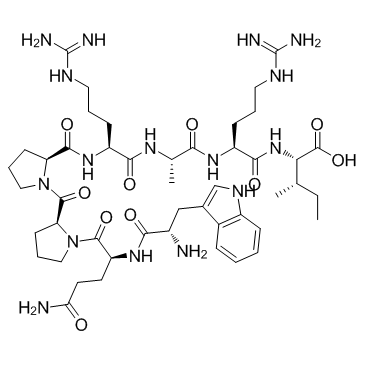
Fibronectin Adhesion-promoting Peptide isa peptide sequence derived from the 33/66kD fragments of fibronectin, which promotes cell adhesion.
Products are for research use only. Not for human use. We do not sell to patients.
Cas No.: 125720-21-0
Sample solution is provided at 25 µL, 10mM.
_1-3.$$$39978408@51.jpg');)
_1-9.$$$38538795@65.jpg');)
_1-9.$$$39112701@51.jpg');)
_1-7.$$$37316672@70.jpg');)
_366-372.$$$36198801@70.jpg');)
.$$$38565142@65.jpg');)
_1867-1883.$$$33248023@67.jpg');)
_eads6055.$$$39977546@45.jpg');)
_eadm9805.$$$40080571@45.jpg');)
_eadj3020.$$$39666821@45.jpg');)
_1-20.$$$39757301@28.jpg');)
_1-24.$$$38898113@28.jpg');)
_273-287.$$$36806353@46.jpg');)
_1-16.$$$37156877@44.jpg');)
_1-19.$$$37460805@44.jpg');)
_1291-1307.$$$34518654@46.jpg');)
Fibronectin Adhesion-promoting Peptide is a peptide sequence derived from the 33/66kD fragments of fibronectin, which promotes cell adhesion[1]. Fibronectin adhesion-promoting peptide activates the transmembrane signaling process by interacting with the cell surface heparan sulfate proteoglycans, thereby inducing the formation of adhesion plaques[2]. Fibronectin adhesion-promoting peptide has been widely used as an internal reference to optimize the parameters of mass spectrometry, enabling the efficient identification of tryptophan-containing peptide segments[3].
In vitro, Fibronectin Adhesion-promoting Peptide treatment (25µM) for 72 hours significantly inhibited the increase in NO levels caused by HBFN-f in the cartilage of rheumatoid arthritis (RA), and reduced the expression of CD44[4].
References:
[1] Mooradian D L, McCarthy J B, Skubitz A P, et al. Characterization of FN-C/HV, a novel synthetic peptide from fibronectin that promotes rabbit corneal epithelial cell adhesion, spreading, and motility[J]. Investigative ophthalmology & visual science, 1993, 34(1): 153-164.
[2] Woods A, McCarthy J B, Furcht L T, et al. A synthetic peptide from the COOH-terminal heparin-binding domain of fibronectin promotes focal adhesion formation[J]. Molecular biology of the cell, 1993, 4(6): 605-613.
[3] Ai Y, Zhao P, Fnu P I J, et al. Absolute Quantitation of Tryptophan-Containing Peptides and Amyloid Beta Peptide Fragments by Coulometric Mass Spectrometry[J]. Journal of the American Society for Mass Spectrometry, 2021, 32(7): 1771.
[4] Yasuda T, Kakinuma T, Julovi S M, et al. COOH-terminal heparin-binding fibronectin fragment induces nitric oxide production in rheumatoid cartilage through CD44[J]. Rheumatology, 2004, 43(9): 1116-1120.
| Cas No. | 125720-21-0 | SDF | |
| Synonyms | Heparin Binding Peptide | ||
| Formula | C47H74N16O10 | M.Wt | 1023.19 |
| Solubility | Water: 2 mg/mL (1.95 mM and warming) | Storage | Store at -20°C |
| Shipping Condition | Evaluation sample solution: shipped with blue ice. All other sizes available: with RT, or with Blue Ice upon request. | ||
| Prepare stock solution | |||

|
1 mg | 5 mg | 10 mg |
| 1 mM | 977.3 μL | 4.8867 mL | 9.7734 mL |
| 5 mM | 195.5 μL | 977.3 μL | 1.9547 mL |
| 10 mM | 97.7 μL | 488.7 μL | 977.3 μL |
Step 1: Enter information below (Recommended: An additional animal making an allowance for loss during the experiment)
 g
μL
g
μL
Step 2: Enter the in vivo formulation (This is only the calculator, not formulation. Please contact us first if there is no in vivo formulation at the solubility Section.)
Calculation results:
Working concentration: mg/ml;
Method for preparing DMSO master liquid: mg drug pre-dissolved in μL DMSO ( Master liquid concentration mg/mL, Please contact us first if the concentration exceeds the DMSO solubility of the batch of drug. )
Method for preparing in vivo formulation: Take μL DMSO master liquid, next addμL PEG300, mix and clarify, next addμL Tween 80, mix and clarify, next add μL saline, mix and clarify.
Method for preparing in vivo formulation: Take μL DMSO master liquid, next add μL Corn oil, mix and clarify.
Note: 1. Please make sure the liquid is clear before adding the next solvent.
2. Be sure to add the solvent(s) in order. You must ensure that the solution obtained, in the previous addition, is a clear solution before proceeding to add the next solvent. Physical methods such as vortex, ultrasound or hot water bath can be used to aid dissolving.
3. All of the above co-solvents are available for purchase on the GlpBio website.
Quality Control & SDS
- View current batch:
- Purity: >98.00% Appearance: A solid
- COA (Certificate of Analysis)
- SDS (Safety Data Sheet)
- Datasheet
Average Rating: 5 (Based on Reviews and 21 reference(s) in Google Scholar.)