

Guadecitabine sodium (Synonyms: SGI-110 sodium; S-110 sodium) |
Catalog No.GC36196
 One-Click Copy Product Info
|

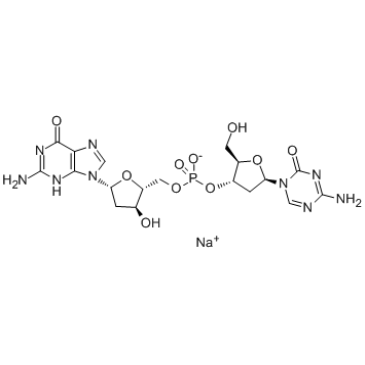
Guadecitabine sodium is a dinucleotide of decitabine (the active metabolite) and deoxyguanosine, resistant to cytidine deaminase.
Products are for research use only. Not for human use. We do not sell to patients.
Cas No.: 929904-85-8
Sample solution is provided at 25 µL, 10mM.
_1-3.$$$39978408@51.jpg');)
_1-9.$$$38538795@65.jpg');)
_1-9.$$$39112701@51.jpg');)
_1-7.$$$37316672@70.jpg');)
_366-372.$$$36198801@70.jpg');)
.$$$38565142@65.jpg');)
_1867-1883.$$$33248023@67.jpg');)
_eads6055.$$$39977546@45.jpg');)
_eadm9805.$$$40080571@45.jpg');)
_eadj3020.$$$39666821@45.jpg');)
_1-20.$$$39757301@28.jpg');)
_1-24.$$$38898113@28.jpg');)
_273-287.$$$36806353@46.jpg');)
_1-16.$$$37156877@44.jpg');)
_1-19.$$$37460805@44.jpg');)
_1291-1307.$$$34518654@46.jpg');)
Guadecitabine sodium is a dinucleotide of decitabine (the active metabolite) and deoxyguanosine, resistant to cytidine deaminase[1]. Gradual release of decitabine from Guadecitabine sodium after subcutaneous injection results in more sustained levels of decitabine, prolonging the exposure window, which allows more incorporation into the DNA of leukemia cells during the synthesis phase of the cell cycle, inducing DNA demethylation and causing cytotoxicity[2]. Guadecitabine sodium has been widely used in tumor research to overcome drug resistance and inhibit the growth of various cancer cells[3].
In vitro, Guadecitabine sodium treatment for 5 days significantly inhibited the viability of SK-UT1 and SK-LMS cells, with IC50 values of 0.3µM and 9.6µM, respectively[4]. Guadecitabine sodium treatment (1µM) for 72 hours markedly reduced the proliferation of HepG2 and Huh-7 cells, and led to a decrease in the methylation levels of CDKN2A, DLEC1, and RUNX3[5]. Treatment with 10µM Guadecitabine sodium for 5 days reduced the protein level of DNMT1 in DU145 cells and increased the protein levels of H3K4me1 and H3K4me2[6].
In vivo, Guadecitabine sodium treatment via intraperitoneal injection at a dose of 50µg/day for 4 days led to a reduction in tumor volume and a decrease in myeloid cells within 4T1 tumor-bearing Balb/cJ mice[7]. Daily intraperitoneal injection of Guadecitabine sodium (1mg/kg) was administered for 13 days, which inhibited the tumor growth in the B16F10 xenograft mouse model and reduced the DNA methylation level in the tumors[8].
References:
[1] Sébert M, Renneville A, Bally C, et al. A phase II study of guadecitabine in higher-risk myelodysplastic syndrome and low blast count acute myeloid leukemia after azacitidine failure[J]. Haematologica, 2019, 104(8): 1565.
[2] Roboz G J, Sanz G, Griffiths E A, et al. Guadecitabine vs TC in relapsed/refractory AML after intensive chemotherapy: a randomized phase 3 ASTRAL-2 trial[J]. Blood advances, 2024, 8(8): 2020-2029.
[3] Gruber E, Franich R L, Shortt J, et al. Distinct and overlapping mechanisms of resistance to azacytidine and guadecitabine in acute myeloid leukemia: Acute myeloid leukemia[J]. Leukemia, 2020, 34(12): 3388-3392.
[4] Fischer C D C, Hu Y, Singh J, et al. Abstract A35: Treatment with demethylating drugs inhibits tumor growth in leiomyosarcoma cell lines and xenograft models[J]. Clinical Cancer Research, 2018, 24(2_Supplement): A35-A35.
[5] Jueliger S, Lyons J, Cannito S, et al. Efficacy and epigenetic interactions of novel DNA hypomethylating agent guadecitabine (SGI-110) in preclinical models of hepatocellular carcinoma[J]. Epigenetics, 2016, 11(10): 709-720.
[6] Karan D, Singh M, Dubey S, et al. DNA methyltransferase 1 targeting using guadecitabine inhibits prostate cancer growth by an apoptosis-independent pathway[J]. Cancers, 2023, 15(10): 2763.
[7] Luker A J, Graham L J, Smith Jr T M, et al. The DNA methyltransferase inhibitor, guadecitabine, targets tumor-induced myelopoiesis and recovers T cell activity to slow tumor growth in combination with adoptive immunotherapy in a mouse model of breast cancer[J]. BMC immunology, 2020, 21(1): 8.
[8] Amaro A, Reggiani F, Fenoglio D, et al. Guadecitabine increases response to combined anti-CTLA-4 and anti-PD-1 treatment in mouse melanoma in vivo by controlling T-cells, myeloid derived suppressor and NK cells[J]. Journal of Experimental & Clinical Cancer Research, 2023, 42(1): 67.
| Cell experiment [1]: | |
|
Cell lines |
22Rv1 cells |
|
Preparation Method |
22Rv1 cells were cultured in RPMI 1640 medium, supplemented with 10% fetal bovine serum (FBS), and 1% penicillin/streptomycin at 37°C in an incubator with 5% CO2. Cells were seeded in a 96-well plate at a density of 5×10⁴ cells/well overnight. Cells were treated with different concentrations of Guadecitabine sodium (0, 5, 10, 15, 20, and 25µM) for 72h. Subsequently, the cell viability was detected. |
|
Reaction Conditions |
0, 5, 10, 15, 20, and 25µM; 72h |
|
Applications |
Guadecitabine sodium treatment reduced the cell viability of 22Rv1 cells in a dose-dependent manner. |
| Animal experiment [2]: | |
|
Animal models |
C57BL/6J mice |
|
Preparation Method |
C57BL/6J mice (8-week-old) were maintained on a 12:12h light-dark schedule in a temperature-controlled, specific pathogen-free facility and fed standard laboratory mouse chow. Mice were shaved and injected s.c. in the right flank with 105 B16F10 cells (>90% viable) in a volume of 0.1ml serum-free medium. Guadecitabine sodium was diluted in PBS and given to mice by i.p. (1mg/kg) from day 3 to 16, daily, post injection of B16F10cells. Tumor volume was calculated daily. |
|
Dosage form |
1mg/kg/day; 13 days; i.p. |
|
Applications |
Guadecitabine sodium treatment inhibited tumor growth in mice with B16F10 xenografts. |
References: [1] Karan D, Singh M, Dubey S, et al. DNA methyltransferase 1 targeting using guadecitabine inhibits prostate cancer growth by an apoptosis-independent pathway[J]. Cancers, 2023, 15(10): 2763. [2] Amaro A, Reggiani F, Fenoglio D, et al. Guadecitabine increases response to combined anti-CTLA-4 and anti-PD-1 treatment in mouse melanoma in vivo by controlling T-cells, myeloid derived suppressor and NK cells[J]. Journal of Experimental & Clinical Cancer Research, 2023, 42(1): 67. | |
| Cas No. | 929904-85-8 | SDF | |
| Synonyms | SGI-110 sodium; S-110 sodium | ||
| Canonical SMILES | O=C1C2=C(N([C@H]3C[C@H](O)[C@@H](COP(O[C@@H]4[C@@H](CO)O[C@@H](N5C=NC(N)=NC5=O)C4)([O-])=O)O3)C=N2)NC(N)=N1.[Na+] | ||
| Formula | C18H23N9NaO10P | M.Wt | 579.39 |
| Solubility | DMSO: 50 mg/mL (86.30 mM); Water | Storage | Store at -20°C |
| Shipping Condition | Evaluation sample solution: shipped with blue ice. All other sizes available: with RT, or with Blue Ice upon request. | ||
| Prepare stock solution | |||

|
1 mg | 5 mg | 10 mg |
| 1 mM | 1.726 mL | 8.6298 mL | 17.2595 mL |
| 5 mM | 345.2 μL | 1.726 mL | 3.4519 mL |
| 10 mM | 172.6 μL | 863 μL | 1.726 mL |
Step 1: Enter information below (Recommended: An additional animal making an allowance for loss during the experiment)
 g
μL
g
μL
Step 2: Enter the in vivo formulation (This is only the calculator, not formulation. Please contact us first if there is no in vivo formulation at the solubility Section.)
Calculation results:
Working concentration: mg/ml;
Method for preparing DMSO master liquid: mg drug pre-dissolved in μL DMSO ( Master liquid concentration mg/mL, Please contact us first if the concentration exceeds the DMSO solubility of the batch of drug. )
Method for preparing in vivo formulation: Take μL DMSO master liquid, next addμL PEG300, mix and clarify, next addμL Tween 80, mix and clarify, next add μL saline, mix and clarify.
Method for preparing in vivo formulation: Take μL DMSO master liquid, next add μL Corn oil, mix and clarify.
Note: 1. Please make sure the liquid is clear before adding the next solvent.
2. Be sure to add the solvent(s) in order. You must ensure that the solution obtained, in the previous addition, is a clear solution before proceeding to add the next solvent. Physical methods such as vortex, ultrasound or hot water bath can be used to aid dissolving.
3. All of the above co-solvents are available for purchase on the GlpBio website.
Quality Control & SDS
- View current batch:
- Purity: >98.00% Appearance: A solid
- COA (Certificate of Analysis)
- SDS (Safety Data Sheet)
- Datasheet
Average Rating: 5 (Based on Reviews and 31 reference(s) in Google Scholar.)