

Talazoparib tosylate (Synonyms: BMN 673ts) |
Catalog No.GC37728
 One-Click Copy Product Info
|

Talazoparib tosylate (BMN 673ts) is a potent and orally active PARP1/2 inhibitor, which is the tosylate salt form of Talazoparib. Talazoparib inhibits PARP1 with an IC50 value of 0.57 nM.
Products are for research use only. Not for human use. We do not sell to patients.
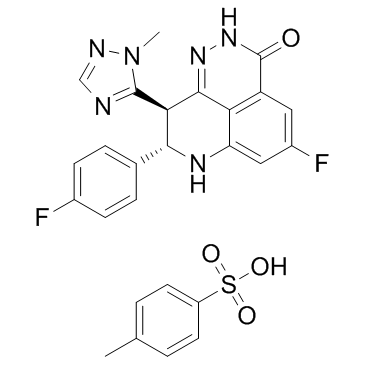
Cas No.: 1373431-65-2
Sample solution is provided at 25 µL, 10mM.
Talazoparib tosylate (BMN 673ts) is a potent and orally active PARP1/2 inhibitor, which is the tosylate salt form of Talazoparib. Talazoparib inhibits PARP1 with an IC50 value of 0.57 nM[1]. PARP1 is a DNA repair enzyme that is important for repairing single-strand breaks[2]. Talazoparib has selective antitumor activity[3].
In vitro, Brca1−/− BR5FVB1-Akt cells treated with Talazoparib (0.1-100 nM) for 72 h inhibited cell proliferation in a dose-dependent manner[4]. Talazoparib treatment of DT40 and DU145 cells for 72 h had significant cytotoxic effects, with IC50 values of 4 nM and 11 nM, respectively[5]. Talazoparib treatment of four human head and neck cancer cell lines (UMSCC-5, -6, -12, -38) showed a relative inhibitory effect on cell growth, with an IC50 range of 0.1-10 μM[6].
In vivo, oral treatment of mice bearing subcutaneous MX-1 tumor xenografts with Talazoparib (0.33mg/kg) significantly inhibited tumor growth and reduced intracellular ADP-ribose (PAR) levels in tumor cells[7].
References:
[1] Shen Y, Rehman F L, Feng Y, et al. BMN 673, a novel and highly potent PARP1/2 inhibitor for the treatment of human cancers with DNA repair deficiency[J]. Clinical Cancer Research, 2013, 19(18): 5003-5015.
[2] Ray Chaudhuri A, Nussenzweig A. The multifaceted roles of PARP1 in DNA repair and chromatin remodelling[J]. Nature reviews Molecular cell biology, 2017, 18(10): 610-621.
[3] Ng R. Niraparib (Zejula), A Small Molecule, PARP1/2 Inhibitor for Treating Breast, Ovarian, and Pancreatic Cancers[J]. Current Drug Synthesis, 2022: 231-251.
[4] Huang J, Wang L, Cong Z, et al. The PARP1 inhibitor BMN 673 exhibits immunoregulatory effects in a Brca1−/− murine model of ovarian cancer[J]. Biochemical and biophysical research communications, 2015, 463(4): 551-556.
[5] Murai J, Huang S Y N, Renaud A, et al. Stereospecific PARP trapping by BMN 673 and comparison with olaparib and rucaparib[J]. Molecular cancer therapeutics, 2014, 13(2): 433-443.
[6] Shin D D, Ratikan J, Manivong K, et al. The poly (ADP-ribose) polymerase inhibitor BMN 673 has single agent activity and augments cytotoxicity of radiation in human head and neck tumor cell line in vitro: a novel strategy for radiosensitization in head and neck cancer[J]. Cancer Research, 2013, 73(8_Supplement): 1595-1595.
[7] Shen Y, Rehman F L, Feng Y, et al. BMN 673, a novel and highly potent PARP1/2 inhibitor for the treatment of human cancers with DNA repair deficiency[J]. Clinical Cancer Research, 2013, 19(18): 5003-5015.
Cell experiment [1]: | |
Cell lines | Brca1−/− BR5FVB1-Akt cells |
Preparation method | Cells were treated with Talazoparib (0.1, 1, 10, or 100 nM) for 72 h. |
Reaction Conditions | 0.1, 1, 10, or 100 nM; 72 h |
Applications | Talazoparib inhibited the proliferation of Brca1−/− BR5FVB1-Akt cells in a dose-dependent manner. |
Animal experiment [2]: | |
Animal models | Female athymic nu/nu mice |
Preparation method | Two PTEN-null cell lines (MDA-MB-468 and LNCap) were established as subcutaneous xenograft models in nude mice, and treated with 0.33 mg/kg Talazoparib (oral, once a day for 28 days). |
Dosage form | 0.33 mg/kg; p.o. |
Applications | Both tumor models responded well to Talazoparib treatment, resulting in tumor growth delay of 15.9 days (MDA-MB-468) and 22.8 days (LNCap) when compared with the vehicle-treated control cohort. |
References: [1] Huang J, Wang L, Cong Z, et al. The PARP1 inhibitor BMN 673 exhibits immunoregulatory effects in a Brca1−/− murine model of ovarian cancer[J]. Biochemical and biophysical research communications, 2015, 463(4): 551-556. [2] Shen Y, Rehman F L, Feng Y, et al. BMN 673, a novel and highly potent PARP1/2 inhibitor for the treatment of human cancers with DNA repair deficiency[J]. Clinical Cancer Research, 2013, 19(18): 5003-5015. | |
| Cas No. | 1373431-65-2 | SDF | |
| Synonyms | BMN 673ts | ||
| Canonical SMILES | O=C1NN=C2C3=C1C=C(F)C=C3N[C@H](C4=CC=C(F)C=C4)[C@H]2C5=NC=NN5C.O=S(C6=CC=C(C)C=C6)(O)=O | ||
| Formula | C26H22F2N6O4S | M.Wt | 552.55 |
| Solubility | DMSO: ≥ 108 mg/mL (195.46 mM) | Storage | Store at -20°C |
| General tips | Please select the appropriate solvent to prepare the stock solution according to the
solubility of the product in different solvents; once the solution is prepared, please store it in
separate packages to avoid product failure caused by repeated freezing and thawing.Storage method
and period of the stock solution: When stored at -80°C, please use it within 6 months; when stored
at -20°C, please use it within 1 month. To increase solubility, heat the tube to 37°C and then oscillate in an ultrasonic bath for some time. |
||
| Shipping Condition | Evaluation sample solution: shipped with blue ice. All other sizes available: with RT, or with Blue Ice upon request. | ||
| Prepare stock solution | |||

|
1 mg | 5 mg | 10 mg |
| 1 mM | 1.8098 mL | 9.049 mL | 18.0979 mL |
| 5 mM | 362 μL | 1.8098 mL | 3.6196 mL |
| 10 mM | 181 μL | 904.9 μL | 1.8098 mL |
Step 1: Enter information below (Recommended: An additional animal making an allowance for loss during the experiment)
 g
μL
g
μL
Step 2: Enter the in vivo formulation (This is only the calculator, not formulation. Please contact us first if there is no in vivo formulation at the solubility Section.)
Calculation results:
Working concentration: mg/ml;
Method for preparing DMSO master liquid: mg drug pre-dissolved in μL DMSO ( Master liquid concentration mg/mL, Please contact us first if the concentration exceeds the DMSO solubility of the batch of drug. )
Method for preparing in vivo formulation: Take μL DMSO master liquid, next addμL PEG300, mix and clarify, next addμL Tween 80, mix and clarify, next add μL saline, mix and clarify.
Method for preparing in vivo formulation: Take μL DMSO master liquid, next add μL Corn oil, mix and clarify.
Note: 1. Please make sure the liquid is clear before adding the next solvent.
2. Be sure to add the solvent(s) in order. You must ensure that the solution obtained, in the previous addition, is a clear solution before proceeding to add the next solvent. Physical methods such as vortex, ultrasound or hot water bath can be used to aid dissolving.
3. All of the above co-solvents are available for purchase on the GlpBio website.
Quality Control & SDS
- View current batch:
- Purity: >99.50% Appearance: A solid
- COA (Certificate of Analysis)
- SDS (Safety Data Sheet)
- Datasheet
Average Rating: 5 (Based on Reviews and 13 reference(s) in Google Scholar.)