

Tipiracil |
Catalog No.GC37798
 One-Click Copy Product Info
|

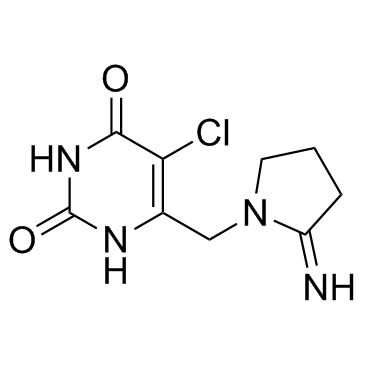
Tipiracil is a competitive inhibitor of thymidine phosphorylase (TPase), with an apparent Ki value of 17nM against recombinant human TPase.
Products are for research use only. Not for human use. We do not sell to patients.
Cas No.: 183204-74-2
Sample solution is provided at 25 µL, 10mM.
_1-3.$$$39978408@51.jpg');)
_1-9.$$$38538795@65.jpg');)
_1-9.$$$39112701@51.jpg');)
_1-7.$$$37316672@70.jpg');)
_366-372.$$$36198801@70.jpg');)
.$$$38565142@65.jpg');)
_1867-1883.$$$33248023@67.jpg');)
_eads6055.$$$39977546@45.jpg');)
_eadm9805.$$$40080571@45.jpg');)
_eadj3020.$$$39666821@45.jpg');)
_1-20.$$$39757301@28.jpg');)
_1-24.$$$38898113@28.jpg');)
_273-287.$$$36806353@46.jpg');)
_1-16.$$$37156877@44.jpg');)
_1-19.$$$37460805@44.jpg');)
_1291-1307.$$$34518654@46.jpg');)
Tipiracil is a competitive inhibitor of thymidine phosphorylase (TPase), with an apparent Ki value of 17nM against recombinant human TPase. Tipiracil selectively inhibits TPase activity only, without inhibiting the activities of uridine phosphorylase, thymidine kinase, ostaurate ribosyltransferase, or dihydropyrimidine dehydrogenase[1]. Trifluridine in combination with Tipiracil is an FDA-approved oral medication for metastatic colorectal cancer. After being ingested by cancer cells, trifluridine is incorporated into DNA, interfering with DNA synthesis and inhibiting cell proliferation. Tipiracil, on the other hand, inhibits trifluridine metabolism via thymidine phosphorylase, thereby increasing trifluridine exposure[2].
In vitro, Tipiracil (0-10µM; 24h) prevented RIG-I induced apoptosis of HUVECs in a dose-dependent manner[3].
In vivo, Trifluridine/Tipiracil (200mg/kg; p.o.) significantly inhibited tumor growth in male nude mice bearing HCT116 (15d) and SW48 (11d) xenografts[4].
References:
[1] Fukushima, M et al. “Structure and activity of specific inhibitors of thymidine phosphorylase to potentiate the function of antitumor 2'-deoxyribonucleosides.” Biochemical pharmacology vol. 59,10 (2000): 1227-36.
[2] Raedler LA. Lonsurf (Trifluridine plus Tipiracil): A New Oral Treatment Approved for Patients with Metastatic Colorectal Cancer. Am Health Drug Benefits. 2016;9(Spec Feature):97-100.
[3] Baris, Adrian et al. “Thymidine phosphorylase facilitates retinoic acid inducible gene-I induced endothelial dysfunction.” Cell death & disease vol. 14,4 294. 26 Apr. 2023.
[4] Nukatsuka, Mamoru et al. “Evaluation of a Novel Combination Therapy, Based on Trifluridine/Tipiracil and Fruquintinib, against Colorectal Cancer.” Chemotherapy vol. 68,2 (2023): 102-110.
| Cell experiment [1]: | |
Cell lines | HUVECs |
Preparation Method | HUVECs were treated with a control or RIG-I agonist in combination with Tipiracil. Cell Death was assessed using a Caspase Glo assay |
Reaction Conditions | 0-10µM; 24h |
Applications | Tipiracil prevented RIG-I induced apoptosis of HUVECs in a dose-dependent manner. |
| Animal experiment [2]: | |
Animal models | Male nude mice bearing HCT116 and SW48 xenografts |
Preparation Method | Trifluridine/Tipiracil was prepared by mixing Trifluridine and Tipiracil at a molar ratio of 1:0.5 in 0.5% (w/v) HPMC. The dose of Trifluridine/Tipiracil was expressed according to the amount of Trifluridine. Trifluridine/Tipiracil (200mg/kg; p.o.) was administered on days 1-5, 8-12, and 15-19 for the HCT116-xenograft model and on days 1-5, 8-12, and 15 for the SW48-xenograft model, respectively. |
Dosage form | 200mg/kg; p.o.; 15 or 11d |
Applications | The tumor volumes in the Trifluridine/Tipiracil (200mg/kg) was significantly lower than that in the control group. |
References: | |
| Cas No. | 183204-74-2 | SDF | |
| Canonical SMILES | O=C1NC(C(Cl)=C(CN2C(CCC2)=N)N1)=O | ||
| Formula | C9H11ClN4O2 | M.Wt | 242.66 |
| Solubility | Water: 1 mg/mL (4.12 mM); DMSO: < 1 mg/mL (insoluble or slightly soluble) | Storage | Store at -20°C |
| General tips | Please select the appropriate solvent to prepare the stock solution according to the
solubility of the product in different solvents; once the solution is prepared, please store it in
separate packages to avoid product failure caused by repeated freezing and thawing.Storage method
and period of the stock solution: When stored at -80°C, please use it within 6 months; when stored
at -20°C, please use it within 1 month. To increase solubility, heat the tube to 37°C and then oscillate in an ultrasonic bath for some time. |
||
| Shipping Condition | Evaluation sample solution: shipped with blue ice. All other sizes available: with RT, or with Blue Ice upon request. | ||
| Prepare stock solution | |||

|
1 mg | 5 mg | 10 mg |
| 1 mM | 4.121 mL | 20.605 mL | 41.2099 mL |
| 5 mM | 824.2 μL | 4.121 mL | 8.242 mL |
| 10 mM | 412.1 μL | 2.0605 mL | 4.121 mL |
Step 1: Enter information below (Recommended: An additional animal making an allowance for loss during the experiment)
 g
μL
g
μL
Step 2: Enter the in vivo formulation (This is only the calculator, not formulation. Please contact us first if there is no in vivo formulation at the solubility Section.)
Calculation results:
Working concentration: mg/ml;
Method for preparing DMSO master liquid: mg drug pre-dissolved in μL DMSO ( Master liquid concentration mg/mL, Please contact us first if the concentration exceeds the DMSO solubility of the batch of drug. )
Method for preparing in vivo formulation: Take μL DMSO master liquid, next addμL PEG300, mix and clarify, next addμL Tween 80, mix and clarify, next add μL saline, mix and clarify.
Method for preparing in vivo formulation: Take μL DMSO master liquid, next add μL Corn oil, mix and clarify.
Note: 1. Please make sure the liquid is clear before adding the next solvent.
2. Be sure to add the solvent(s) in order. You must ensure that the solution obtained, in the previous addition, is a clear solution before proceeding to add the next solvent. Physical methods such as vortex, ultrasound or hot water bath can be used to aid dissolving.
3. All of the above co-solvents are available for purchase on the GlpBio website.
Quality Control & SDS
- View current batch:
- Purity: >98.00% Appearance: A solid
- COA (Certificate of Analysis)
- SDS (Safety Data Sheet)
- Datasheet
Average Rating: 5 (Based on Reviews and 36 reference(s) in Google Scholar.)