

USP25/28 inhibitor AZ1 (Synonyms: AZ1) |
Catalog No.GC38043
 One-Click Copy Product Info
|

USP25/28 inhibitor AZ1 is an orally active, selective, noncompetitive, dual ubiquitin specific protease (USP) 25/28 inhibitor with IC50 values of 0.62μM and 0.7μM, respectively.
Products are for research use only. Not for human use. We do not sell to patients.
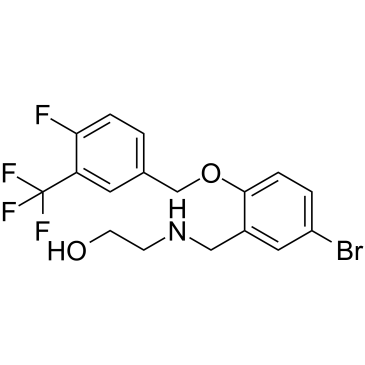
Cas No.: 2165322-94-9
Sample solution is provided at 25 µL, 10mM.
_1-3.$$$39978408@51.jpg');)
_1-9.$$$38538795@65.jpg');)
_1-9.$$$39112701@51.jpg');)
_1-7.$$$37316672@70.jpg');)
_366-372.$$$36198801@70.jpg');)
.$$$38565142@65.jpg');)
_1867-1883.$$$33248023@67.jpg');)
_eads6055.$$$39977546@45.jpg');)
_eadm9805.$$$40080571@45.jpg');)
_eadj3020.$$$39666821@45.jpg');)
_1-20.$$$39757301@28.jpg');)
_1-24.$$$38898113@28.jpg');)
_273-287.$$$36806353@46.jpg');)
_1-16.$$$37156877@44.jpg');)
_1-19.$$$37460805@44.jpg');)
_1291-1307.$$$34518654@46.jpg');)
USP25/28 inhibitor AZ1 is an orally active, selective, noncompetitive, dual ubiquitin specific protease (USP) 25/28 inhibitor with IC50 values of 0.62μM and 0.7μM, respectively[1]. USP25/28 inhibitor AZ1 blocks USP28-dependent stabilization of ΔNp63, causing an imbalance in the Fanconi anemia (FA)-DNA damage response (DDR) signal, and enhancing the sensitivity of squamous cell carcinoma cells to chemotherapy[2]. USP25/28 inhibitor AZ1 has been widely used to enhance the immune response and inhibit the activity of USP25 in promoting intestinal cancer[3].
In vitro, USP25/28 inhibitor AZ1 (20μM) treatment for 48 hours significantly inhibited the proliferation of A549 and H460 cells, and induced cell cycle arrest and the expression of P27[4]. Treatment with 10μM of the USP25/28 inhibitor AZ1 for 48 hours significantly reduced the protein expression levels of SMARCA4, UIMC1 and SLX4 in SKOV3 cells, and induced DNA double-strand break damage. Inhibit homologous recombination repair[5].
In vivo, USP25/28 inhibitor AZ1 treatment via intraperitoneal injection at a dose of 20mg/kg/day for 4 weeks improved amyloid plaque deposition in Alzheimer's disease mice[6]. Subcutaneous intraperitoneal injection of USP25/28 inhibitor AZ1 (5mg/kg/day) for 7 consecutive weeks inhibited the development of renal cysts in mice with Autosomal dominant polycystic kidney disease (ADPKD), and down-regulated the expression levels of STAT3 as well as the transcriptional targets c-Myc, Bcl-xL and CyclinD2[7]. Intragastric gavage of the USP25/28 inhibitor AZ1 at a dose of 60mg/kg every other day for 24 days inhibited tumor growth in the 786-O xenograft mouse model without affecting body weight[8].
References:
[1] Wrigley J D, Gavory G, Simpson I, et al. Identification and characterization of dual inhibitors of the USP25/28 deubiquitinating enzyme subfamily[J]. ACS chemical biology, 2017, 12(12): 3113-3125.
[2] Prieto-Garcia C, Hartmann O, Reissland M, et al. Inhibition of USP28 overcomes Cisplatin-resistance of squamous tumors by suppression of the Fanconi anemia pathway[J]. Cell Death & Differentiation, 2022, 29(3): 568-584.
[3] Patzke J V, Sauer F, Nair R K, et al. Structural basis for the bi-specificity of USP25 and USP28 inhibitors[J]. EMBO reports, 2024, 25(7): 2950.
[4] Song Y, Wang L, Zheng Y, et al. Deubiquitinating enzyme USP28 inhibitor AZ1 alone and in combination with cisplatin for the treatment of non-small cell lung cancer[J]. Apoptosis, 2024, 29(9): 1793-1809.
[5] Han F, Qi G, Li R, et al. USP28 promotes PARP inhibitor resistance by enhancing SOX9-mediated DNA damage repair in ovarian cancer[J]. Cell Death & Disease, 2025, 16(1): 305.
[6] Zheng Q, Song B, Li G, et al. USP25 inhibition ameliorates Alzheimer’s pathology through the regulation of APP processing and Aβ generation[J]. The Journal of clinical investigation, 2022, 132(5).
[7] Ren Y, Zhu X, Fu K, et al. Inhibition of deubiquitinase USP28 attenuates cyst growth in autosomal dominant polycystic kidney disease[J]. Biochemical Pharmacology, 2023, 207: 115355.
[8] Ren Y, Yang Y, Zhu X, et al. Targeting USP28 inhibits clear cell renal cell carcinoma growth[J]. Cellular Signalling, 2025: 112344.
| Cell experiment [1]: | |
|
Cell lines |
H460 cells |
|
Preparation Method |
H460 cells were cultivated in DMEM medium supplemented with 10% heat-inactivated fetal bovine serum (FBS), 100units/ml penicillin, and 100mg/ml streptomycin at 37°C in an incubator with 5% CO2. Cells were seeded in a 96-well plate at a density of 1×10⁴ cells/well for 24h. Cells were treated with USP25/28 inhibitor AZ1 at a range of concentrations (0, 6, 8, 10, 12, 14, 16, 18 and 20μM). After 24h of treatment, the cell viability was determined. |
|
Reaction Conditions |
0, 6, 8, 10, 12, 14, 16, 18 and 20μM; 24h |
|
Applications |
USP25/28 inhibitor AZ1 treatment inhibited cell viability of H460 cells in a dose-dependent manner. |
| Animal experiment [2]: | |
|
Animal models |
Female BALB/C nude mice |
|
Preparation Method |
Female BALB/C nude mice (5 weeks old) were maintained in a controlled environment at 22±3°C and 60% relative humidity under a 12h light/dark cycle, and were given free access to standard rodent nutrition and water. Approximately 5×10⁶ 786-O cells were injected subcutaneously into mice and mice were randomly assigned into two groups: Control or USP25/28 inhibitor AZ1 (60mg/kg; intragastric gavage every other day). Tumor volume and body weight were measured every 4 days. On day 24 of tumor monitoring, mice were euthanized, tumor were removed and tumor weight were measured. |
|
Dosage form |
60mg/kg; every other day; 24 days; i.g. |
|
Applications |
USP25/28 inhibitor AZ1 treatment significantly inhibited tumor growth in the 786-O xenograft mouse model. |
References: [1] Song Y, Wang L, Zheng Y, et al. Deubiquitinating enzyme USP28 inhibitor AZ1 alone and in combination with cisplatin for the treatment of non-small cell lung cancer[J]. Apoptosis, 2024, 29(9): 1793-1809. [2] Ren Y, Yang Y, Zhu X, et al. Targeting USP28 inhibits clear cell renal cell carcinoma growth[J]. Cellular Signalling, 2025: 112344. | |
| Cas No. | 2165322-94-9 | SDF | |
| Synonyms | AZ1 | ||
| Canonical SMILES | FC(C1=CC(COC2=CC=C(Br)C=C2CNCCO)=CC=C1F)(F)F | ||
| Formula | C17H16BrF4NO2 | M.Wt | 422.21 |
| Solubility | DMSO: ≥ 320 mg/mL (757.91 mM); Water: < 0.1 mg/mL (insoluble) | Storage | Store at -20°C |
| Shipping Condition | Evaluation sample solution: shipped with blue ice. All other sizes available: with RT, or with Blue Ice upon request. | ||
| Prepare stock solution | |||

|
1 mg | 5 mg | 10 mg |
| 1 mM | 2.3685 mL | 11.8424 mL | 23.6849 mL |
| 5 mM | 473.7 μL | 2.3685 mL | 4.737 mL |
| 10 mM | 236.8 μL | 1.1842 mL | 2.3685 mL |
Step 1: Enter information below (Recommended: An additional animal making an allowance for loss during the experiment)
 g
μL
g
μL
Step 2: Enter the in vivo formulation (This is only the calculator, not formulation. Please contact us first if there is no in vivo formulation at the solubility Section.)
Calculation results:
Working concentration: mg/ml;
Method for preparing DMSO master liquid: mg drug pre-dissolved in μL DMSO ( Master liquid concentration mg/mL, Please contact us first if the concentration exceeds the DMSO solubility of the batch of drug. )
Method for preparing in vivo formulation: Take μL DMSO master liquid, next addμL PEG300, mix and clarify, next addμL Tween 80, mix and clarify, next add μL saline, mix and clarify.
Method for preparing in vivo formulation: Take μL DMSO master liquid, next add μL Corn oil, mix and clarify.
Note: 1. Please make sure the liquid is clear before adding the next solvent.
2. Be sure to add the solvent(s) in order. You must ensure that the solution obtained, in the previous addition, is a clear solution before proceeding to add the next solvent. Physical methods such as vortex, ultrasound or hot water bath can be used to aid dissolving.
3. All of the above co-solvents are available for purchase on the GlpBio website.
Quality Control & SDS
- View current batch:
- Purity: >98.00% Appearance: A solid
- COA (Certificate of Analysis)
- SDS (Safety Data Sheet)
- Datasheet
Average Rating: 5 (Based on Reviews and 29 reference(s) in Google Scholar.)