

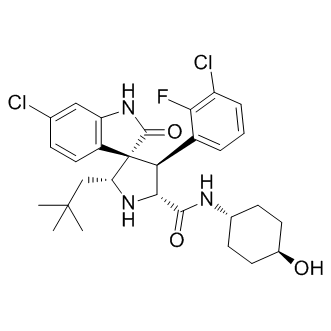
MI-773 |
Catalog No.GC16296
 One-Click Copy Product Info
|

MDM2 inhibitor
Products are for research use only. Not for human use. We do not sell to patients.
Cas No.: 1303607-07-9
Sample solution is provided at 25 µL, 10mM.
_1-3.$$$39978408@51.jpg');)
_1-9.$$$38538795@65.jpg');)
_1-9.$$$39112701@51.jpg');)
_1-7.$$$37316672@70.jpg');)
_366-372.$$$36198801@70.jpg');)
.$$$38565142@65.jpg');)
_1867-1883.$$$33248023@67.jpg');)
_eads6055.$$$39977546@45.jpg');)
_eadm9805.$$$40080571@45.jpg');)
_eadj3020.$$$39666821@45.jpg');)
_1-20.$$$39757301@28.jpg');)
_1-24.$$$38898113@28.jpg');)
_273-287.$$$36806353@46.jpg');)
_1-16.$$$37156877@44.jpg');)
_1-19.$$$37460805@44.jpg');)
_1291-1307.$$$34518654@46.jpg');)
MI-773 is a small molecule inhibitor of MDM2 with IC50 value of 62nM [1].
MI-773 is a small molecule MDM2 antagonist. It is a spirooxindole derivative. MI-773 shows a high MDM2 affinity with IC50 value of 62nM in the FP competitive binding experiment. In the in vitro cell-based assay, MI-773 shows a similar inhibition efficacy with its enantiomer MI-77301. The GI50 values are 58nM and 33nM for MI-773 and MI-77301, respectively. Both MI-773 and MI-77301 exert considerable activity at dose of 100 mg/kg in mouse xenograft models of osteosarcoma, prostate cancer, colorectal cancer, leukemia or melanoma. Currently, an international and multicenter phase I trial of MI-773 is underway for patients with liposarcomas and other p53-wild-type tumors [1, 2].
References:
[1] Zak K, Pecak A, Rys B, Wladyka B, Dömling A, Weber L, Holak TA, Dubin G. Mdm2 and MdmX inhibitors for the treatment of cancer: a patent review (2011-present). Expert Opin Ther Pat. 2013 Apr;23(4):425-48.
[2] Shoushtari AN, Van Tine BA, Schwartz GK. Novel treatment targets in sarcoma: more than just the GIST. Am Soc Clin Oncol Educ Book. 2014:e488-95.
Cell experiment: | Sulforhodamine B or the WST-1 cytotoxicity assay are performed to determine the effect of MI-773 on ACC cell viability. Briefly, 1 to 3×10³ UM-HACC cells are plated per well, and treated with 0 to 40 μM MI-773 for 24 to 96 hours. To assess apoptosis, 2×10⁵ cells are plated in 60 mm3 dishes, attached overnight, and treated with 0 to 20 μM MI-773 for 72 hours. Cells are lysed with a hypotonic buffer and stained with propidium iodide. Primary low passage ACC cells (UM-HACC-5) are stably transduced with lentiviral vectors expressing shRNA-p53 or scrambled sequence control shRNA-C and selected with 1.0 μg/mL puromycin[1]. |
Animal experiment: | Mice[1] To establish a patient-derived xenograft (PDX) model of ACC, human tumor fragments from the UM-HACC-5 patient are transplanted subcutaneously into the dorsal region of male severe combined immunodeficient (SCID) mice (CB.17.SCID). Two of six initial patient tumor fragments transplant, grow, and are retransplanted in vivo into new male or female mice for up to 12 passages. When tumors reach an average of 250 mm3, mice are randomized into groups and received either vehicle (polyethylene glycol-200 + D-α-tocopherol polyethylene glycol 1000 succinate), or treatment with 10, 50, or 100 mg/kg MI-773 daily by oral gavage. The ACCx6 and ACCx9 models are treated with vehicle or 100 mg/kg MI-773. |
References: [1]. Warner KA, et al. Targeting MDM2 for Treatment of Adenoid Cystic Carcinoma. Clin Cancer Res. 2016 Jul 15;22(14):3550-9. | |
| Cas No. | 1303607-07-9 | SDF | |
| Chemical Name | (2'R,3S,4'S,5'R,Z)-6-chloro-4'-(3-chloro-2-fluorophenyl)-2-hydroxy-N-((1r,4R)-4-hydroxycyclohexyl)-2'-neopentylspiro[indole-3,3'-pyrrolidine]-5'-carbimidic acid | ||
| Canonical SMILES | CC(C)(C[C@](N1)([H])[C@@]([C@@]([C@]1([H])/C(O)=N/[C@]2([H])CC[C@](O)([H])CC2)([H])C3=C(F)C(Cl)=CC=C3)(C(O)=N4)C5=C4C=C(Cl)C=C5)C | ||
| Formula | C29H34Cl2FN3O3 | M.Wt | 562.5 |
| Solubility | Soluble in DMSO | Storage | Store at -20°C |
| General tips | Please select the appropriate solvent to prepare the stock solution according to the
solubility of the product in different solvents; once the solution is prepared, please store it in
separate packages to avoid product failure caused by repeated freezing and thawing.Storage method
and period of the stock solution: When stored at -80°C, please use it within 6 months; when stored
at -20°C, please use it within 1 month. To increase solubility, heat the tube to 37°C and then oscillate in an ultrasonic bath for some time. |
||
| Shipping Condition | Evaluation sample solution: shipped with blue ice. All other sizes available: with RT, or with Blue Ice upon request. | ||
| Prepare stock solution | |||

|
1 mg | 5 mg | 10 mg |
| 1 mM | 1.7778 mL | 8.8889 mL | 17.7778 mL |
| 5 mM | 355.6 μL | 1.7778 mL | 3.5556 mL |
| 10 mM | 177.8 μL | 888.9 μL | 1.7778 mL |
Step 1: Enter information below (Recommended: An additional animal making an allowance for loss during the experiment)
 g
μL
g
μL
Step 2: Enter the in vivo formulation (This is only the calculator, not formulation. Please contact us first if there is no in vivo formulation at the solubility Section.)
Calculation results:
Working concentration: mg/ml;
Method for preparing DMSO master liquid: mg drug pre-dissolved in μL DMSO ( Master liquid concentration mg/mL, Please contact us first if the concentration exceeds the DMSO solubility of the batch of drug. )
Method for preparing in vivo formulation: Take μL DMSO master liquid, next addμL PEG300, mix and clarify, next addμL Tween 80, mix and clarify, next add μL saline, mix and clarify.
Method for preparing in vivo formulation: Take μL DMSO master liquid, next add μL Corn oil, mix and clarify.
Note: 1. Please make sure the liquid is clear before adding the next solvent.
2. Be sure to add the solvent(s) in order. You must ensure that the solution obtained, in the previous addition, is a clear solution before proceeding to add the next solvent. Physical methods such as vortex, ultrasound or hot water bath can be used to aid dissolving.
3. All of the above co-solvents are available for purchase on the GlpBio website.
Quality Control & SDS
- View current batch:
- Purity: >98.00% Appearance: A solid
- COA (Certificate of Analysis)
- SDS (Safety Data Sheet)
- Datasheet
Average Rating: 5 (Based on Reviews and 2 reference(s) in Google Scholar.)