

Barbadin |
Catalog No.GC38351
 One-Click Copy Product Info
|

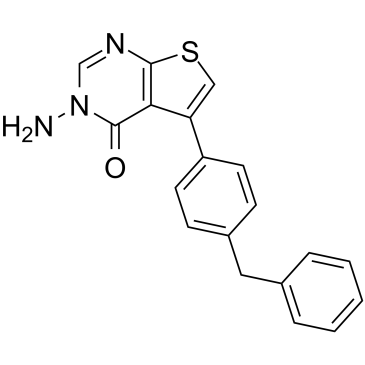
Barbadin is a selective inhibitor of the β-arrestin/β2-adaptin interaction, with IC50 values of 19.1μM and 15.6μM for β-arrestin1 and β-arrestin2, respectively.
Products are for research use only. Not for human use. We do not sell to patients.
Cas No.: 356568-70-2
Sample solution is provided at 25 µL, 10mM.
Barbadin is a selective inhibitor of the β-arrestin/β2-adaptin interaction, with IC50 values of 19.1μM and 15.6μM for β-arrestin1 and β-arrestin2, respectively. Barbadin exerts its inhibitory effect by blocking the internalization of β2-adrenergic receptors, V2 vasopressin (V2R), and angiotensin II type 1 (AT1R) receptors[1,2]. Barbadin is commonly used in studies investigating neutrophil function modulation, G protein-coupled receptor (GPCR) internalization, and related signaling pathways[3,4].
In vitro, pretreatment of HEK293T cells with Barbadin (50μM) for 30min completely blocked V2R agonist arginine vasopressin (AVP)-induced ERK1/2 phosphorylation, but did not affect epidermal growth factor (EGF)-induced ERK activation[1]. Pretreatment of MDA-MB-231 cells with Barbadin (100μM) for 30min, followed by AVP stimulation for 45min, significantly increased the level of the autophagy marker LC3II[5]. Pretreatment of HEK293 cells expressing wild-type μ-opioid receptor (MOR1) with Barbadin (100μM) for 15 or 30min significantly inhibited DAMGO (10μM)-induced receptor internalization and MAPK signaling pathway activation[6]. Treatment of goldfish pituitary cells via a cell column perifusion system with Barbadin (25μM) for 65min significantly increased basal growth hormone secretion levels, but had no sustained effect on basal luteinizing hormone secretion[7].
In vivo, bilateral injection of Barbadin (300ng/side) via pre-implanted cannulas into the dorsal striatum of a tardive dyskinesia (TD) mouse model induced by long-term oral haloperidol (2mg/kg/day; 21 days) blocked the ameliorative effect of the A2A receptor agonist CGS 21680A (1ng/side) on vacuous chewing movements (VCMs)[8].
References:
[1] BEAUTRAIT A, PARADIS J S, ZIMMERMAN B, et al. A new inhibitor of the β-arrestin/AP2 endocytic complex reveals interplay between GPCR internalization and signalling[J]. Nature communications, 2017, 8(1): 15054.
[2] HESSIEN M, DONIA T, TABLL A A, et al. Mechanistic-based classification of endocytosis-related inhibitors: does it aid in assigning drugs against SARS-CoV-2?[J]. Viruses, 2023, 15(5): 1040.
[3] SUNDQVIST M, HOLDFELDT A, WRIGHT S C, et al. Barbadin selectively modulates FPR2-mediated neutrophil functions independent of receptor endocytosis[J]. Biochimica et Biophysica Acta (BBA)-Molecular Cell Research, 2020, 1867(12): 118849.
[4] HE Y, LIU H, YIN N, et al. Barbadin potentiates long-term effects of lorcaserin on POMC neurons and weight loss[J]. Journal of Neuroscience, 2021, 41(26): 5734-5746.
[5] DONIA T, ABOUDA M, KELANY M, et al. β-Arrestin inhibition induces autophagy, apoptosis, G0/G1 cell cycle arrest in agonist-activated V2R receptor in breast cancer cells[J]. Medical Oncology, 2021, 38(4): 38.
[6] SHIRAKI A, SHIMIZU S. The molecular associations in clathrin-coated pit regulate β-arrestin-mediated MAPK signaling downstream of μ-opioid receptor[J]. Biochemical and Biophysical Research Communications, 2023, 640: 64-72.
[7] KHALID E, CHANG J P. β-Arrestin-dependent signaling in GnRH control of hormone secretion from goldfish gonadotrophs and somatotrophs[J]. General and Comparative Endocrinology, 2020, 287: 113340.
[8] NAGAOKA K, ASAOKA N, NAGAYASU K, et al. Enhancement of adenosine A2A signaling improves dopamine D2 receptor antagonist-induced dyskinesia via β-arrestin signaling[J]. Frontiers in Neuroscience, 2023, 16: 1082375.
| Cell experiment [1]: | |
Cell lines | HEK293T cells |
Preparation Method | HEK293T cells were pretreated with Barbadin (50μM) for 30min, followed by stimulation with AVP (100nM) or EGF (100ng/mL) for the indicated times. Lysates were resolved on a 10% SDS-PAGE and analysed by western blot using anti-phospho-ERK1/2 (1:1000) and anti-total-ERK1/2 (1:2000). Signals from western blots were determined by densitometry analysis using the Image J software. |
Reaction Conditions | 50μM; 30min |
Applications | Barbadin completely blocked the AVP-stimulated ERK1/2 activation. This effect was selective since Barbadin did not block EGF-stimulated ERK1/2. |
| Animal experiment [2]: | |
Animal models | Tardive dyskinesia (TD) mouse model |
Preparation Method | Mice were orally administered haloperidol (2mg/kg/day) daily for 21 days. On day 22, VCMs were counted for 5min as an initial baseline before the mice received CGS 21680A + Barbadin (300ng/side) through a pre-implanted cannula in their dorsal striatum. Five minutes after the injection, the VCMs were counted for another 5min to determine the effect of the injected drug. Daily haloperidol treatment was continued for 8 more days; on day 26 and 30, the second and third sets of VCM measurements were taken in a crossover design. |
Dosage form | 300ng/side; bilateral infusion; microinjection |
Applications | The number of VCMs decreased after bilateral infusion of CGS 21680A (1ng/side), when compared with the vehicle-infused mice, whereas this effect was abolished upon co-administration of CGS 21680A and Barbadin (300ng/side). |
References: | |
| Cas No. | 356568-70-2 | SDF | |
| Canonical SMILES | O=C1C(C(C2=CC=C(CC3=CC=CC=C3)C=C2)=CS4)=C4N=CN1N | ||
| Formula | C19H15N3OS | M.Wt | 333.41 |
| Solubility | DMSO: 50 mg/mL (149.97 mM) | Storage | Store at -20°C |
| General tips | Please select the appropriate solvent to prepare the stock solution according to the
solubility of the product in different solvents; once the solution is prepared, please store it in
separate packages to avoid product failure caused by repeated freezing and thawing.Storage method
and period of the stock solution: When stored at -80°C, please use it within 6 months; when stored
at -20°C, please use it within 1 month. To increase solubility, heat the tube to 37°C and then oscillate in an ultrasonic bath for some time. |
||
| Shipping Condition | Evaluation sample solution: shipped with blue ice. All other sizes available: with RT, or with Blue Ice upon request. | ||
| Prepare stock solution | |||

|
1 mg | 5 mg | 10 mg |
| 1 mM | 2.9993 mL | 14.9966 mL | 29.9931 mL |
| 5 mM | 599.9 μL | 2.9993 mL | 5.9986 mL |
| 10 mM | 299.9 μL | 1.4997 mL | 2.9993 mL |
Step 1: Enter information below (Recommended: An additional animal making an allowance for loss during the experiment)
 g
μL
g
μL
Step 2: Enter the in vivo formulation (This is only the calculator, not formulation. Please contact us first if there is no in vivo formulation at the solubility Section.)
Calculation results:
Working concentration: mg/ml;
Method for preparing DMSO master liquid: mg drug pre-dissolved in μL DMSO ( Master liquid concentration mg/mL, Please contact us first if the concentration exceeds the DMSO solubility of the batch of drug. )
Method for preparing in vivo formulation: Take μL DMSO master liquid, next addμL PEG300, mix and clarify, next addμL Tween 80, mix and clarify, next add μL saline, mix and clarify.
Method for preparing in vivo formulation: Take μL DMSO master liquid, next add μL Corn oil, mix and clarify.
Note: 1. Please make sure the liquid is clear before adding the next solvent.
2. Be sure to add the solvent(s) in order. You must ensure that the solution obtained, in the previous addition, is a clear solution before proceeding to add the next solvent. Physical methods such as vortex, ultrasound or hot water bath can be used to aid dissolving.
3. All of the above co-solvents are available for purchase on the GlpBio website.
Quality Control & SDS
- View current batch:
- Purity: >99.50% Appearance: A solid
- COA (Certificate of Analysis)
- SDS (Safety Data Sheet)
- Datasheet
Average Rating: 5 (Based on Reviews and 9 reference(s) in Google Scholar.)