

BTdCPU |
Catalog No.GC38467
 One-Click Copy Product Info
|

BTdCPU is a compound that exerts its function by activating the heme-regulated inhibitor (HRI) kinase. BTdCPU promotes the phosphorylation of eIF2α and induces cellular apoptosis.
Products are for research use only. Not for human use. We do not sell to patients.
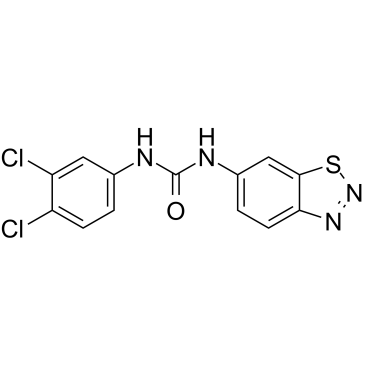
Cas No.: 1257423-87-2
Sample solution is provided at 25 µL, 10mM.
_1-3.$$$39978408@51.jpg');)
_1-9.$$$38538795@65.jpg');)
_1-9.$$$39112701@51.jpg');)
_1-7.$$$37316672@70.jpg');)
_366-372.$$$36198801@70.jpg');)
.$$$38565142@65.jpg');)
_1867-1883.$$$33248023@67.jpg');)
_eads6055.$$$39977546@45.jpg');)
_eadm9805.$$$40080571@45.jpg');)
_eadj3020.$$$39666821@45.jpg');)
_1-20.$$$39757301@28.jpg');)
_1-24.$$$38898113@28.jpg');)
_273-287.$$$36806353@46.jpg');)
_1-16.$$$37156877@44.jpg');)
_1-19.$$$37460805@44.jpg');)
_1291-1307.$$$34518654@46.jpg');)
BTdCPU is a compound that exerts its function by activating the heme-regulated inhibitor (HRI) kinase. BTdCPU promotes the phosphorylation of eIF2α and induces cellular apoptosis[1-2]. BTdCPU holds potential in cancer research, particularly for the study of multiple myeloma and its drug-resistant subtypes[3-4].
In vitro, treatment of multiple myeloma cell lines (MM1.S, H929, MM1.R, RPMI8266, U266) and primary CD138+ cells derived from multiple myeloma patients with BTdCPU (10-20μM) for 4 or 48 hours activated the HRI kinase, induced phosphorylation of eIF2α, upregulated the expression of the pro-apoptotic protein CHOP, and triggered apoptosis[5]. When HEK293T cells, SHSY5Y cells, and Perk+/+ and Perk-/- MEFs were treated with BTdCPU (10μM) for 3 hours, BTdCPU induced mitochondrial membrane depolarization, activated the OMA1-DELE1-HRI mitochondrial stress signaling axis, led to mitochondrial fragmentation, and reduced ATP-linked respiration. This mitochondrial depolarization occurred independently of the integrated stress response (ISR) signaling[6].
In vivo, in a C57BL/6 leukemia mouse model bearing BCR-ABL+ B-ALL cells, intraperitoneal administration of BTdCPU (400mg/kg/day) combined with oral ABT-263 (100mg/kg/day) for 14 consecutive days (starting from day 5 post-transplantation), BTdCPU significantly prolonged the survival of leukemic mice, reduced peripheral white blood cell counts, suppressed MCL-1 protein expression, and upregulated ATF4 levels in the bone marrow[7]. In female nude mice carrying MCF-7 human breast cancer xenografts, intraperitoneal administration of BTdCPU (175mg/kg/day) for 21 consecutive days (starting from tumor transplantation), BTdCPU significantly inhibited tumor growth, induced complete tumor stasis, upregulated phosphorylated eIF2α protein levels in tumor tissues, and did not cause significant hematological toxicity or organ pathological damage[8].
References:
[1] Blázquez AB, Martín-Acebes MA, Poderoso T, et al. Relevance of oxidative stress in inhibition of eIF2 alpha phosphorylation and stress granules formation during Usutu virus infection. PLoS Negl Trop Dis. 2021 Jan 25;15(1):e0009072.
[2] Cuoco CA, Ren W, Baron KR, et al. Pharmacological targeting of RIG-I can selectively activate the integrated stress response. Sci Adv. 2025 Oct 31;11(44):eadt3014.
[3] Zhang C, Xu H, Tang Q, et al. CaMKII suppresses proteotoxicity by phosphorylating BAG3 in response to proteasomal dysfunction. EMBO Rep. 2024 Oct;25(10):4488-4514.
[4] Ogami K, Richard P, Chen Y, et al. An Mtr4/ZFC3H1 complex facilitates turnover of unstable nuclear RNAs to prevent their cytoplasmic transport and global translational repression. Genes Dev. 2017 Jun 15;31(12):1257-1271.
[5] Burwick N, Zhang MY, de la Puente P, et al. The eIF2-alpha kinase HRI is a novel therapeutic target in multiple myeloma. Leuk Res. 2017 Apr;55:23-32.
[6] Perea V, Baron KR, Dolina V, et al. Pharmacologic Activation of a Compensatory Integrated Stress Response Kinase Promotes Mitochondrial Remodeling in PERK-deficient Cells. bioRxiv [Preprint]. 2023 May 17:2023.03.11.532186.
[7] Smith KH, Budhraja A, Lynch J, et al. The Heme-Regulated Inhibitor Pathway Modulates Susceptibility of Poor Prognosis B-Lineage Acute Leukemia to BH3-Mimetics. Mol Cancer Res. 2021 Apr;19(4):636-650.
[8] Chen T, Ozel D, Qiao Y, et al. Chemical genetics identify eIF2α kinase heme-regulated inhibitor as an anticancer target. Nat Chem Biol. 2011 Jul 17;7(9):610-6.
| Cell experiment [1]: | |
Cell lines | Multiple myeloma cell lines (MM1.S, H929, MM1.R, RPMI8266, U266), primary CD138+ multiple myeloma cells from patients, and healthy donor bone marrow mononuclear cells |
Preparation Method | Cells were cultured in RPMI-1640 medium supplemented with 10% fetal bovine serum (FBS) at 37°C, 5% CO₂. Cells were treated with BTdCPU at concentrations ranging from 10 to 20μM for 4 to 48 hours. |
Reaction Conditions | 10–20μM; 4–48 hours |
Applications | BTdCPU activated the heme-regulated inhibitor (HRI) kinase, inducing phosphorylation of eIF2α and upregulating pro-apoptotic proteins CHOP and ATF4. BTdCPU significantly induced apoptosis in both dexamethasone-sensitive and-resistant multiple myeloma cells, with minimal toxicity to normal bone marrow cells. |
| Animal experiment [2]: | |
Animal models | C57BL/6 mice bearing BCR-ABL+ B-ALL leukemia cells. |
Preparation Method | Mice were intraperitoneally administered BTdCPU (400mg/kg/day) and orally administered ABT-263 (100mg/kg/day) for 14 consecutive days, starting 5 days after leukemia cell injection. Mice were monitored for survival and analyzed for leukemia burden and molecular changes. |
Dosage form | 400mg/kg/day; i.p.; Daily for 14 days. |
Applications | BTdCPU combined with ABT-263 significantly prolonged survival of leukemia-bearing mice, reduced peripheral white blood cell counts, and repressed MCL-1 protein expression while inducing ATF4 upregulation in bone marrow cells, demonstrating in vivo efficacy of HRI pathway activation in sensitizing leukemia to BH3-mimetic therapy. |
References: | |
| Cas No. | 1257423-87-2 | SDF | |
| Canonical SMILES | O=C(NC1=CC=C2N=NSC2=C1)NC3=CC=C(C(Cl)=C3)Cl | ||
| Formula | C13H8Cl2N4OS | M.Wt | 339.2 |
| Solubility | DMSO: ≥ 250 mg/mL (737.03 mM) | Storage | Store at -20°C |
| General tips | Please select the appropriate solvent to prepare the stock solution according to the
solubility of the product in different solvents; once the solution is prepared, please store it in
separate packages to avoid product failure caused by repeated freezing and thawing.Storage method
and period of the stock solution: When stored at -80°C, please use it within 6 months; when stored
at -20°C, please use it within 1 month. To increase solubility, heat the tube to 37°C and then oscillate in an ultrasonic bath for some time. |
||
| Shipping Condition | Evaluation sample solution: shipped with blue ice. All other sizes available: with RT, or with Blue Ice upon request. | ||
| Prepare stock solution | |||

|
1 mg | 5 mg | 10 mg |
| 1 mM | 2.9481 mL | 14.7406 mL | 29.4811 mL |
| 5 mM | 589.6 μL | 2.9481 mL | 5.8962 mL |
| 10 mM | 294.8 μL | 1.4741 mL | 2.9481 mL |
Step 1: Enter information below (Recommended: An additional animal making an allowance for loss during the experiment)
 g
μL
g
μL
Step 2: Enter the in vivo formulation (This is only the calculator, not formulation. Please contact us first if there is no in vivo formulation at the solubility Section.)
Calculation results:
Working concentration: mg/ml;
Method for preparing DMSO master liquid: mg drug pre-dissolved in μL DMSO ( Master liquid concentration mg/mL, Please contact us first if the concentration exceeds the DMSO solubility of the batch of drug. )
Method for preparing in vivo formulation: Take μL DMSO master liquid, next addμL PEG300, mix and clarify, next addμL Tween 80, mix and clarify, next add μL saline, mix and clarify.
Method for preparing in vivo formulation: Take μL DMSO master liquid, next add μL Corn oil, mix and clarify.
Note: 1. Please make sure the liquid is clear before adding the next solvent.
2. Be sure to add the solvent(s) in order. You must ensure that the solution obtained, in the previous addition, is a clear solution before proceeding to add the next solvent. Physical methods such as vortex, ultrasound or hot water bath can be used to aid dissolving.
3. All of the above co-solvents are available for purchase on the GlpBio website.
Quality Control & SDS
- View current batch:
- Purity: >99.00% Appearance: A solid
- COA (Certificate of Analysis)
- SDS (Safety Data Sheet)
- Datasheet
Average Rating: 5 (Based on Reviews and 24 reference(s) in Google Scholar.)