

STY-BODIPY (Synonyms: Styrene-BODIPY) |
Catalog No.GC45571
 One-Click Copy Product Info
|

Products are for research use only. Not for human use. We do not sell to patients.

Cas No.: 2383063-37-2
Sample solution is provided at 25 µL, 10mM.
_1-3.$$$39978408@51.jpg');)
_1-9.$$$38538795@65.jpg');)
_1-9.$$$39112701@51.jpg');)
_1-7.$$$37316672@70.jpg');)
_366-372.$$$36198801@70.jpg');)
.$$$38565142@65.jpg');)
_1867-1883.$$$33248023@67.jpg');)
_eads6055.$$$39977546@45.jpg');)
_eadm9805.$$$40080571@45.jpg');)
_eadj3020.$$$39666821@45.jpg');)
_1-20.$$$39757301@28.jpg');)
_1-24.$$$38898113@28.jpg');)
_273-287.$$$36806353@46.jpg');)
_1-16.$$$37156877@44.jpg');)
_1-19.$$$37460805@44.jpg');)
_1291-1307.$$$34518654@46.jpg');)
STY-BODIPY is a styrene-conjugated fluorogenic probe for radical-trapping antioxidant (RTA) activity.1 Co-autoxidation of the STY-BODIPY signal carrier and a hydrocarbon co-substrate can be quantified by monitoring the loss of absorbance at 571 nm. STY-BODIPY has been used to measure the activity of RTAs, as well as the kinetics and stoichiometry of RTA reactions in cell-free assays.1,2,3
References
1. Haidasz, E.A., Van Kessel, A.T.M., and Pratt, D.A. A continuous visible light spectrophotometric approach to accurately determine the reactivity of radical-trapping antioxidants. J. Org. Chem. 81(3), 737-744 (2016).
2. Shah, R., Shchepinov, M.S., and Pratt, D.A. Resolving the role of lipoxygenases in the initiation and execution of ferroptosis. ACS Cent. Sci. 4(3), 387-396 (2018).
3. Chauvin, J.-P.R., Haidasz, E.A., Griesser, M., et al. Polysulfide-1-oxides react with peroxyl radicals as quickly as hindered phenolic antioxidants and do so by a surprising concerted homolytic substitution. Chem. Sci. 7(10), 6347-6356 (2016).
This plan only provides a guide, please modify it to meet your specific needs.
STY-BODIPY is a highly absorbable auto-oxidizable co-substrate, and the reaction progress can be monitored by detecting the consumption of STY-BODIPY.
Application example: STY-BODIPY serves as a signal carrier for inhibited auto-oxidation and can determine the inhibition rate constant (kinh) and stoichiometry (n) of the reaction between the inhibitor and chain-carrying peroxyl radicals.
Literature source:
Ron Shah,Mikhail S Shchepinov,Derek A Pratt. Resolving the Role of Lipoxygenases in the Initiation and Execution of Ferroptosis. ACS Cent Sci. 2018 Mar 28;4(3):387-396. doi: 10.1021/acscentsci.7b00589. Epub 2018 Feb 7.
experimental method:
1. Add liposomes (125 µL of 20mM PBS solution, pH 7.4) to a cuvette containing 2.34 mL of PBS (pH 7.4, 10 mM) and equilibrate the solution for 5 min at 37°C (as described from Egg -PC forms liposomes);
2. Empty the cuvette, add 10 µL of 2 mM STY-BODIPY in DMSO, then add 10 µL of 0.05M MeOAMVN in acetonitrile, and mix the solution thoroughly;
3. After 5 minutes, add an aliquot of the LOX inhibitor or RTA stock solution (1 mM in DMSO) and measure the absorbance loss at 565 nm to determine the inhibition rate constant (kinh) and stoichiometry (n) for each experiment according to the equation ). They are (1) and (2) respectively. Kinetic data are given as the average of three independent measurements. Indistinguishable results were obtained in selected control experiments in which antioxidants were added before liposome removal.
Example of experimental results:
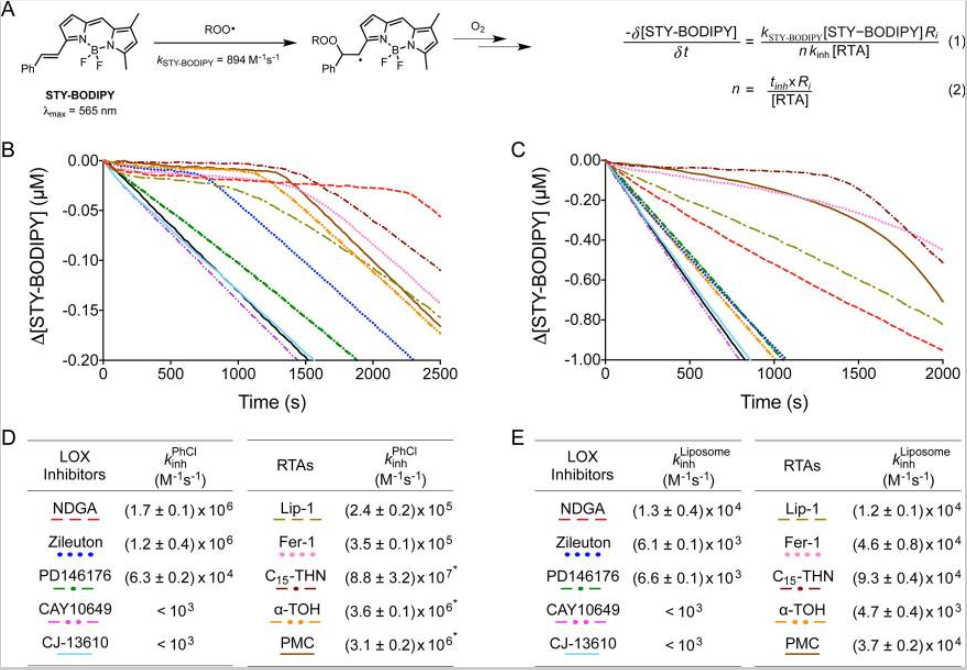
STY-BODIPY (A) serves as the signal carrier in inhibited autoxidations, enabling determination of inhibition rate constants (kinh) and stoichiometries (n) for reactions of inhibitors with chain-carrying peroxyl radicals (eqs 1 and 2, respectively). Coautoxidations of cumene (3.6 M) and STY-BODIPY (10 μM) initiated by AIBN (6 mM) in chlorobenzene at 37 °C (black) and inhibited by 2 μM of NDGA, zileuton, PD146176, CAY10649, CJ-13610, Lip-1, Fer-1, C15-THN, α-TOH, and PMC (B). Coautoxidations of egg phosphatidylcholine liposomes (1.0 mM) and STY-BODIPY (10 μM) suspended in phosphate-buffered saline (10 mM) at pH 7.4 initiated by MeOAMVN (0.2 mM) at 37 °C (black) and inhibited by 2 μM of NDGA, zileuton, PD146176, CAY10649, CJ-13610, Lip-1, Fer-1, C15-THN, α-TOH, and PMC (C). Inhibition rate constants obtained from coautoxidations of cumene (D) or phosphatidylcholine liposomes (E) with STY-BODIPY at 37 °C.
Precautions:
1) Fluorescent dyes all have quenching problems. Please avoid light as much as possible to slow down fluorescence quenching.
2) For your safety and health, please wear a lab coat and disposable gloves.
| Cas No. | 2383063-37-2 | SDF | |
| Synonyms | Styrene-BODIPY | ||
| Chemical Name | (T-4)-[2-[(3,5-dimethyl-2H-pyrrol-2-ylidene-κN)methyl]-5-[(1E)-2-phenylethenyl]-1H-pyrrolato-κN]difluoro-boron | ||
| Canonical SMILES | CC(C=C1C)=[N+](C1=C2)[B-](F)(F)N3C2=CC=C3/C=C/C4=CC=CC=C4 | ||
| Formula | C19H17BF2N2 | M.Wt | 322.2 |
| Solubility | Benzene: 1 mg/ml | Storage | Store at -20°C,protect from light |
| General tips | Please select the appropriate solvent to prepare the stock solution according to the
solubility of the product in different solvents; once the solution is prepared, please store it in
separate packages to avoid product failure caused by repeated freezing and thawing.Storage method
and period of the stock solution: When stored at -80°C, please use it within 6 months; when stored
at -20°C, please use it within 1 month. To increase solubility, heat the tube to 37°C and then oscillate in an ultrasonic bath for some time. |
||
| Shipping Condition | Evaluation sample solution: shipped with blue ice. All other sizes available: with RT, or with Blue Ice upon request. | ||
| Prepare stock solution | |||

|
1 mg | 5 mg | 10 mg |
| 1 mM | 3.1037 mL | 15.5183 mL | 31.0366 mL |
| 5 mM | 620.7 μL | 3.1037 mL | 6.2073 mL |
| 10 mM | 310.4 μL | 1.5518 mL | 3.1037 mL |
Step 1: Enter information below (Recommended: An additional animal making an allowance for loss during the experiment)
 g
μL
g
μL
Step 2: Enter the in vivo formulation (This is only the calculator, not formulation. Please contact us first if there is no in vivo formulation at the solubility Section.)
Calculation results:
Working concentration: mg/ml;
Method for preparing DMSO master liquid: mg drug pre-dissolved in μL DMSO ( Master liquid concentration mg/mL, Please contact us first if the concentration exceeds the DMSO solubility of the batch of drug. )
Method for preparing in vivo formulation: Take μL DMSO master liquid, next addμL PEG300, mix and clarify, next addμL Tween 80, mix and clarify, next add μL saline, mix and clarify.
Method for preparing in vivo formulation: Take μL DMSO master liquid, next add μL Corn oil, mix and clarify.
Note: 1. Please make sure the liquid is clear before adding the next solvent.
2. Be sure to add the solvent(s) in order. You must ensure that the solution obtained, in the previous addition, is a clear solution before proceeding to add the next solvent. Physical methods such as vortex, ultrasound or hot water bath can be used to aid dissolving.
3. All of the above co-solvents are available for purchase on the GlpBio website.
Quality Control & SDS
- View current batch:
- Purity: >98.00% Appearance: A solution in benzene
- COA (Certificate of Analysis)
- SDS (Safety Data Sheet)
- Datasheet
Average Rating: 5 (Based on Reviews and 19 reference(s) in Google Scholar.)