

HO-1-IN-1 hydrochloride |
Catalog No.GC34618
 One-Click Copy Product Info
|

Heme Oxygenase-1-IN-1 (Compound 2) hydrochloride is a heme oxygenase 1 (HO-1) inhibitor with an IC50 of 0.25 μM.
Products are for research use only. Not for human use. We do not sell to patients.
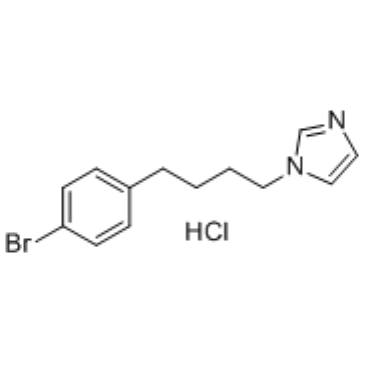
Cas No.: 1092851-70-1
Sample solution is provided at 25 µL, 10mM.
_1-3.$$$39978408@51.jpg');)
_1-9.$$$38538795@65.jpg');)
_1-9.$$$39112701@51.jpg');)
_1-7.$$$37316672@70.jpg');)
_366-372.$$$36198801@70.jpg');)
.$$$38565142@65.jpg');)
_1867-1883.$$$33248023@67.jpg');)
_eads6055.$$$39977546@45.jpg');)
_eadm9805.$$$40080571@45.jpg');)
_eadj3020.$$$39666821@45.jpg');)
_1-20.$$$39757301@28.jpg');)
_1-24.$$$38898113@28.jpg');)
_273-287.$$$36806353@46.jpg');)
_1-16.$$$37156877@44.jpg');)
_1-19.$$$37460805@44.jpg');)
_1291-1307.$$$34518654@46.jpg');)
HO-1-IN-1 hydrochloride is a heme oxygenase 1 (HO-1) inhibitor with an IC50 of 0.25μM[1]. HO-1 is an inducible enzyme that plays a key role in maintaining cellular redox balance and protecting cells from oxidative stress by catalyzing the degradation of heme to produce carbon monoxide, biliverdin, and free iron[2][3]. HO-1-IN-1 hydrochloride is usually used in studies related to oxidative stress, inflammatory responses, and apoptosis[4][5].
In vitro, HO-1-IN-1 hydrochloride (10μM; 4h) attenuated GRIM-19 deficiency-induced NF-κB activation and p65 nuclear translocation in GES-1 cells[6]. HO-1-IN-1 hydrochloride (5-10μM; 6h) significantly attenuated GRIM-19 deficiency-driven gastric cancer cell migration and invasion, and downregulated metastasis-associated gene expressions such as HIF-1α, COX-2, VEGF-A, VEGF-C, MMP-9, and BACH-1[7].
References:
[1] Floresta G, Pittalà V, Sorrenti V, Romeo G, Salerno L, Rescifina A. Development of new HO-1 inhibitors by a thorough scaffold-hopping analysis. Bioorg Chem. 2018;81:334-339.
[2] Consoli V, Sorrenti V, Grosso S, Vanella L. Heme Oxygenase-1 Signaling and Redox Homeostasis in Physiopathological Conditions. Biomolecules. 2021;11(4):589.
[3] Ryter SW. Heme oxygenase-1/carbon monoxide as modulators of autophagy and inflammation. Arch Biochem Biophys. 2019;678:108186.
[4] Lu JJ, Abudukeyoumu A, Zhang X, Liu LB, Li MQ, Xie F. Heme oxygenase 1: a novel oncogene in multiple gynecological cancers. Int J Biol Sci. 2021;17(9):2252-2261.
[5] Spampinato M, Sferrazzo G, Pittalà V, et al. Non-competitive heme oxygenase-1 activity inhibitor reduces non-small cell lung cancer glutathione content and regulates cell proliferation. Mol Biol Rep. 2020;47(3):1949-1964.
[6] Zeng X, Yang M, Ye T, et al. Mitochondrial GRIM-19 loss in parietal cells promotes spasmolytic polypeptide-expressing metaplasia through NLR family pyrin domain-containing 3 (NLRP3)-mediated IL-33 activation via a reactive oxygen species (ROS) -NRF2- Heme oxygenase-1(HO-1)-NF-кB axis. Free Radic Biol Med. 2023;202:46-61.
[7] Wang X, Ye T, Xue B, et al. Mitochondrial GRIM-19 deficiency facilitates gastric cancer metastasis through oncogenic ROS-NRF2-HO-1 axis via a NRF2-HO-1 loop. Gastric Cancer. 2021;24(1):117-132.
| Cell experiment [1]: | |
Cell lines | Human normal gastric epithelial GES-1 cells |
Preparation Method | Human normal gastric epithelial GES-1 cells were cultured in DMEM or RPMI 1640 supplemented with 10% fetal bovine serum, 100U/ml penicillin and 100μg/ml streptomycin at 37℃ in a humidified chamber containing 5% CO2. Recombinant CRISPR/Cas9 lentivirus harboring GRIM-19-specific small-guide RNA 134 target (sgRNA-134) and corresponding negative control (NC) with GFP reporter gene were constructed. GES-1 cells at 60% confluence were infected with a multiplicity of infection (MOI) at 30 and 50, respectively. The infected GFP+cells were sorted by flow cytometry and single-cell clones were screened and expanded in vitro. GRIM-19 expression was determined by western blotting and IF staining. GRIM-19-deficient GES-1 cells were treated with HO-1-IN-1 hydrochloride (10μM) for 4h. NF-кB transcriptional activation was analyzed by luciferase reporter assay, while p65, p-p65 and NF-кB downstream targets were detected by western blotting. |
Reaction Conditions | 10μM; 4h |
Applications | HO-1-IN-1 hydrochloride attenuated GRIM-19 deficiency-induced NF-κB activation and p65 nuclear translocation in GES-1 cells. |
References: | |
| Cas No. | 1092851-70-1 | SDF | |
| Canonical SMILES | BrC1=CC=C(CCCCN2C=CN=C2)C=C1.Cl | ||
| Formula | C13H16BrClN2 | M.Wt | 315.64 |
| Solubility | DMSO : 125 mg/mL (396.02 mM) | Storage | Store at -20°C |
| General tips | Please select the appropriate solvent to prepare the stock solution according to the
solubility of the product in different solvents; once the solution is prepared, please store it in
separate packages to avoid product failure caused by repeated freezing and thawing.Storage method
and period of the stock solution: When stored at -80°C, please use it within 6 months; when stored
at -20°C, please use it within 1 month. To increase solubility, heat the tube to 37°C and then oscillate in an ultrasonic bath for some time. |
||
| Shipping Condition | Evaluation sample solution: shipped with blue ice. All other sizes available: with RT, or with Blue Ice upon request. | ||
| Prepare stock solution | |||

|
1 mg | 5 mg | 10 mg |
| 1 mM | 3.1682 mL | 15.8408 mL | 31.6817 mL |
| 5 mM | 633.6 μL | 3.1682 mL | 6.3363 mL |
| 10 mM | 316.8 μL | 1.5841 mL | 3.1682 mL |
Step 1: Enter information below (Recommended: An additional animal making an allowance for loss during the experiment)
 g
μL
g
μL
Step 2: Enter the in vivo formulation (This is only the calculator, not formulation. Please contact us first if there is no in vivo formulation at the solubility Section.)
Calculation results:
Working concentration: mg/ml;
Method for preparing DMSO master liquid: mg drug pre-dissolved in μL DMSO ( Master liquid concentration mg/mL, Please contact us first if the concentration exceeds the DMSO solubility of the batch of drug. )
Method for preparing in vivo formulation: Take μL DMSO master liquid, next addμL PEG300, mix and clarify, next addμL Tween 80, mix and clarify, next add μL saline, mix and clarify.
Method for preparing in vivo formulation: Take μL DMSO master liquid, next add μL Corn oil, mix and clarify.
Note: 1. Please make sure the liquid is clear before adding the next solvent.
2. Be sure to add the solvent(s) in order. You must ensure that the solution obtained, in the previous addition, is a clear solution before proceeding to add the next solvent. Physical methods such as vortex, ultrasound or hot water bath can be used to aid dissolving.
3. All of the above co-solvents are available for purchase on the GlpBio website.
Quality Control & SDS
- View current batch:
- Purity: >99.00% Appearance: A solid
- COA (Certificate of Analysis)
- SDS (Safety Data Sheet)
- Datasheet
Average Rating: 5 (Based on Reviews and 10 reference(s) in Google Scholar.)