

HX 531 |
Catalog No.GC16814
 One-Click Copy Product Info
|

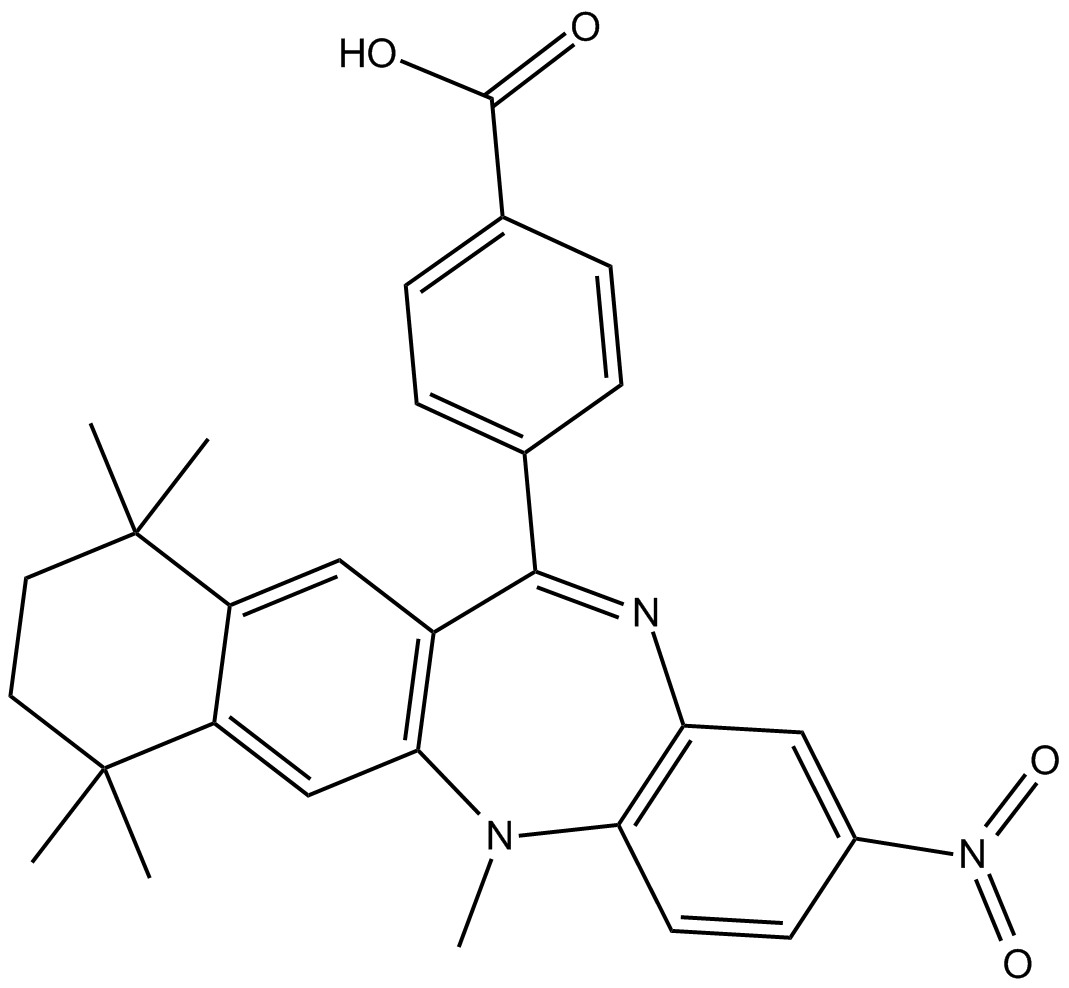
HX 531 is a potent retinoid X receptor (RXR) antagonist.
Products are for research use only. Not for human use. We do not sell to patients.
Cas No.: 188844-34-0
Sample solution is provided at 25 µL, 10mM.
_1-3.$$$39978408@51.jpg');)
_1-9.$$$38538795@65.jpg');)
_1-9.$$$39112701@51.jpg');)
_1-7.$$$37316672@70.jpg');)
_366-372.$$$36198801@70.jpg');)
.$$$38565142@65.jpg');)
_1867-1883.$$$33248023@67.jpg');)
_eads6055.$$$39977546@45.jpg');)
_eadm9805.$$$40080571@45.jpg');)
_eadj3020.$$$39666821@45.jpg');)
_1-20.$$$39757301@28.jpg');)
_1-24.$$$38898113@28.jpg');)
_273-287.$$$36806353@46.jpg');)
_1-16.$$$37156877@44.jpg');)
_1-19.$$$37460805@44.jpg');)
_1291-1307.$$$34518654@46.jpg');)
HX 531 is a potent retinoid X receptor (RXR) antagonist[1].
In vitro, Pre-treatment with HX 531 (2.5μM; 30min) attenuated the anti-apoptotic effect of all-trans retinoic acid (t-RA) in protecting mesangial cells from H₂O₂-induced apoptosis via the inhibition of the activator protein 1 (AP-1) pathway[2]. HX 531 (0.1μM; 45-60min) significantly inhibits Benzophenone-3 (BP-3)-induced neuronal apoptosis and partially reverses the effects of BP-3 on the expression of RXR receptors and epigenetic status[3].
In vivo, Wild-type mice treated with HX 531(2 weeks; p.o.) were protected from high-fat (HF) diet-induced hyperglycemia and insulin resistance[4]. The weight gain of OLETF rats treated with HX 531 (10mg/kg/day; 22 weeks; p.o.) was significantly suppressed, and the fat pad weight was significantly reduced, comparable to that of non-diabetic LETO rats[5].
References:
[1] Alique M, Lucio FJ, Herrero JF. Vitamin A active metabolite, all-trans retinoic acid, induces spinal cord sensitization. II. Effects after intrathecal administration. Br J Pharmacol. 2006 Sep;149(1):65-72.
[2] Konta T, Xu Q, Furusu A, et al. Selective roles of retinoic acid receptor and retinoid x receptor in the suppression of apoptosis by all-trans-retinoic acid. J Biol Chem. 2001 Apr 20;276(16):12697-701.
[3] Wnuk A, Rzemieniec J, Lasoń W, et al. Benzophenone-3 Impairs Autophagy, Alters Epigenetic Status, and Disrupts Retinoid X Receptor Signaling in Apoptotic Neuronal Cells. Mol Neurobiol. 2018 Jun;55(6):5059-5074.
[4] Yamauchi T, Waki H, Kamon J, et al. Inhibition of RXR and PPARgamma ameliorates diet-induced obesity and type 2 diabetes. J Clin Invest. 2001 Oct;108(7):1001-13.
[5] Nakatsuka A, Wada J, Hida K, et al. RXR antagonism induces G0 /G1 cell cycle arrest and ameliorates obesity by up-regulating the p53-p21(Cip1) pathway in adipocytes. J Pathol. 2012 Apr;226(5):784-95.
| Cell experiment [1]: | |
Cell lines | RBL-2H3 cells |
Preparation Method | Primary neuronal cell cultures were exposed to BP-3 (10-100μM) for 6 or 24h. The involvement of RXR signaling in BP-3-induced effects was verified with the high-affinity RXR antagonist HX 531 (0.1μM) and the RXR agonist DHA (1μM). Specific ligands were added to the culture media 45-60min before BP-3. Apoptotic cells were detected via Hoechst 33342 staining at 24h after treatment. Neocortical cells that were cultured on glass coverslips were washed with 10mM phosphate-buffered saline (PBS) and stained with Hoechst 33342 (0.6mg/ml) at room temperature (RT) for 5min. The cells containing bright blue fragmented nuclei, indicative of condensed chromatin, were identified as apoptotic cells. Qualitative analysis was performed using a fluorescence microscope. The level of cellular fluorescence from fluorescence microscopy images was determined using ImageJ software. |
Reaction Conditions | 0.1μM; 45-60min |
Applications | HX 531 significantly inhibits Benzophenone-3 (BP-3)-induced neuronal apoptosis and partially reverses the effects of BP-3 on the expression of RXR receptors and epigenetic status. |
| Animal experiment [2]: | |
Animal models | Eight-week-old male Otsuka Long–Evans Tokushima Fatty (OLETF) rats |
Preparation Method | Eight-week-old male Otsuka Long–Evans Tokushima Fatty (OLETF) rats, which serve as a model for obesity and type 2 diabetes, were divided into three groups: OLETF rats (OLETF group); OLETF rats treated with pioglitazone (PIO group); and OLETF rats treated with HX 531 (HX 531 group). Non-diabetic Long–Evans Tokushima Otsuka (LETO) rats were fed a chow diet and served as the control group (LETO group). Pioglitazone and HX 531 were mixed into the diet, and each group orally received 1mg pioglitazone/kg body weight/day and 10mg HX 531/kg body weight/day throughout the experimental period. After conducting the described studies, the rats were sacrificed at 30 weeks of age. |
Dosage form | 10mg/kg/day; 22 weeks; p.o. |
Applications | The weight gain of OLETF rats treated with HX 531 was significantly suppressed, and the fat pad weight was significantly reduced, comparable to that of non-diabetic LETO rats. |
References: | |
| Cas No. | 188844-34-0 | SDF | |
| Chemical Name | 4-(5,7,7,10,10-pentamethyl-2-nitro-7,8,9,10-tetrahydro-5H-benzo[b]naphtho[2,3-e][1,4]diazepin-12-yl)benzoic acid | ||
| Canonical SMILES | CC(CCC1(C)C)(C2=CC(C(C3=CC=C(C(O)=O)C=C3)=NC4=C(N5C)C=CC(N(=O)=O)=C4)=C5C=C21)C | ||
| Formula | C29H29N3O4 | M.Wt | 483.56 |
| Solubility | 0.12mg/mL in ethanol, 10mg/mL in DMSO, 15mg/mL in DMF | Storage | Store at -20°C |
| General tips | Please select the appropriate solvent to prepare the stock solution according to the
solubility of the product in different solvents; once the solution is prepared, please store it in
separate packages to avoid product failure caused by repeated freezing and thawing.Storage method
and period of the stock solution: When stored at -80°C, please use it within 6 months; when stored
at -20°C, please use it within 1 month. To increase solubility, heat the tube to 37°C and then oscillate in an ultrasonic bath for some time. |
||
| Shipping Condition | Evaluation sample solution: shipped with blue ice. All other sizes available: with RT, or with Blue Ice upon request. | ||
| Prepare stock solution | |||

|
1 mg | 5 mg | 10 mg |
| 1 mM | 2.068 mL | 10.34 mL | 20.68 mL |
| 5 mM | 413.6 μL | 2.068 mL | 4.136 mL |
| 10 mM | 206.8 μL | 1.034 mL | 2.068 mL |
Step 1: Enter information below (Recommended: An additional animal making an allowance for loss during the experiment)
 g
μL
g
μL
Step 2: Enter the in vivo formulation (This is only the calculator, not formulation. Please contact us first if there is no in vivo formulation at the solubility Section.)
Calculation results:
Working concentration: mg/ml;
Method for preparing DMSO master liquid: mg drug pre-dissolved in μL DMSO ( Master liquid concentration mg/mL, Please contact us first if the concentration exceeds the DMSO solubility of the batch of drug. )
Method for preparing in vivo formulation: Take μL DMSO master liquid, next addμL PEG300, mix and clarify, next addμL Tween 80, mix and clarify, next add μL saline, mix and clarify.
Method for preparing in vivo formulation: Take μL DMSO master liquid, next add μL Corn oil, mix and clarify.
Note: 1. Please make sure the liquid is clear before adding the next solvent.
2. Be sure to add the solvent(s) in order. You must ensure that the solution obtained, in the previous addition, is a clear solution before proceeding to add the next solvent. Physical methods such as vortex, ultrasound or hot water bath can be used to aid dissolving.
3. All of the above co-solvents are available for purchase on the GlpBio website.
Quality Control & SDS
- View current batch:
- Purity: >97.00% Appearance: A solid
- COA (Certificate of Analysis)
- SDS (Safety Data Sheet)
- Datasheet
Average Rating: 5 (Based on Reviews and 24 reference(s) in Google Scholar.)