

Itaconic acid |
Catalog No.GC12809
 One-Click Copy Product Info
|

Itaconic acid, an unsaturated dicarboxylic acid, can be synthesized by prokaryotes and fungi, and is also produced and secreted by aconitate decarboxylase1 (ACOD1, also known as IRG1) in mammalian macrophages during infections.
Products are for research use only. Not for human use. We do not sell to patients.
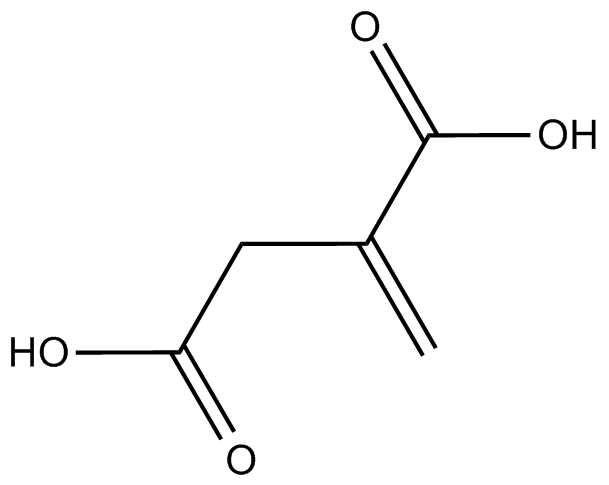
Cas No.: 97-65-4
Sample solution is provided at 25 µL, 10mM.
_1-3.$$$39978408@51.jpg');)
_1-9.$$$38538795@65.jpg');)
_1-9.$$$39112701@51.jpg');)
_1-7.$$$37316672@70.jpg');)
_366-372.$$$36198801@70.jpg');)
.$$$38565142@65.jpg');)
_1867-1883.$$$33248023@67.jpg');)
_eads6055.$$$39977546@45.jpg');)
_eadm9805.$$$40080571@45.jpg');)
_eadj3020.$$$39666821@45.jpg');)
_1-20.$$$39757301@28.jpg');)
_1-24.$$$38898113@28.jpg');)
_273-287.$$$36806353@46.jpg');)
_1-16.$$$37156877@44.jpg');)
_1-19.$$$37460805@44.jpg');)
_1291-1307.$$$34518654@46.jpg');)
Itaconic acid, an unsaturated dicarboxylic acid, can be synthesized by prokaryotes and fungi, and is also produced and secreted by aconitate decarboxylase1 (ACOD1, also known as IRG1) in mammalian macrophages during infections[1][2]. It is an endogenous antibacterial metabolite that reduces the production of pro-inflammatory cytokines through various mechanisms[3].
Itaconic acid (10mM, 24h) inhibit S. typhimurium replication in the macrophage[4]. Itaconic acid (4mM, 6-24h) activates autophagy through increased the expression of microtubule-associated protein 1 light chain 3 beta-II (MAP1LC3β-II) in PANC1 cells[5].
Itaconic acid (50mg/kg, once every other day, 2 weeks, i.p.) suppresses tumor growth in human pancreatic cancer cell line PANC1 mouse model[5].
References:
[1] Cordes T, Michelucci A, Hiller K. Itaconic acid: the surprising role of an industrial compound as a mammalian antimicrobial metabolite. Annual review of nutrition. 2015 Jul 17;35(1):451-73.
[2] Wu R, Chen F, Wang N, et al. ACOD1 in immunometabolism and disease. Cellular & molecular immunology. 2020 Aug;17(8):822-33.
[3] Mills EL, Ryan DG, Prag HA, et al. Itaconate is an anti-inflammatory metabolite that activates Nrf2 via alkylation of KEAP1. Nature. 2018 Apr 5;556(7699):113-7.
[4] Zhu X, Guo Y, Liu Z, et al. Itaconic acid exerts anti-inflammatory and antibacterial effects via promoting pentose phosphate pathway to produce ROS. Scientific reports. 2021 Sep 13;11(1):18173.
[5] Qu C, Dai E, Lai T, et al. Itaconic acid induces ferroptosis by activating ferritinophagy. Biochemical and biophysical research communications. 2021 Dec 17;583:56-62.
| Cell experiment [1]: | |
|
Cell lines |
Monocyte/macrophage-like cell line RAW264.7 and RAW264.7-IRG1KO |
|
Preparation Method |
Salmonella typhimurium strain 14028 (ATCC) was cultured aerobically at 37°C in Luria–Bertani (LB) broth overnight. Cultured bacteria were recovered by centrifuging at 10,000g for 30s, then washed twice and re-suspended in sterile PBS (pH7.2) with a suitable concentration. Salmonella typhimurium (~ 100:1) was added into medium of cultured cells (RAW264.7 and RAW264.7-IRG1KO). After 30min of co-culture, gentamicin was added at a final concentration of 100μg/mL to clear bacteria in medium. One hour later, medium was replaced with fresh medium containing 16μg/mL gentamicin and maintained with or without treatments (10mM Itaconic acid, 2.5mM N-acetyl-L-cysteine) for 24h. Then cells were collected, weighted, and lysed for 10min with TritonX-100 (0.1%). Cell lysates with bacteria were diluted with PBS into desired concentration and the bacteria number was determined by plate counts on solid LB culture medium. Six repeats were conducted for each of the treatment. |
|
Reaction Conditions |
10mM, 24h |
|
Applications |
Itaconic acid can inhibit S. typhimurium replication in the macrophage. |
| Animal experiment [2]: | |
|
Animal models |
Human pancreatic cancer cell line PANC1 mouse model |
|
Preparation Method |
To generate murine subcutaneous tumors, 5×10⁶ PANC1 cells in 100μl PBS were injected subcutaneously into the right of the dorsal midline in 6- to 8-week-old female athymic nude mice (n = 6 mice/group). After the tumor reached 60-80mm3 on day 7, the mice were randomly grouped and then given intraperitoneal injections with Itaconic acid (50mg/kg, once every other day) at day 7 for 2 weeks. |
|
Dosage form |
50mg/kg, once every other day, 2 weeks, i.p. |
|
Applications |
Itaconic acid suppresses tumor growth in pancreatic cancer mouse model. |
|
References: |
|
| Cas No. | 97-65-4 | SDF | |
| Chemical Name | 2-methylenesuccinic acid | ||
| Canonical SMILES | C=C(C(O)=O)CC(O)=O | ||
| Formula | C5H6O4 | M.Wt | 130.1 |
| Solubility | ≥ 13mg/mL in DMSO,30mg/mL in Water | Storage | Store at -20°C |
| General tips | Please select the appropriate solvent to prepare the stock solution according to the
solubility of the product in different solvents; once the solution is prepared, please store it in
separate packages to avoid product failure caused by repeated freezing and thawing.Storage method
and period of the stock solution: When stored at -80°C, please use it within 6 months; when stored
at -20°C, please use it within 1 month. To increase solubility, heat the tube to 37°C and then oscillate in an ultrasonic bath for some time. |
||
| Shipping Condition | Evaluation sample solution: shipped with blue ice. All other sizes available: with RT, or with Blue Ice upon request. | ||
| Prepare stock solution | |||

|
1 mg | 5 mg | 10 mg |
| 1 mM | 7.6864 mL | 38.432 mL | 76.864 mL |
| 5 mM | 1.5373 mL | 7.6864 mL | 15.3728 mL |
| 10 mM | 768.6 μL | 3.8432 mL | 7.6864 mL |
Step 1: Enter information below (Recommended: An additional animal making an allowance for loss during the experiment)
 g
μL
g
μL
Step 2: Enter the in vivo formulation (This is only the calculator, not formulation. Please contact us first if there is no in vivo formulation at the solubility Section.)
Calculation results:
Working concentration: mg/ml;
Method for preparing DMSO master liquid: mg drug pre-dissolved in μL DMSO ( Master liquid concentration mg/mL, Please contact us first if the concentration exceeds the DMSO solubility of the batch of drug. )
Method for preparing in vivo formulation: Take μL DMSO master liquid, next addμL PEG300, mix and clarify, next addμL Tween 80, mix and clarify, next add μL saline, mix and clarify.
Method for preparing in vivo formulation: Take μL DMSO master liquid, next add μL Corn oil, mix and clarify.
Note: 1. Please make sure the liquid is clear before adding the next solvent.
2. Be sure to add the solvent(s) in order. You must ensure that the solution obtained, in the previous addition, is a clear solution before proceeding to add the next solvent. Physical methods such as vortex, ultrasound or hot water bath can be used to aid dissolving.
3. All of the above co-solvents are available for purchase on the GlpBio website.
Quality Control & SDS
- View current batch:
- Purity: >98.00% Appearance: A solid
- COA (Certificate of Analysis)
- SDS (Safety Data Sheet)
- Datasheet
Average Rating: 5 (Based on Reviews and 18 reference(s) in Google Scholar.)