

IWP-2 (Synonyms: IWP 2) |
Catalog No.GC16454
 One-Click Copy Product Info
|

IWP-2 is a specific inhibitor of Porcupine enzyme in the Wnt signaling pathway, with an IC50 value of 27 nM.
Products are for research use only. Not for human use. We do not sell to patients.
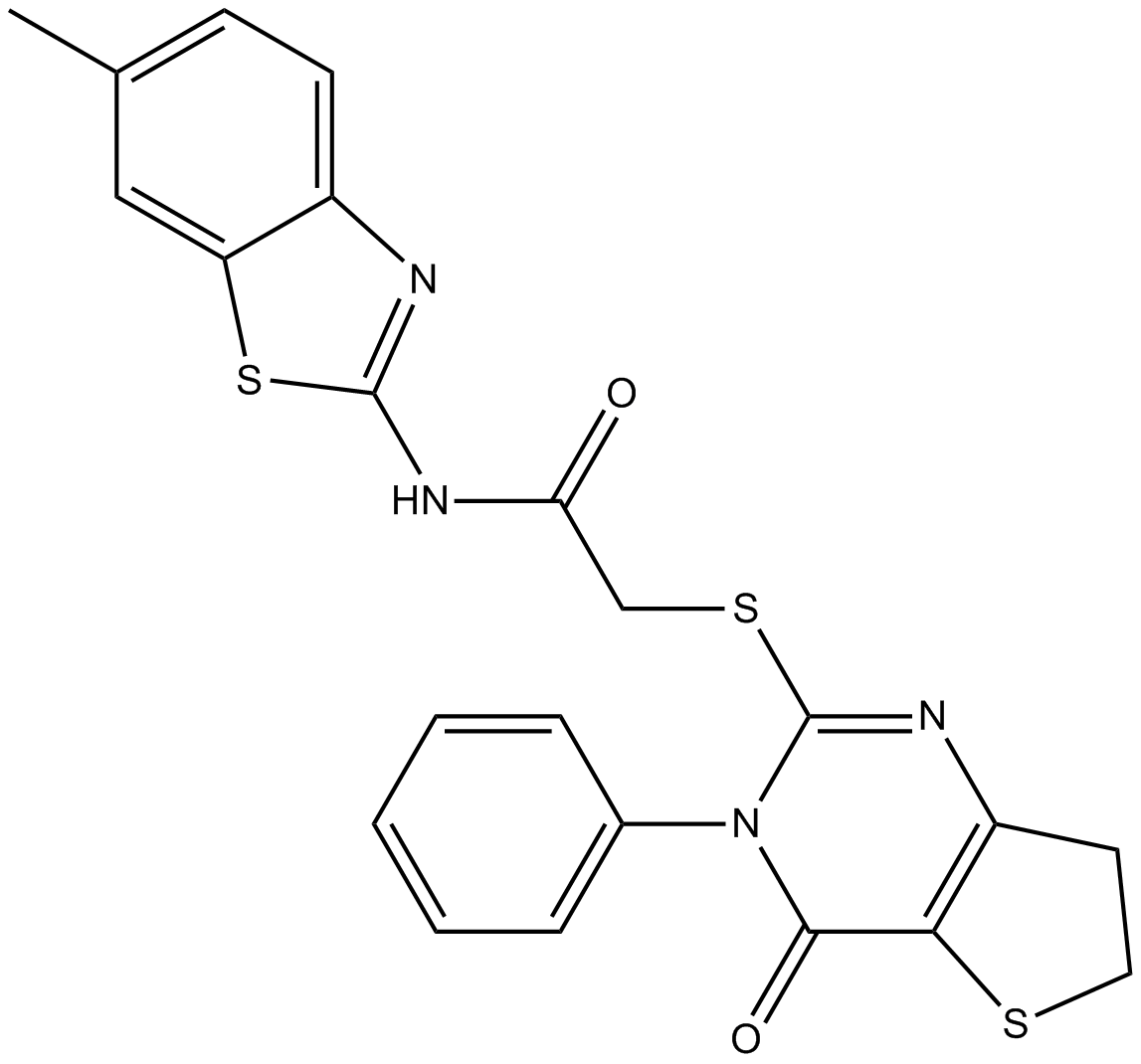
Cas No.: 686770-61-6
Sample solution is provided at 25 µL, 10mM.
IWP-2 is a specific inhibitor of Porcupine enzyme in the Wnt signaling pathway, with an IC50 value of 27 nM[1]. IWP-2 is also an ATP-competitive Casein Kinase 1δ (CK1δ) inhibitor, with an IC50 value of 40 nM for CK1δ[2]. In addition, the application of IWP-2 resulted in the inhibition of growth and proliferation of certain cancer cell lines, demonstrating its potential application value in exploring the relationship between Wnt signaling and tumor growth.
In vitro, IWP-2 inhibits the proliferation of A818-6, MiaPaCa2, Panc-1 and other cell lines at low doses, with EC50s of 8.96 µM, 1.90 µM, and 2.33 µM respectively. IWP-2 (2.33 µM) treatment for 48 hours reduced the activity of CK1δ in Panc1 cells[2]. IWP-2 (10-50 µM) treatment significantly inhibited the proliferation, migration, and invasion of MKN28 cells, and enhanced caspase 3/7 activity. IWP-2 treatment inhibits the transcriptional activity of the Wnt/β-catenin signaling pathway and down-regulates the expression levels of Wnt/β-catenin downstream target genes [3].
In vivo, microinjection of IWP-2 into the nucleus accumbens (NAc) dose-dependently blocks amphetamine (AMPH)-induced acquisition and expression of CPP in rats [4]. IWP-2 (60-180 µM, i.t.) dose-dependently inhibits remifentanil-induced activation of the wnt 3a/β-catenin signaling pathway and subsequently reverses the overexpression of c-fos, NR 2 B, and NF-κB [5].
References:
[1] Chen B, et al. Small molecule-mediated disruption of Wnt-dependent signaling in tissue regeneration and cancer. Nat Chem Biol. 2009 Feb;5(2):100-7.
[2] GarcÍa-Reyes B, et al. Discovery of Inhibitor of Wnt Production 2 (IWP-2) and Related Compounds As Selective ATP-Competitive Inhibitors of Casein Kinase 1 (CK1) δ/ε. J Med Chem. 2018 May 10;61(9):4087-4102.
[3] Mo M L, Li M R, Chen Z, et al. Inhibition of the Wnt palmitoyltransferase porcupine suppresses cell growth and downregulates the Wnt/β-catenin pathway in gastric cancer[J]. Oncology letters, 2013, 5(5): 1719-1723.
[4] Islam F , Xu K , Beninger R J. Inhibition of Wnt signalling dose-dependently impairs the acquisition and expression of amphetamine-induced conditioned place preference[J].Behavioural brain research, 2017, 326:217-225.
[5] Gao Y , Zhou S , Pan Y ,et al.Wnt3a Inhibitor Attenuates Remifentanil-Induced Hyperalgesia via Downregulating Spinal NMDA Receptor in Rats[J].Journal of Pain Research, 2020, Volume 13:1049-1058.
| Cell experiment [1]: | |
|
Cell lines |
MKN28 cells |
|
Preparation Method |
The cells were cultured in Dulbecco's modified Eagle's medium supplemented with 10% fetal bovine serum. Cells were cultured at 37°C in a humid incubator with 5% CO2. Wnt palmitoyltransferase inhibitor (IWP-2) was used 10-50µM to treat the cells. |
|
Reaction Conditions |
10-50 µM; 4 days |
|
Applications |
IWP-2 significantly suppressed the proliferation, migration and invasion, and elevated caspase 3/7 activity. IWP-2 treatment downregulated the transcriptional activity of the Wnt/β-catenin signaling pathway and downregulated the expression levels of downstream Wnt/β-catenin target genes in MKN28 cells. |
| Animal experiment [2]: | |
|
Animal models |
rats with RIH model |
|
Preparation Method |
Thirty rats were randomly divided into five groups (n = 6 in each group): group C (controlled group); group R (rats with RIH model); group iwplow (i.t. 60µM IWP-2), group iwpmedium (i.t. 120µM IWP-2) and group iwphigh (i.t. 180µM IWP-2). 10µL different doses of IWP-2 were injected using a microinjection syringe 30 min before RIH model establishment. An additional 20µL normal saline was administered to flush the catheter. |
|
Dosage form |
60µM, 120µM, 180µM; i.t. |
|
Applications |
IWP-2 dose-dependently inhibited remifentanil-induced activation of wnt3a/β-catenin signaling pathway and subsequently reverse overexpression of c-fos, NR2B and NF-κB (p < 0.001). |
|
References: [1] Mo M L, Li M R, Chen Z, et al. Inhibition of the Wnt palmitoyltransferase porcupine suppresses cell growth and downregulates the Wnt/β-catenin pathway in gastric cancer[J]. Oncology letters, 2013, 5(5): 1719-1723. |
|
| Cas No. | 686770-61-6 | SDF | |
| Synonyms | IWP 2 | ||
| Chemical Name | N-(6-methyl-1,3-benzothiazol-2-yl)-2-[(4-oxo-3-phenyl-6,7-dihydrothieno[3,2-d]pyrimidin-2-yl)sulfanyl]acetamide | ||
| Canonical SMILES | CC1=CC2=C(C=C1)N=C(S2)NC(=O)CSC3=NC4=C(C(=O)N3C5=CC=CC=C5)SCC4 | ||
| Formula | C22H18N4O2S3 | M.Wt | 466.6 |
| Solubility | ≥ 23.35 mg/mL in DMF with gentle warming | Storage | Store at -20°C |
| General tips | Please select the appropriate solvent to prepare the stock solution according to the
solubility of the product in different solvents; once the solution is prepared, please store it in
separate packages to avoid product failure caused by repeated freezing and thawing.Storage method
and period of the stock solution: When stored at -80°C, please use it within 6 months; when stored
at -20°C, please use it within 1 month. To increase solubility, heat the tube to 37°C and then oscillate in an ultrasonic bath for some time. |
||
| Shipping Condition | Evaluation sample solution: shipped with blue ice. All other sizes available: with RT, or with Blue Ice upon request. | ||
| Prepare stock solution | |||

|
1 mg | 5 mg | 10 mg |
| 1 mM | 2.1432 mL | 10.7158 mL | 21.4316 mL |
| 5 mM | 428.6 μL | 2.1432 mL | 4.2863 mL |
| 10 mM | 214.3 μL | 1.0716 mL | 2.1432 mL |
Step 1: Enter information below (Recommended: An additional animal making an allowance for loss during the experiment)
 g
μL
g
μL
Step 2: Enter the in vivo formulation (This is only the calculator, not formulation. Please contact us first if there is no in vivo formulation at the solubility Section.)
Calculation results:
Working concentration: mg/ml;
Method for preparing DMSO master liquid: mg drug pre-dissolved in μL DMSO ( Master liquid concentration mg/mL, Please contact us first if the concentration exceeds the DMSO solubility of the batch of drug. )
Method for preparing in vivo formulation: Take μL DMSO master liquid, next addμL PEG300, mix and clarify, next addμL Tween 80, mix and clarify, next add μL saline, mix and clarify.
Method for preparing in vivo formulation: Take μL DMSO master liquid, next add μL Corn oil, mix and clarify.
Note: 1. Please make sure the liquid is clear before adding the next solvent.
2. Be sure to add the solvent(s) in order. You must ensure that the solution obtained, in the previous addition, is a clear solution before proceeding to add the next solvent. Physical methods such as vortex, ultrasound or hot water bath can be used to aid dissolving.
3. All of the above co-solvents are available for purchase on the GlpBio website.
Quality Control & SDS
- View current batch:
- Purity: >98.00% Appearance: A solid
- COA (Certificate of Analysis)
- SDS (Safety Data Sheet)
- Datasheet
Average Rating: 5 (Based on Reviews and 30 reference(s) in Google Scholar.)