

Kartogenin |
Catalog No.GC15057
 One-Click Copy Product Info
|

Kartogenin is an inducer of cartilage-like tissue formation (EC50: 100nM)
Products are for research use only. Not for human use. We do not sell to patients.
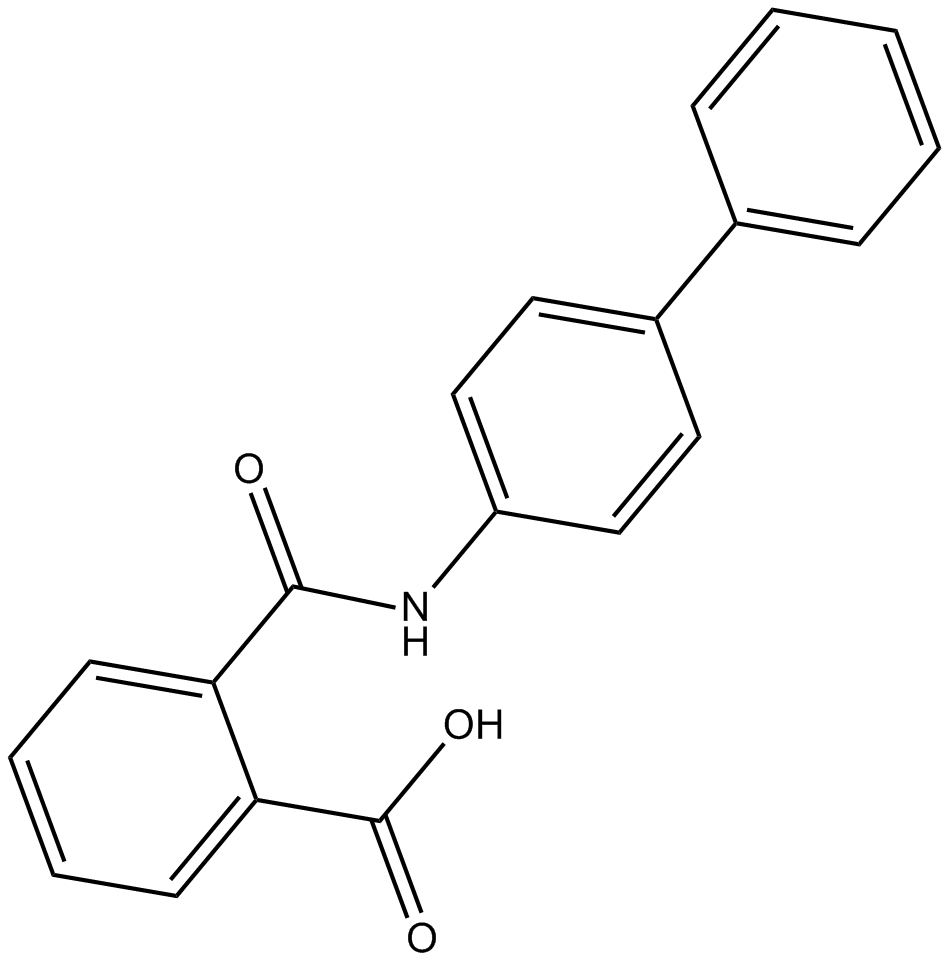
Cas No.: 4727-31-5
Sample solution is provided at 25 µL, 10mM.
_1-3.$$$39978408@51.jpg');)
_1-9.$$$38538795@65.jpg');)
_1-9.$$$39112701@51.jpg');)
_1-7.$$$37316672@70.jpg');)
_366-372.$$$36198801@70.jpg');)
.$$$38565142@65.jpg');)
_1867-1883.$$$33248023@67.jpg');)
_eads6055.$$$39977546@45.jpg');)
_eadm9805.$$$40080571@45.jpg');)
_eadj3020.$$$39666821@45.jpg');)
_1-20.$$$39757301@28.jpg');)
_1-24.$$$38898113@28.jpg');)
_273-287.$$$36806353@46.jpg');)
_1-16.$$$37156877@44.jpg');)
_1-19.$$$37460805@44.jpg');)
_1291-1307.$$$34518654@46.jpg');)
Kartogenin is an inducer of cartilage-like tissue formation (EC50: 100nM) [1]. Kartogenin activates chondrogenesis and promotes cartilage matrix synthesis by regulating signaling pathways such as filaminA/CBFβ/RUNX1, Ihh, and TGF-β/Smad [2-3]. Kartogenin is commonly used to treat osteoarthritis and tendon repair [4].
In rabbit bone marrow stromal cells (BMSCs), Kartogenin (1nM–5µM; 3d) enhances cell proliferation and induces chondrogenic differentiation of stem cells in a concentration-dependent manner [5]. In rat cartilage-derived chondrogenic stem/progenitor cells (CSPCs), Kartogenin (10µM; 7d) promotes the proliferation of cell [6].
In surgically induced osteoarthritis mouse model, Kartogenin (1μM, 100μM; intra-articular injection; 4 weeks) prevents cartilage degradation and alleviates osteoarthritis progression in mice via the miR-146a/NRF2 axis [7]. In monoiodoacetate-induced osteoarthritis mouse model, Kartogenin (100μM; intra-articular injection; 14d) inhibits pain behavior, chondrocyte inflammation, and attenuates osteoarthritis progression in mice through induction of IL-10 [8].
References:
[1]. Johnson K A. A stem cell-based approach to cartilage repair[J]. Osteoarthritis and Cartilage, 2013, 21: S4.
[2]. Cai J, Zhang L, Chen J, et al. Kartogenin and its application in regenerative medicine[J]. Current medical science, 2019, 39(1): 16-20.
[3]. Bhuyan S, Swain S, Misra R D K, et al. Nanomedicine-Driven Approaches for Kartogenin Delivery: Advancing Chondrogenic Differentiation and Cartilage Regeneration in Tissue Engineering[J]. International Journal of Nanomedicine, 2025: 7443-7468.
[4]. Im G I. Application of kartogenin for musculoskeletal regeneration[J]. Journal of Biomedical Materials Research Part A, 2018, 106(4): 1141-1148.
[5]. Zhang J, Wang J H C. Kartogenin induces cartilage-like tissue formation in tendon–bone junction[J]. Bone research, 2014, 2(1): 1-10.
[6]. Liu T, Li X, Wang T, et al. Kartogenin mediates cartilage regeneration by stimulating the IL-6/Stat3-dependent proliferation of cartilage stem/progenitor cells[J]. Biochemical and Biophysical Research Communications, 2020, 532(3): 385-392.
[7]. Hou M, Zhang Y, Zhou X, et al. Kartogenin prevents cartilage degradation and alleviates osteoarthritis progression in mice via the miR-146a/NRF2 axis[J]. Cell death & disease, 2021, 12(5): 483.
[8]. Kwon J Y, Lee S H, Na H S, et al. Kartogenin inhibits pain behavior, chondrocyte inflammation, and attenuates osteoarthritis progression in mice through induction of IL-10[J]. Scientific reports, 2018, 8(1): 13832.
| Cell experiment [1]: | |
Cell lines | Rabbit bone marrow stromal cells (BMSCs) |
Preparation Method | Rabbit BMSCs were seeded in 6-well plates at a density of 6×10⁴ per well and cultured for two weeks in growth medium with various concentrations (1nM–5µM) of Kartogenin. The medium was changed every 3 days and after 2 weeks, cell proliferation was measured by population doubling time (PDT), and cell differentiation was assessed by measuring the expression of chondrogenic markers (aggrecan, collagen type II and Sox-9) using quantitative RT-PCR (qRT-PCR), cytochemical and immunocytochemical staining for proteoglycans, collagen type II and osteocalcin. |
Reaction Conditions | 1nM–5µM; 3d |
Applications | Kartogenin enhances cell proliferation and induces chondrogenic differentiation of stem cells in a concentration-dependent manner. |
| Animal experiment [2]: | |
Animal models | Surgically induced osteoarthritis mouse model |
Preparation Method | A knee osteoarthritis (OA) model was established in six- to eight-week-old male C57BL/6J mice using DMM (medial meniscus instability transection) surgery. Mice were anesthetized with 2% isoflurane in 30% oxygen, and the medial meniscotibial ligament was transected using microscissors by the same surgeon. A sham surgery group was treated with joint capsule exposure but no ligamentous integrity was altered. Following surgery, intra-articular injections of 10μL of saline were administered to the control group, while 1μM or 100μM Kartogenin solutions (Kartogenin dissolved in DMSO and diluted in 0.9% saline) were administered to the experimental groups twice weekly. MiR-146a mimics were used simultaneously in some mice to further explore its protective effect on Kartogenin. |
Dosage form | 1μM, 100μM; intra-articular injection; 4 weeks |
Applications | Kartogenin prevents cartilage degradation and alleviates osteoarthritis progression in mice via the miR-146a/NRF2 axis. |
References: | |
| Cas No. | 4727-31-5 | SDF | |
| Chemical Name | 2-[(4-phenylphenyl)carbamoyl]benzoic acid | ||
| Canonical SMILES | O=C(C1=CC=CC=C1C(O)=O)NC2=CC=C(C=C2)C3=CC=CC=C3 | ||
| Formula | C20H15NO3 | M.Wt | 317.34 |
| Solubility | ≥ 10.6mg/mL in DMSO | Storage | Store at -20°C |
| General tips | Please select the appropriate solvent to prepare the stock solution according to the
solubility of the product in different solvents; once the solution is prepared, please store it in
separate packages to avoid product failure caused by repeated freezing and thawing.Storage method
and period of the stock solution: When stored at -80°C, please use it within 6 months; when stored
at -20°C, please use it within 1 month. To increase solubility, heat the tube to 37°C and then oscillate in an ultrasonic bath for some time. |
||
| Shipping Condition | Evaluation sample solution: shipped with blue ice. All other sizes available: with RT, or with Blue Ice upon request. | ||
| Prepare stock solution | |||

|
1 mg | 5 mg | 10 mg |
| 1 mM | 3.1512 mL | 15.756 mL | 31.5119 mL |
| 5 mM | 630.2 μL | 3.1512 mL | 6.3024 mL |
| 10 mM | 315.1 μL | 1.5756 mL | 3.1512 mL |
Step 1: Enter information below (Recommended: An additional animal making an allowance for loss during the experiment)
 g
μL
g
μL
Step 2: Enter the in vivo formulation (This is only the calculator, not formulation. Please contact us first if there is no in vivo formulation at the solubility Section.)
Calculation results:
Working concentration: mg/ml;
Method for preparing DMSO master liquid: mg drug pre-dissolved in μL DMSO ( Master liquid concentration mg/mL, Please contact us first if the concentration exceeds the DMSO solubility of the batch of drug. )
Method for preparing in vivo formulation: Take μL DMSO master liquid, next addμL PEG300, mix and clarify, next addμL Tween 80, mix and clarify, next add μL saline, mix and clarify.
Method for preparing in vivo formulation: Take μL DMSO master liquid, next add μL Corn oil, mix and clarify.
Note: 1. Please make sure the liquid is clear before adding the next solvent.
2. Be sure to add the solvent(s) in order. You must ensure that the solution obtained, in the previous addition, is a clear solution before proceeding to add the next solvent. Physical methods such as vortex, ultrasound or hot water bath can be used to aid dissolving.
3. All of the above co-solvents are available for purchase on the GlpBio website.
Quality Control & SDS
- View current batch:
- Purity: >98.00% Appearance: A solid
- COA (Certificate of Analysis)
- SDS (Safety Data Sheet)
- Datasheet
Average Rating: 5 (Based on Reviews and 3 reference(s) in Google Scholar.)