

Leupeptin, Microbial (Synonyms: Acetyl-L-leucyl-L-leucyl-L-argininal) |
Catalog No.GC10027
 One-Click Copy Product Info
|

Leupeptin, Microbial is broad-spectrum, membrane-permeable protease inhibitor that decreases protein degradation.
Products are for research use only. Not for human use. We do not sell to patients.
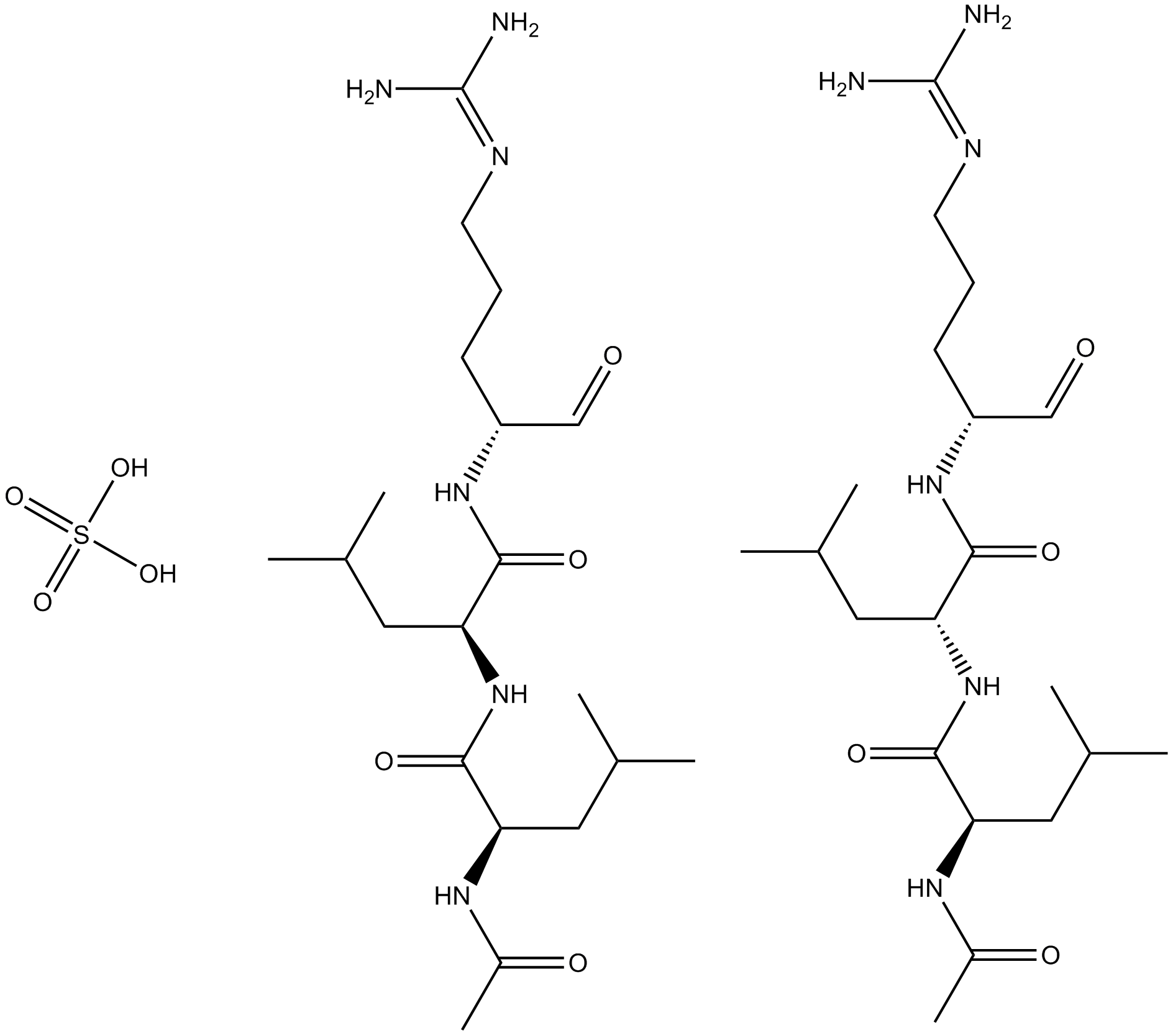
Cas No.: 103476-89-7
Sample solution is provided at 25 µL, 10mM.
Leupeptin, Microbial is broad-spectrum, membrane-permeable protease inhibitor that decreases protein degradation[1]. Leupeptin can reduce the ability of lysosomes to fuse by causing lysosomal constipation and neutralization/swelling [2]. Leupeptin has been widely used to promote accumulation of pigments in liver cells of rats [3].
In vitro, Leupeptin treatment for 48 hours significantly inhibited the replication of SARS-CoV-2 in Vero cells, with an EC50 value of 42.34μM[4]. Treatment with 100μM Leupeptin for 6 hours significantly increased the accumulation of Aβ1-42 in N9 cells[5]. Treatment with 200μM Leupeptin for 3.5 hours significantly inhibited the production of NO and reactive oxygen (ROS) in mouse peritoneal macrophages induced by lipopolysaccharide (LPS), and maintained mitochondrial homeostasis[6].
In vivo, Leupeptin treatment via a single intraperitoneal injection at the dose of 15mg/kg for 1 hour significantly increased the level of LC3-II in the liver of mice that had been fasting for 24 hours[7]. The intracerebroventricular infusion of 10mg/ml Leupeptin at a rate of 0.25μl/h was conducted for 2 weeks, which increased the number of apoptotic neurons in mice that express mutant presenilin 1 (PS) and mutant amyloid precursor protein (APP)[8].
References:
[1] Libby P, Goldberg A L. Leupeptin, a protease inhibitor, decreases protein degradation in normal and diseased muscles[J]. Science, 1978, 199(4328): 534-536.
[2] Kovács A L, Reith A, Seglen P O. Accumulation of autophagosomes after inhibition of hepatocytic protein degradation by vinblastine, leupeptin or a lysosomotropic amine[J]. Experimental cell research, 1982, 137(1): 191-201.
[3] Ivy G O, Kanai S, Ohta M, et al. Leupeptin causes an accumulation of lipofuscin-like substances in liver cells of young rats[J]. Mechanisms of ageing and development, 1991, 57(3): 213-231.
[4] Fu L, Shao S, Feng Y, et al. Mechanism of microbial metabolite leupeptin in the treatment of COVID-19 by traditional Chinese medicine herbs[J]. MBio, 2021, 12(5): 10.1128/mbio. 02220-21.
[5] Chu T, Tran T, Yang F, et al. Effect of chloroquine and leupeptin on intracellular accumulation of amyloid-beta (Aβ) 1–42 peptide in a murine N9 microglial cell line[J]. FEBS letters, 1998, 436(3): 439-444.
[6] Sharma A, Khan M A, Tirpude N V. Leupeptin maintains redox homeostasis via targeting ROS-autophagy-inflammatory axis in LPS-stimulated macrophages and cytokines dichotomy in Con-A challenged lymphocyte[J]. Peptides, 2023, 168: 171066.
[7] Ezaki J, Matsumoto N, Takeda-Ezaki M, et al. Liver autophagy contributes to the maintenance of blood glucose and amino acid levels[J]. Autophagy, 2011, 7(7): 727-736.
[8] Yang D S, Kumar A, Stavrides P, et al. Neuronal apoptosis and autophagy cross talk in aging PS/APP mice, a model of Alzheimer's disease[J]. The American journal of pathology, 2008, 173(3): 665-681.
| Cell experiment [1]: | |
Cell lines | Mouse peritoneal macrophages |
Preparation Method | Mouse peritoneal macrophages were cultured in RPMI-1640 medium supplemented with 10% fetal bovine serum (FBS), and 1% antimycotic-antibiotic at 37°C in 5% CO2/atmosphere. Cells were seeded at a density of 0.35×10⁶ cells/ml in the 6-well plates and allowed to adhere in a 5% CO2 incubator at 37°C for 24h. Cells were treated with different concentrations of Leupeptin (0, 50, 100 and 200µM) for 3.5h and subsequently challenged with LPS (1.5µg/ml) for 16h at 37°C in a CO2 incubator. NO production and intracellular ROS were measured. |
Reaction Conditions | 0, 50, 100 and 200µM; 3.5h |
Applications | Leupeptin treatment reduced NO and ROS production within mouse peritoneal macrophages in a dose-dependent manner. |
| Animal experiment [2]: | |
Animal models | Transgenic PS/APP mice |
Preparation Method | Transgenic PS/APP mice were housed under controlled temperature (21-23°C), humidity (30-35%) and light cycle (7:00 AM to 7:00 PM) and maintained on a standard rodent diet. Leupeptin (10mg/ml in HEPES) or HEPES was infused into the lateral ventricle (i.c.v.) of 6-month-old PS/APP mice for a period of 2 weeks using an osmotic pump (0.25μl/h delivery rate). The brains were removed from the mice for analysis. |
Dosage form | 10mg/ml; 0.25μl/h; 2 weeks; i.c.v. |
Applications | Leupeptin treatment increased the number of apoptotic neurons in PS/APP mice. |
References: | |
| Cas No. | 103476-89-7 | SDF | |
| Synonyms | Acetyl-L-leucyl-L-leucyl-L-argininal | ||
| Chemical Name | 2-acetamido-N-(1-((5-((diaminomethylene)amino)-1-oxopentan-2-yl)amino)-4-methyl-1-oxopentan-2-yl)-4-methylpentanamide | ||
| Canonical SMILES | O=C(C(C([H])([H])C(C([H])([H])[H])([H])C([H])([H])[H])([H])N([H])C(C([H])([H])[H])=O)N([H])C(C(N([H])C(C([H])=O)([H])C([H])([H])C([H])([H])C([H])([H])/N=C(N([H])[H])/N([H])[H])=O)([H])C([H])([H])C(C([H])([H])[H])([H])C([H])([H])[H] | ||
| Formula | C20H38N6O4.1/2H2SO4 | M.Wt | 493.6 |
| Solubility | ≥ 24.7mg/mL in DMSO, ≥ 20mg/mL in Water | Storage | Store at -20°C |
| General tips | Please select the appropriate solvent to prepare the stock solution according to the
solubility of the product in different solvents; once the solution is prepared, please store it in
separate packages to avoid product failure caused by repeated freezing and thawing.Storage method
and period of the stock solution: When stored at -80°C, please use it within 6 months; when stored
at -20°C, please use it within 1 month. To increase solubility, heat the tube to 37°C and then oscillate in an ultrasonic bath for some time. |
||
| Shipping Condition | Evaluation sample solution: shipped with blue ice. All other sizes available: with RT, or with Blue Ice upon request. | ||
| Prepare stock solution | |||

|
1 mg | 5 mg | 10 mg |
| 1 mM | 2.0259 mL | 10.1297 mL | 20.2593 mL |
| 5 mM | 405.2 μL | 2.0259 mL | 4.0519 mL |
| 10 mM | 202.6 μL | 1.013 mL | 2.0259 mL |
Step 1: Enter information below (Recommended: An additional animal making an allowance for loss during the experiment)
 g
μL
g
μL
Step 2: Enter the in vivo formulation (This is only the calculator, not formulation. Please contact us first if there is no in vivo formulation at the solubility Section.)
Calculation results:
Working concentration: mg/ml;
Method for preparing DMSO master liquid: mg drug pre-dissolved in μL DMSO ( Master liquid concentration mg/mL, Please contact us first if the concentration exceeds the DMSO solubility of the batch of drug. )
Method for preparing in vivo formulation: Take μL DMSO master liquid, next addμL PEG300, mix and clarify, next addμL Tween 80, mix and clarify, next add μL saline, mix and clarify.
Method for preparing in vivo formulation: Take μL DMSO master liquid, next add μL Corn oil, mix and clarify.
Note: 1. Please make sure the liquid is clear before adding the next solvent.
2. Be sure to add the solvent(s) in order. You must ensure that the solution obtained, in the previous addition, is a clear solution before proceeding to add the next solvent. Physical methods such as vortex, ultrasound or hot water bath can be used to aid dissolving.
3. All of the above co-solvents are available for purchase on the GlpBio website.
Quality Control & SDS
- View current batch:
- Purity: >98.00% Appearance: A solid
- COA (Certificate of Analysis)
- SDS (Safety Data Sheet)
- Datasheet
Average Rating: 5 (Based on Reviews and 30 reference(s) in Google Scholar.)