

Lixisenatide |
Catalog No.GC31334
 One-Click Copy Product Info
|

Lixisenatide is a glucagon-like peptide-1 receptor (GLP-1 receptor) agonist that can be used for the treatment of type 2 diabetes.
Products are for research use only. Not for human use. We do not sell to patients.
Cas No.: 320367-13-3
Sample solution is provided at 25 µL, 10mM.
_1-3.$$$39978408@51.jpg');)
_1-9.$$$38538795@65.jpg');)
_1-9.$$$39112701@51.jpg');)
_1-7.$$$37316672@70.jpg');)
_366-372.$$$36198801@70.jpg');)
.$$$38565142@65.jpg');)
_1867-1883.$$$33248023@67.jpg');)
_eads6055.$$$39977546@45.jpg');)
_eadm9805.$$$40080571@45.jpg');)
_eadj3020.$$$39666821@45.jpg');)
_1-20.$$$39757301@28.jpg');)
_1-24.$$$38898113@28.jpg');)
_273-287.$$$36806353@46.jpg');)
_1-16.$$$37156877@44.jpg');)
_1-19.$$$37460805@44.jpg');)
_1291-1307.$$$34518654@46.jpg');)
Lixisenatide is a glucagon-like peptide-1 receptor (GLP-1 receptor) agonist that can be used for the treatment of type 2 diabetes[1]. Lixisenatide enhances insulin secretion in a glucose-dependent manner, inhibits glucagon release, and delays gastric emptying to reduce food intake, thereby exerting hypoglycemic and weight-loss-promoting effects[2]. Lixisenatide can also inhibit inflammatory responses by downregulating pro-inflammatory cytokines and blocking cellular signaling pathways[3]. Lixisenatide can slow the progression of motor disorders in early Parkinson's disease patients[4].
In vitro, pretreatment of human umbilical vein endothelial cells (HUVECs) with Lixisenatide (5-20nM) for 6 hours, followed by oxygen-glucose deprivation/reperfusion (OGD/R) to simulate ischemia-reperfusion injury, significantly improved cell viability, inhibited the accumulation of reactive oxygen species (ROS), and alleviated the impairment of endothelial cell tube formation ability induced by OGD/R. Lixisenatide also enhanced eNOS phosphorylation and nitric oxide (NO) production by activating the PI3K/Akt pathway[5]. Pretreatment of HEK-293 cells stably expressing GFP-labeled α-synuclein A53T (α-Syn-HEK-293 cells) and SH-SY5Y cells with Lixisenatide (10-20nM) for 6 hours, followed by stimulation with α-synuclein preformed fibrils (α-Syn PFFs, 3μg/mL) for 48 hours, significantly inhibited the phosphorylation (pS129) and aggregation of α-synuclein, reduced cell apoptosis and mitochondrial dysfunction, and improved cell viability[6].
In vivo, continuous treatment of high-fat diet-induced obese insulin-resistant mice with Lixisenatide (50nmol/kg; subcutaneous injection twice daily) for 40 days significantly improved insulin sensitivity in the mice, enhanced glucose tolerance and insulin secretion, and significantly improved the mice's novel object recognition memory ability[7]. Treatment of rats that had experienced transient ischemia-reperfusion injury with Lixisenatide (10μg/kg/day; subcutaneous injection) for 10 weeks improved left ventricular end-diastolic pressure and relaxation time and prevented pulmonary congestion[8].
References:
[1] Nauck MA, Quast DR, Wefers J, et al. GLP-1 receptor agonists in the treatment of type 2 diabetes - state-of-the-art. Mol Metab. 2021 Apr;46:101102.
[2] Baker DE, Levien TL. Lixisenatide. Hosp Pharm. 2017 Jan;52(1):65-80.
[3] Pfeffer MA, Claggett B, Diaz R, et al. Lixisenatide in Patients with Type 2 Diabetes and Acute Coronary Syndrome. N Engl J Med. 2015 Dec 3;373(23):2247-57.
[4] Meissner WG, Remy P, Giordana C, et al. LIXIPARK Study Group. Trial of Lixisenatide in Early Parkinson's Disease. N Engl J Med. 2024 Apr 4;390(13):1176-1185.
[5] Xiao M, Lu D, Tian J, et al. The protective effects of GLP-1 receptor agonist lixisenatide on oxygen-glucose deprivation/reperfusion (OGD/R)-induced deregulation of endothelial tube formation. RSC Adv. 2020 Mar 10;10(17):10245-10253.
[6] Xu L, Chen G, Zhang L, et al. Lixisenatide ameliorated lipopolysaccharide (LPS)-induced expression of mucin and inflammation in bronchial epithelial cells. J Biochem Mol Toxicol. 2024 Jan;38(1):e23618.
[7] Lennox R, Flatt PR, Gault VA. Lixisenatide improves recognition memory and exerts neuroprotective actions in high-fat fed mice. Peptides. 2014 Nov;61:38-47.
[8] Wohlfart P, Linz W, Hübschle T, et al. Cardioprotective effects of lixisenatide in rat myocardial ischemia-reperfusion injury studies. J Transl Med. 2013 Mar 28;11:84. doi: 10.1186/1479-5876-11-84.
| Cell experiment [1]: | |
Cell lines | HUVECs (Human Umbilical Vein Endothelial Cells) |
Preparation Method | HUVECs were maintained in EGM-2 medium supplemented with 2% fetal bovine serum (FBS) at 37°C, 5% CO₂. For pretreatment, HUVECs were treated with Lixisenatide (5, 10, 20nM) for 6 hours prior to Oxygen-Glucose Deprivation/Reperfusion (OGD/R) injury. OGD/R was induced by transferring cells to glucose-free medium and placing them in an anaerobic chamber (95% N₂/5% CO₂) for 6 hours, followed by reperfusion with complete medium for 24 hours. |
Reaction Conditions | 5-20mM; 6h pretreatment |
Applications | Lixisenatide pretreatment significantly protected HUVECs from OGD/R-induced cytotoxicity and improved cell viability. Lixisenatide ameliorated OGD/R-induced ROS accumulation and restored impaired endothelial tube formation. |
| Animal experiment [2]: | |
Animal models | High-fat fed Swiss NIH mice |
Preparation Method | Mice were fed a high-fat diet (45% fat) for 4 months to establish obesity, insulin resistance and impaired cognition. Animals then received twice-daily subcutaneous injections of Lixisenatide (50nmol/kg) or saline vehicle for 40 days. |
Dosage form | 50nmol/kg; s.c. |
Applications | Lixisenatide treatment significantly improved recognition memory during novel object recognition tasks, enhanced hippocampal progenitor cell proliferation, increased immature neuron numbers. Lixisenatide improved glycemic control, insulin sensitivity, and pancreatic insulin content without affecting body weight or food intake. |
References: | |
| Cas No. | 320367-13-3 | SDF | |
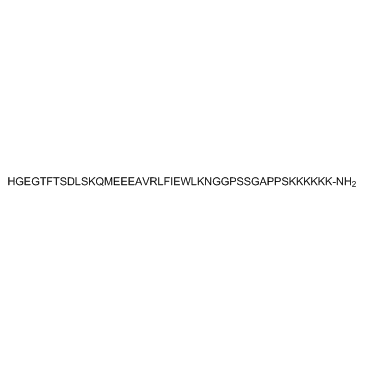
| Canonical SMILES | His-Gly-Glu-Gly-Thr-Phe-Thr-Ser-Asp-Leu-Ser-Lys-Gln-Met-Glu-Glu-Glu-Ala-Val-Arg-Leu-Phe-Ile-Glu-Trp-Leu-Lys-Asn-Gly-Gly-Pro-Ser-Ser-Gly-Ala-Pro-Pro-Ser-Lys-Lys-Lys-Lys-Lys-Lys-NH2 | ||
| Formula | C215H347N61O65S | M.Wt | 4858.49 |
| Solubility | Water : 106 mg/mL (21.82 mM) | Storage | Store at -20°C |
| General tips | Please select the appropriate solvent to prepare the stock solution according to the
solubility of the product in different solvents; once the solution is prepared, please store it in
separate packages to avoid product failure caused by repeated freezing and thawing.Storage method
and period of the stock solution: When stored at -80°C, please use it within 6 months; when stored
at -20°C, please use it within 1 month. To increase solubility, heat the tube to 37°C and then oscillate in an ultrasonic bath for some time. |
||
| Shipping Condition | Evaluation sample solution: shipped with blue ice. All other sizes available: with RT, or with Blue Ice upon request. | ||
| Prepare stock solution | |||

|
1 mg | 5 mg | 10 mg |
| 1 mM | 205.8 μL | 1.0291 mL | 2.0583 mL |
| 5 mM | 41.2 μL | 205.8 μL | 411.7 μL |
| 10 mM | 20.6 μL | 102.9 μL | 205.8 μL |
Step 1: Enter information below (Recommended: An additional animal making an allowance for loss during the experiment)
 g
μL
g
μL
Step 2: Enter the in vivo formulation (This is only the calculator, not formulation. Please contact us first if there is no in vivo formulation at the solubility Section.)
Calculation results:
Working concentration: mg/ml;
Method for preparing DMSO master liquid: mg drug pre-dissolved in μL DMSO ( Master liquid concentration mg/mL, Please contact us first if the concentration exceeds the DMSO solubility of the batch of drug. )
Method for preparing in vivo formulation: Take μL DMSO master liquid, next addμL PEG300, mix and clarify, next addμL Tween 80, mix and clarify, next add μL saline, mix and clarify.
Method for preparing in vivo formulation: Take μL DMSO master liquid, next add μL Corn oil, mix and clarify.
Note: 1. Please make sure the liquid is clear before adding the next solvent.
2. Be sure to add the solvent(s) in order. You must ensure that the solution obtained, in the previous addition, is a clear solution before proceeding to add the next solvent. Physical methods such as vortex, ultrasound or hot water bath can be used to aid dissolving.
3. All of the above co-solvents are available for purchase on the GlpBio website.
Quality Control & SDS
- View current batch:
- Purity: >98.00% Appearance: A solid
- COA (Certificate of Analysis)
- SDS (Safety Data Sheet)
- Datasheet
Average Rating: 5 (Based on Reviews and 8 reference(s) in Google Scholar.)