

Lysophosphatidylcholines (Synonyms: Lyso-Lecithins (egg)) |
Catalog No.GC18241
 One-Click Copy Product Info
|

Lysophosphatidylcholines is an important class of phospholipid molecules, which are the products of phosphatidylcholine hydrolysis by phospholipase A2.
Products are for research use only. Not for human use. We do not sell to patients.
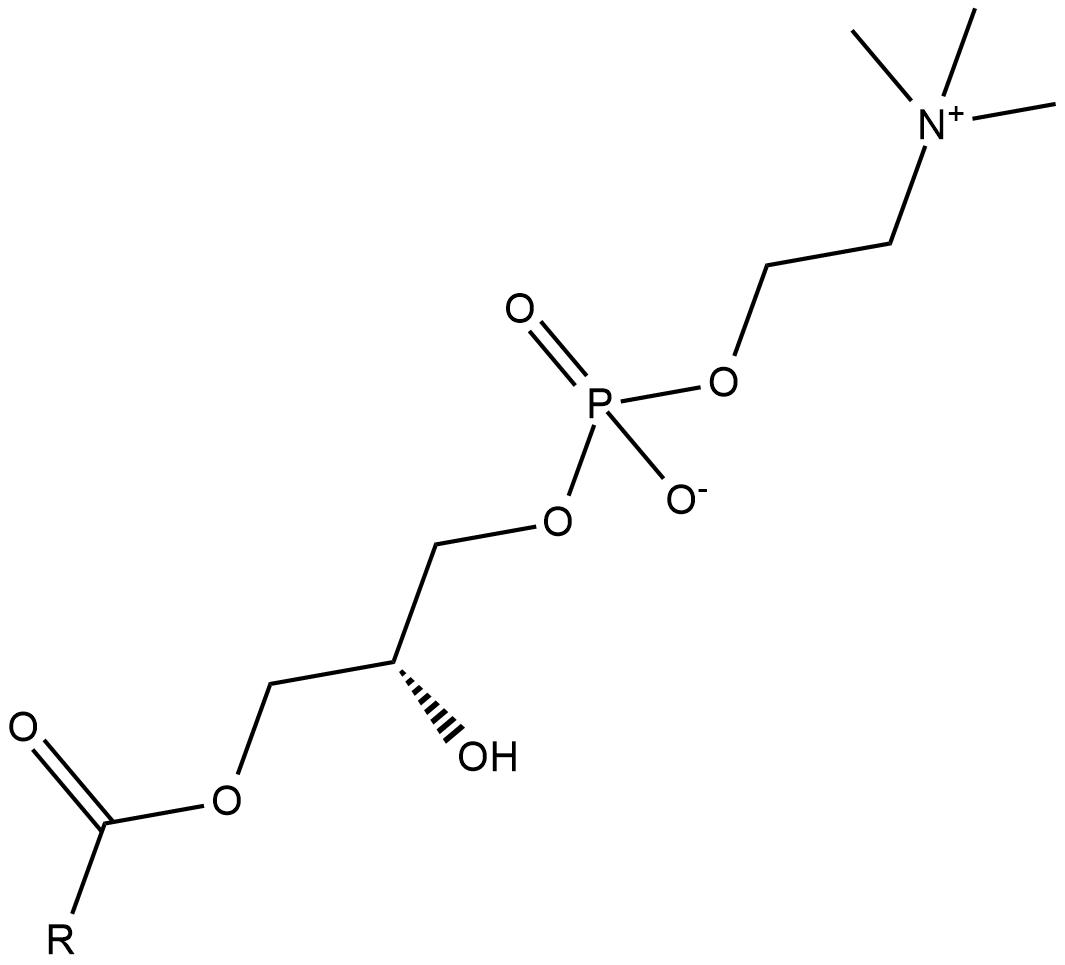
Cas No.: 9008-30-4
Sample solution is provided at 25 µL, 10mM.
Lysophosphatidylcholines is an important class of phospholipid molecules, which are the products of phosphatidylcholine hydrolysis by phospholipase A2 [1]. Lysophosphatidylcholines participate in regulating the recruitment and activation of immune cells by activating G protein-coupled receptors and regulating leukocyte chemotaxis [2-3]. Lysophosphatidylcholines are commonly used to treat inflammatory-related diseases [4].
In human fibroblasts, the decreased membrane stability by Lysophosphatidylcholines (6μM, 7μM; 0-6h) leads to increased 14C release, which in turn causes changes in cell morphology [5]. In human umbilical vein endothelial cells, Lysophosphatidylcholines (25-100μM; 0-48h) induces apoptosis in human endothelial cells through a p38-MAPK-dependent pathway [6]. In AR42J cells, Lysophosphatidylcholine (0.1-100μM; 25h) induces cell apoptosis [7].
In sepsis mice models, Lysophosphatidylcholines (5mg/kg; ip; 10d) treatment significantly enhanced the clearance of intraperitoneal bacteria and blocked cecal ligation and puncture-induced neutrophil inactivation [8]. In ICR mice, blood glucose levels in mice decreased in a dose-dependent manner after Lysophosphatidylcholines (15μmol/kg, 30μmol/kg; iv; single injection) administration [9].
References:
[1]. Law S H, Chan M L, Marathe G K, et al. An updated review of lysophosphatidylcholine metabolism in human diseases[J]. International journal of molecular sciences, 2019, 20(5): 1149.
[2]. Yang L V, Radu C G, Wang L, et al. Gi-independent macrophage chemotaxis to lysophosphatidylcholine via the immunoregulatory GPCR G2A[J]. Blood, 2005, 105(3): 1127-1134.
[3]. Kabarowski J H. G2A and LPC: regulatory functions in immunity[J]. Prostaglandins & other lipid mediators, 2009, 89(3-4): 73-81.
[4]. Akram W, Rihan M, Ahmed S, et al. Marine-derived compounds applied in cardiovascular diseases: submerged medicinal industry[J]. Marine drugs, 2023, 21(3): 193.
[5]. Colles S M, Chisolm G M. Lysophosphatidylcholine-induced cellular injury in cultured fibroblasts involves oxidative events[J]. Journal of lipid research, 2000, 41(8): 1188-1198.
[6]. Takahashi M, Okazaki H, Ogata Y, et al. Lysophosphatidylcholine induces apoptosis in human endothelial cells through a p38-mitogen-activated protein kinase-dependent mechanism[J]. Atherosclerosis, 2002, 161(2): 387-394.
[7]. Masamune A, Sakai Y, Satoh A, et al. Lysophosphatidylcholine induces apoptosis in AR42J cells[J]. Pancreas, 2001, 22(1): 75-83.
[8]. Yan J J, Jung J S, Lee J E, et al. Therapeutic effects of lysophosphatidylcholine in experimental sepsis[J]. Nature medicine, 2004, 10(2): 161-167.
[9]. Yea K, Kim J, Yoon J H, et al. Lysophosphatidylcholine activates adipocyte glucose uptake and lowers blood glucose levels in murine models of diabetes[J]. Journal of Biological Chemistry, 2009, 284(49): 33833-33840.
| Cell experiment [1]: | |
|
Cell lines |
Human fibroblasts |
|
Preparation Method |
Cells were incubated with Lysophosphatidylcholines (lysoPC) at different concentrations and times as indicated. The specific percentage release of 14C was defined as the 14C release in response to lysoPC minus the basal 14C release (from untreated cells) divided by the total possible 14C release (obtained with 0.5% Triton X-100) minus the basal release. Pretreatment with antioxidants was started 24 hours before the addition of lysoPC and then removed. Cells were washed with DMEM-F12 to minimize non-cellular interactions between antioxidants and lysoPC. |
|
Reaction Conditions |
6μM, 7μM; 0-6h |
|
Applications |
The decreased membrane stability by Lysophosphatidylcholines leads to increased 14C release, which in turn causes changes in cell morphology. |
| Animal experiment [2]: | |
|
Animal models |
Sepsis mice models |
|
Preparation Method |
Mice were anesthetized with pentobarbital (50mg/kg, i.p.), a small abdominal midline incision was made, and the cecum was exposed. The cecum was mobilized and ligated below the ileocecal valve, punctured through both surfaces twice or once (for less severe cecal ligation and puncture) with a 22-gauge needle, and the abdomen was closed. Mice subjected to sham cecal ligation and puncture underwent the same procedure, except for ligation and puncture of the cecum. For other sepsis models, mice were injected i.p. with either a bacterial suspension containing 108 live E. coli cells or Lysophosphatidylcholines (5mg/kg). |
|
Dosage form |
5mg/kg; ip; 10d |
|
Applications |
In vivo Lysophosphatidylcholines treatment significantly enhanced the clearance of intraperitoneal bacteria and blocked CLP-induced neutrophil inactivation. |
|
References: |
|
| Cas No. | 9008-30-4 | SDF | |
| Synonyms | Lyso-Lecithins (egg) | ||
| Canonical SMILES | O[C@@H](COP(OCC[N+](C)(C)C)([O-])=O)COC([R])=O | ||
| Formula | C24H50NO7P (for palmitoyl) | M.Wt | 495.6 |
| Solubility | Soluble in 2:1 solution of Chloroform : Methanol | Storage | Store at -20°C, protect from light |
| General tips | Please select the appropriate solvent to prepare the stock solution according to the
solubility of the product in different solvents; once the solution is prepared, please store it in
separate packages to avoid product failure caused by repeated freezing and thawing.Storage method
and period of the stock solution: When stored at -80°C, please use it within 6 months; when stored
at -20°C, please use it within 1 month. To increase solubility, heat the tube to 37°C and then oscillate in an ultrasonic bath for some time. |
||
| Shipping Condition | Evaluation sample solution: shipped with blue ice. All other sizes available: with RT, or with Blue Ice upon request. | ||
| Prepare stock solution | |||

|
1 mg | 5 mg | 10 mg |
| 1 mM | 2.0178 mL | 10.0888 mL | 20.1776 mL |
| 5 mM | 403.6 μL | 2.0178 mL | 4.0355 mL |
| 10 mM | 201.8 μL | 1.0089 mL | 2.0178 mL |
Step 1: Enter information below (Recommended: An additional animal making an allowance for loss during the experiment)
 g
μL
g
μL
Step 2: Enter the in vivo formulation (This is only the calculator, not formulation. Please contact us first if there is no in vivo formulation at the solubility Section.)
Calculation results:
Working concentration: mg/ml;
Method for preparing DMSO master liquid: mg drug pre-dissolved in μL DMSO ( Master liquid concentration mg/mL, Please contact us first if the concentration exceeds the DMSO solubility of the batch of drug. )
Method for preparing in vivo formulation: Take μL DMSO master liquid, next addμL PEG300, mix and clarify, next addμL Tween 80, mix and clarify, next add μL saline, mix and clarify.
Method for preparing in vivo formulation: Take μL DMSO master liquid, next add μL Corn oil, mix and clarify.
Note: 1. Please make sure the liquid is clear before adding the next solvent.
2. Be sure to add the solvent(s) in order. You must ensure that the solution obtained, in the previous addition, is a clear solution before proceeding to add the next solvent. Physical methods such as vortex, ultrasound or hot water bath can be used to aid dissolving.
3. All of the above co-solvents are available for purchase on the GlpBio website.
Quality Control & SDS
- View current batch:
- Purity: >99.00% Appearance: A solid
- COA (Certificate of Analysis)
- SDS (Safety Data Sheet)
- Datasheet
Average Rating: 5 (Based on Reviews and 33 reference(s) in Google Scholar.)