

Methysticin (DL-Methysticin) |
Catalog No.GC30985
 One-Click Copy Product Info
|

Products are for research use only. Not for human use. We do not sell to patients.
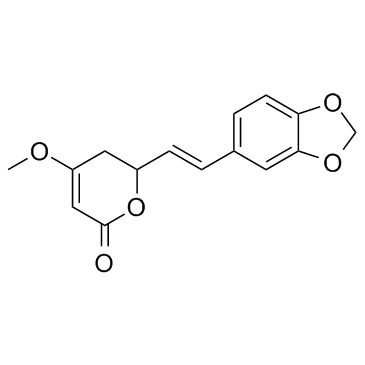
Cas No.: 20697-20-5
Sample solution is provided at 25 µL, 10mM.
_1-3.$$$39978408@51.jpg');)
_1-9.$$$38538795@65.jpg');)
_1-9.$$$39112701@51.jpg');)
_1-7.$$$37316672@70.jpg');)
_366-372.$$$36198801@70.jpg');)
.$$$38565142@65.jpg');)
_1867-1883.$$$33248023@67.jpg');)
_eads6055.$$$39977546@45.jpg');)
_eadm9805.$$$40080571@45.jpg');)
_eadj3020.$$$39666821@45.jpg');)
_1-20.$$$39757301@28.jpg');)
_1-24.$$$38898113@28.jpg');)
_273-287.$$$36806353@46.jpg');)
_1-16.$$$37156877@44.jpg');)
_1-19.$$$37460805@44.jpg');)
_1291-1307.$$$34518654@46.jpg');)
Methysticin is a major kavalactone in kava extract to induce CYP1A1.
Methysticin triggers the most profound inducing effect on CYP1A1. Consistent with the experimental results, in silico molecular docking studies based on the aryl hydrocarbon receptor (AhR)-ligand binding domain homology model also reveals favorable binding to AhR for Methysticin compared with the remaining kavalactones. Additionally, results from a luciferase gene reporter assay suggested that kava extract, Methysticin is able to activate the AhR signaling pathway. Kava extract induces the expression of CYP1A1 via an AhR-dependent mechanism and that Methysticin contributes to CYP1A1 induction. The induction of CYP1A1 indicates a potential interaction between kava or kavalactones and CYP1A1-mediated chemical carcinogenesis. The MTS cell viability assay is used to determine the effects of kava extract and kavalactones on cell viability in mouse hepatic cells. Hepa1c1c7 cells are treated with various concentrations of kava extract (0-50 µg/mL) and six kavalactones (0-100 µM) for 24 h. The results indicate that kava extract at concentrations up to 50 µg/mL and kavalactones up to 100 µM do not induce cell death. For the following studies, kava extract at 0.78-6.25 µg/mL and kavalactones at 0.78-25 µM, concentrations that cause no damage to cells, are used[1].
The kavalactone Methysticin (6 mg/kg) is administered once a week for a period of 6 months to 6 month old transgenic APP/Psen1 mice by oral gavage. Methysticin treatment activates the Nrf2 pathway in the hippocampus and cortex of mice. The Aβ deposition in brains of Methysticin-treated APP/Psen1 mice is not altered compared to untreated mice. However, Methysticin treatment significantly reduces microgliosis, astrogliosis and secretion of the pro-inflammatory cytokines TNF-α and IL-17A. Methysticin treatment results in a significant activation of the Nrf2/ARE pathway in hippocampus and the cortex but not in the midbrain and cerebellum of ARE-luciferase reporter gene mice. Methysticin treatment significantly increases the expression of both genes compared to untreated animals[2].
[1]. Li Y, et al. Methysticin and 7,8-dihydromethysticin are two major kavalactones in kava extract to induce CYP1A1. Toxicol Sci. 2011 Dec;124(2):388-99. [2]. Fragoulis A, et al. Oral administration of Methysticin improves cognitive deficits in a mouse model of Alzheimer's disease. Redox Biol. 2017 Aug;12:843-853.
Cell experiment: | The mouse hepatoma cell line Hepa1c1c7 and AhR-deficient cell line CRL-2710 are grown in α-MEM supplemented with 10% FBS and antibiotics (50 U/mL Penicillin and 50 µg/mL Streptomycin) and maintained at 37°C in a humidified atmosphere with 5% CO2. The cytotoxicity of kava extract and kavalactones (e.g., Methysticin; 0.195313, 0.390625, 0.78125, 1.5625, 3.125, 6.25, 12.5, 25, 50, and 100 μM) is assessed using the tetrazolium reduction cell viability assay (MTS). After treatment for 24 h, the MTS assay is performed. The viability of the cells is calculated by comparing the absorbance of the treated cells with that of the DMSO controls[1]. |
Animal experiment: | Mice[2]Treatment of transgenic APP/Psen1 mice (n=6) is started at an age of 25 weeks and lasted for 27 weeks. The animals are treated once a week with 6 mg/kg bodyweight Methysticin (0.15 mg/25 g mouse, corresponding to 100 µL of working solution). Control groups consist of wild type mice (n=6) and APP/Psen1 mice (n=6) which are vehicle-treated with an identical treatment regimen. At 52 weeks, the animals undergo behavioral testing and are euthanized afterwards. The brain hemispheres are separated to obtain both formalin-fixed tissue for paraffin embedding and tissue for biochemical analysis from the same animal. The left hemisphere is further dissected to separate the hippocampus from the remaining brain tissue. The fresh tissue is snap-frozen and immediately stored at -80°C. To induce Nrf2/ARE in the ARE-luciferase reporter gene mice, the mice receive 6 mg/kg bodyweight of Methysticin once. The mice's hippocampus, cortex, midbrain, and cerebellum are prepared and immediately snap-frozen in liquid nitrogen 6 h after Methysticin treatment[2]. |
References: [1]. Li Y, et al. Methysticin and 7,8-dihydromethysticin are two major kavalactones in kava extract to induce CYP1A1. Toxicol Sci. 2011 Dec;124(2):388-99. | |
| Cas No. | 20697-20-5 | SDF | |
| Canonical SMILES | O=C1C=C(OC)CC(/C=C/C2=CC=C(OCO3)C3=C2)O1 | ||
| Formula | C15H14O5 | M.Wt | 274.27 |
| Solubility | Soluble in DMSO | Storage | Store at -20°C |
| General tips | Please select the appropriate solvent to prepare the stock solution according to the
solubility of the product in different solvents; once the solution is prepared, please store it in
separate packages to avoid product failure caused by repeated freezing and thawing.Storage method
and period of the stock solution: When stored at -80°C, please use it within 6 months; when stored
at -20°C, please use it within 1 month. To increase solubility, heat the tube to 37°C and then oscillate in an ultrasonic bath for some time. |
||
| Shipping Condition | Evaluation sample solution: shipped with blue ice. All other sizes available: with RT, or with Blue Ice upon request. | ||
| Prepare stock solution | |||

|
1 mg | 5 mg | 10 mg |
| 1 mM | 3.646 mL | 18.2302 mL | 36.4604 mL |
| 5 mM | 729.2 μL | 3.646 mL | 7.2921 mL |
| 10 mM | 364.6 μL | 1.823 mL | 3.646 mL |
Step 1: Enter information below (Recommended: An additional animal making an allowance for loss during the experiment)
 g
μL
g
μL
Step 2: Enter the in vivo formulation (This is only the calculator, not formulation. Please contact us first if there is no in vivo formulation at the solubility Section.)
Calculation results:
Working concentration: mg/ml;
Method for preparing DMSO master liquid: mg drug pre-dissolved in μL DMSO ( Master liquid concentration mg/mL, Please contact us first if the concentration exceeds the DMSO solubility of the batch of drug. )
Method for preparing in vivo formulation: Take μL DMSO master liquid, next addμL PEG300, mix and clarify, next addμL Tween 80, mix and clarify, next add μL saline, mix and clarify.
Method for preparing in vivo formulation: Take μL DMSO master liquid, next add μL Corn oil, mix and clarify.
Note: 1. Please make sure the liquid is clear before adding the next solvent.
2. Be sure to add the solvent(s) in order. You must ensure that the solution obtained, in the previous addition, is a clear solution before proceeding to add the next solvent. Physical methods such as vortex, ultrasound or hot water bath can be used to aid dissolving.
3. All of the above co-solvents are available for purchase on the GlpBio website.
Quality Control & SDS
- View current batch:
- Purity: >98.00% Appearance: A solid
- COA (Certificate of Analysis)
- SDS (Safety Data Sheet)
- Datasheet
Average Rating: 5 (Based on Reviews and 8 reference(s) in Google Scholar.)