

NBD-556 |
Catalog No.GC16035
 One-Click Copy Product Info
|

A small molecule CD4 mimetic
Products are for research use only. Not for human use. We do not sell to patients.
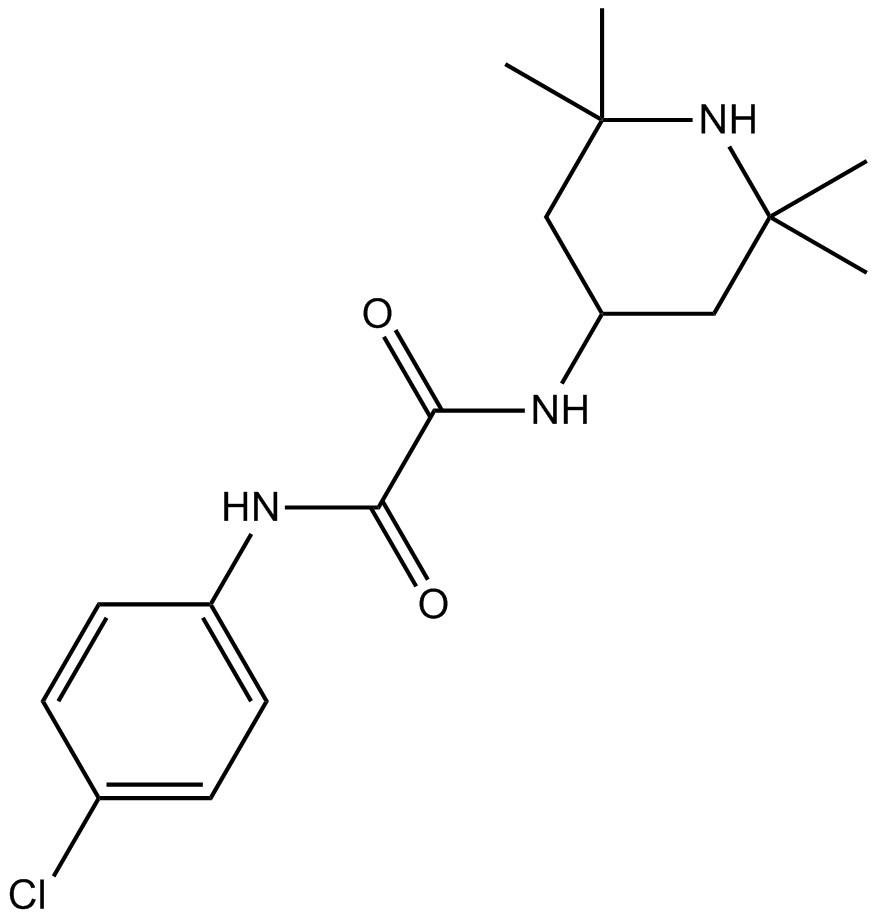
Cas No.: 333353-44-9
Sample solution is provided at 25 µL, 10mM.
_1-3.$$$39978408@51.jpg');)
_1-9.$$$38538795@65.jpg');)
_1-9.$$$39112701@51.jpg');)
_1-7.$$$37316672@70.jpg');)
_366-372.$$$36198801@70.jpg');)
.$$$38565142@65.jpg');)
_1867-1883.$$$33248023@67.jpg');)
_eads6055.$$$39977546@45.jpg');)
_eadm9805.$$$40080571@45.jpg');)
_eadj3020.$$$39666821@45.jpg');)
_1-20.$$$39757301@28.jpg');)
_1-24.$$$38898113@28.jpg');)
_273-287.$$$36806353@46.jpg');)
_1-16.$$$37156877@44.jpg');)
_1-19.$$$37460805@44.jpg');)
_1291-1307.$$$34518654@46.jpg');)
IC50: NBD-556 inhibited cell–cell fusion between H9/HIV-1IIIB and MT-2 (IC50 ~3 μM)
The entry of HIV-1 into host cells is mediated by the binding of the surface subunit gp120 to the host cell receptor CD4. NBD-556 is a novel class of human immunodeficiency virus type 1 (HIV-1) entry inhibitor that block the gp120–CD4 interaction with drug-like properties.
In vitro: A systematic study showed that NBD-556 and NBD-557 target viral entry by inhibiting the binding of HIV-1 envelope glycoprotein gp120 to the cellular receptor CD4 but did not inhibit reverse transcriptase, protease, or integrase, demonstrating that they do not target the later stages of the HIV-1 life cycle to inhibit HIV-1 infection. NBD-556 and NBD-557 were also active against HIV-1 laboratory-adapted strains including an AZT-resistant strain and HIV-1 primary isolates, showing that these compounds can potentially be further modified to become potent HIV-1 entry inhibitors [1].
In vivo: No animal in-vivo data available currently.
Clinical trial: No clinical data are available.
Reference:
[1] Zhao, Q. , L. Ma, S. Jiang, H. Lu, S. Liu, Y. He, N. Strick, N. Neamati, and A. K. Debnath. 2005. Identification of N-phenyl-N′-(2,2,6,6-tetramethyl-piperidin-4-yl)-oxalamides as a new class of HIV-1 entry inhibitors that prevent gp120 binding to CD4. Virology 339:213-225.
| Cas No. | 333353-44-9 | SDF | |
| Chemical Name | N'-(4-chlorophenyl)-N-(2,2,6,6-tetramethylpiperidin-4-yl)oxamide | ||
| Canonical SMILES | CC1(CC(CC(N1)(C)C)NC(=O)C(=O)NC2=CC=C(C=C2)Cl)C | ||
| Formula | C17H24ClN3O2 | M.Wt | 337.84 |
| Solubility | DMF: 30 mg/mL,DMSO: 30 mg/mL,DMSO:PBS (pH 7.2) (1:1): 0.5 mg/mL,Ethanol: 10 mg/mL | Storage | Store at -20°C |
| General tips | Please select the appropriate solvent to prepare the stock solution according to the
solubility of the product in different solvents; once the solution is prepared, please store it in
separate packages to avoid product failure caused by repeated freezing and thawing.Storage method
and period of the stock solution: When stored at -80°C, please use it within 6 months; when stored
at -20°C, please use it within 1 month. To increase solubility, heat the tube to 37°C and then oscillate in an ultrasonic bath for some time. |
||
| Shipping Condition | Evaluation sample solution: shipped with blue ice. All other sizes available: with RT, or with Blue Ice upon request. | ||
| Prepare stock solution | |||

|
1 mg | 5 mg | 10 mg |
| 1 mM | 2.96 mL | 14.7999 mL | 29.5998 mL |
| 5 mM | 592 μL | 2.96 mL | 5.92 mL |
| 10 mM | 296 μL | 1.48 mL | 2.96 mL |
Step 1: Enter information below (Recommended: An additional animal making an allowance for loss during the experiment)
 g
μL
g
μL
Step 2: Enter the in vivo formulation (This is only the calculator, not formulation. Please contact us first if there is no in vivo formulation at the solubility Section.)
Calculation results:
Working concentration: mg/ml;
Method for preparing DMSO master liquid: mg drug pre-dissolved in μL DMSO ( Master liquid concentration mg/mL, Please contact us first if the concentration exceeds the DMSO solubility of the batch of drug. )
Method for preparing in vivo formulation: Take μL DMSO master liquid, next addμL PEG300, mix and clarify, next addμL Tween 80, mix and clarify, next add μL saline, mix and clarify.
Method for preparing in vivo formulation: Take μL DMSO master liquid, next add μL Corn oil, mix and clarify.
Note: 1. Please make sure the liquid is clear before adding the next solvent.
2. Be sure to add the solvent(s) in order. You must ensure that the solution obtained, in the previous addition, is a clear solution before proceeding to add the next solvent. Physical methods such as vortex, ultrasound or hot water bath can be used to aid dissolving.
3. All of the above co-solvents are available for purchase on the GlpBio website.
Quality Control & SDS
- View current batch:
- Purity: >99.50% Appearance: A solid
- COA (Certificate of Analysis)
- SDS (Safety Data Sheet)
- Datasheet
Average Rating: 5 (Based on Reviews and 30 reference(s) in Google Scholar.)