

TD139 |
Catalog No.GC19350
 One-Click Copy Product Info
|

TD139 is a high-affinity inhibitor of the galectin-1 and galectin-3 with Kd values of 12nM and 14nM, respectively.
Products are for research use only. Not for human use. We do not sell to patients.
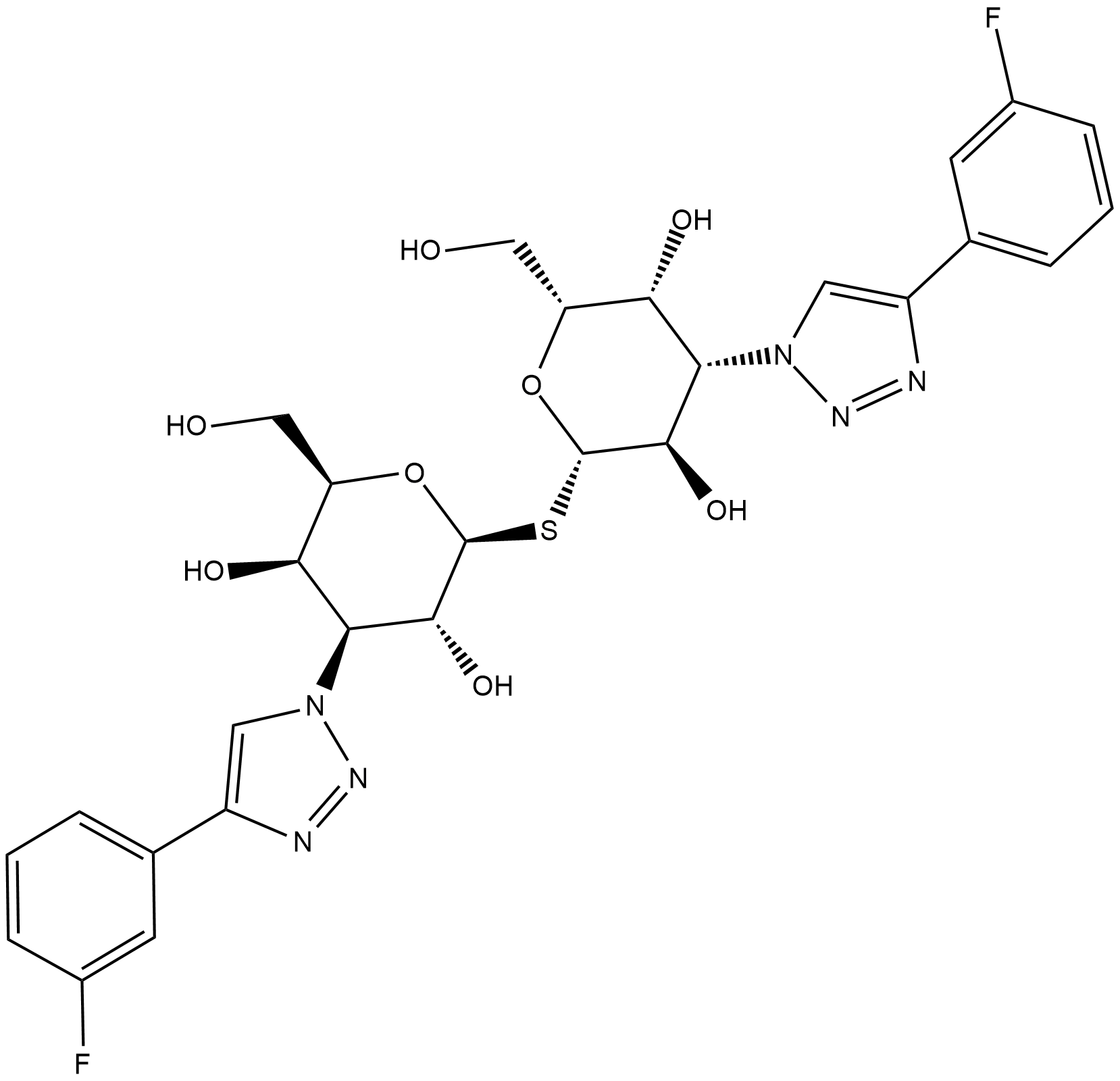
Cas No.: 1450824-22-2
Sample solution is provided at 25 µL, 10mM.
TD139 is a high-affinity inhibitor of the galectin-1 and galectin-3 with Kd values of 12nM and 14nM, respectively[1]. TD139 selectively targets galectin-3 by disrupting β-galactoside-binding activity and promotes M2-like macrophage polarization[2]. TD139 has been used to suppress Galectin-3-potentiated platelet activation and inhibit occlusive thrombosis[3].
In vitro, TD139 treatment (20μM) for 24 hours significantly inhibited the activation of NLRP3 inflammasome in BV2 cells, and reduced the protein levels of IL-1β, IL-6, IL-18, and TNF-α[4]. Treatment with 100μM TD139 for 72 hours significantly inhibited the growth of FTC-133 and 8505C cells, and reduced the migration of the cells as well as the expressions of β-catenin and MMP2[5]. Treatment with 10μM TD139 for 24 hours the suppressed TNF-α-induced inflammatory response and inhibited the activation of the ERK/JNK/p38 signaling pathway in placental tissues[6].
In vivo, TD139 treatment via intraperitoneal injection at a dose of 15mg/kg, once every 12 hours for 24 hours, alleviated the neuroinflammatory damage after subarachnoid hemorrhage and improved neurological dysfunction in mice[7]. Daily intrathecal injection of TD139 at a dose of 30µg/day for 14 days reduced fibrotic scar formation after spinal cord injury (SCI) and promoted the neurological recovery in mice[8].
References:
[1] Lee L Y G N, Leow S Y, Wen H, et al. An evaluation of the mechanisms of galacto-oligosaccharide (GOS)-Induced IgE cross-linking on basophils in GOS allergy[J]. Frontiers in Allergy, 2022, 3: 840454.
[2] Wang M, Jiang Y, Wan J, et al. Inhibition of Galectin-3 expression could preserve the immunoregulatory function of mesenchymal stem cells during cell passaging[J]. Frontiers in Bioscience-Landmark, 2025, 30(8): 39918.
[3] Chen Y, Fu W, Zheng Y, et al. Galectin 3 enhances platelet aggregation and thrombosis via Dectin-1 activation: a translational study[J]. European Heart Journal, 2022, 43(37): 3556-3574.
[4] Sun W, Hao Y, Li C, et al. Inhibition of Galectin-3 in a rat model of epilepsy and Kainate-Activated BV2 cells limits microglial activation through the NLRP3/Pyroptosis pathway[J]. Neuroimmunomodulation, 2023, 30(1): 325-337.
[5] Lee J J, Hsu Y C, Li Y S, et al. Galectin‐3 inhibitors suppress anoikis resistance and invasive capacity in thyroid cancer cells[J]. International Journal of Endocrinology, 2021, 2021(1): 5583491.
[6] Xia J, Wang Y, Qi B R. In vitro and in vivo effects of Galectin‐3 inhibitor TD139 on inflammation and ERK/JNK/p38 pathway in gestational diabetes mellitus[J]. The Kaohsiung Journal of Medical Sciences, 2024, 40(10): 916-925.
[7] Shen Y, Zhang W, Chang H, et al. Galectin-3 modulates microglial activation and neuroinflammation in early brain injury after subarachnoid hemorrhage[J]. Experimental neurology, 2024, 377: 114777.
[8] Shan F, Ye J, Xu X, et al. Galectin-3 inhibition reduces fibrotic scarring and promotes functional recovery after spinal cord injury in mice[J]. Cell & Bioscience, 2024, 14(1): 128.
| Cell experiment [1]: | |
|
Cell lines |
FTC-133 cells |
|
Preparation Method |
FTC-133 cells were cultivated in DMEM/F12 medium supplemented with 10% heat-inactivated fetal bovine serum (FBS), 1% penicillin-streptomycin at 37°C in an incubator with 5% CO2. Cells were seeded in a 96-well plate at a density of 1×10⁴ cells/well for 24h. Cells were treated with TD139 at different concentrations (0, 1, 10, and 100μM). After 72h of treatment, the cell viability was determined. |
|
Reaction Conditions |
0, 1, 10, and 100μM; 72h |
|
Applications |
TD139 treatment inhibited cell viability of FTC-133 cells in a dose-dependent manner. |
| Animal experiment [2]: | |
|
Animal models |
Female C57BL/6J mice |
|
Preparation Method |
Female C57BL/6J mice (8 weeks old) were housed in specific pathogen-free facilities under a 12h light-dark cycle at a temperature of 24±1°C with controlled humidity, and had access to food and water. The mice were anesthetized with intraperitoneal injection of sodium pentobarbital (50mg/kg) and placed in the prone position on the operating table. The dorsal surface around the T10 segment was shaved, and the skin was disinfected with iodophor. The T9-T11 dorsal skin was dissected, and the back muscle was sequentially peeled off. Laminectomy was performed to expose the spinal cord at the T10 level, which served as the clamping site. Crush-induced spinal cord injuries were made without spacers, with a tip width of 0.5mm, to completely compress the entire spinal cord laterally from both sides for 5s. Successful SCI induction was confirmed by observing transient spasms in the hind limbs and tail along with a continuous red clamp mark after saline irrigation. The wound was then sutured layer by layer. Postoperatively, the mice were subjected to auxiliary urination twice daily (morning and afternoon) until spontaneous urination was restored after SCI. Prior to injection into the lumbar 5-6 intervertebral space in mice, the dorsal surface was shaved, and the skin was disinfected with iodophor. The successful insertion of the needle into the intradural space was confirmed by sudden tail wagging. 30mg TD139 was dissolved in 10ml PBS containing 3% DMSO and was injected (i.t.) daily at 10µl using a microinjection needle. For the SCI mice, TD139 was injected post-operatively daily for 14 days. The control mice received the same volume of 10µl of PBS containing 3% DMSO. The damaged spinal cords of mice were collected for analysis. |
|
Dosage form |
3µg/day; 14 days; i.t. |
|
Applications |
TD139 treatment reduced fibrotic scar formation after SCI in mice. |
References: [1] Lee J J, Hsu Y C, Li Y S, et al. Galectin‐3 inhibitors suppress anoikis resistance and invasive capacity in thyroid cancer cells[J]. International Journal of Endocrinology, 2021, 2021(1): 5583491. [2] Shan F, Ye J, Xu X, et al. Galectin-3 inhibition reduces fibrotic scarring and promotes functional recovery after spinal cord injury in mice[J]. Cell & Bioscience, 2024, 14(1): 128. | |
| Cas No. | 1450824-22-2 | SDF | |
| Canonical SMILES | O[C@H]([C@@H](N1N=NC(C2=CC=CC(F)=C2)=C1)[C@H]([C@@H](CO)O3)O)[C@@H]3S[C@H]4[C@@H]([C@@H](N5N=NC(C6=CC=CC(F)=C6)=C5)[C@H]([C@@H](CO)O4)O)O | ||
| Formula | C28H30F2N6O8S | M.Wt | 648.64 |
| Solubility | DMSO : 50 mg/mL (77.08 mM);Ethanol : ≥ 3.33 mg/mL (5.13 mM);Water : < 0.1 mg/mL (insoluble) | Storage | Store at -20°C |
| General tips | Please select the appropriate solvent to prepare the stock solution according to the
solubility of the product in different solvents; once the solution is prepared, please store it in
separate packages to avoid product failure caused by repeated freezing and thawing.Storage method
and period of the stock solution: When stored at -80°C, please use it within 6 months; when stored
at -20°C, please use it within 1 month. To increase solubility, heat the tube to 37°C and then oscillate in an ultrasonic bath for some time. |
||
| Shipping Condition | Evaluation sample solution: shipped with blue ice. All other sizes available: with RT, or with Blue Ice upon request. | ||
| Prepare stock solution | |||

|
1 mg | 5 mg | 10 mg |
| 1 mM | 1.5417 mL | 7.7084 mL | 15.4169 mL |
| 5 mM | 308.3 μL | 1.5417 mL | 3.0834 mL |
| 10 mM | 154.2 μL | 770.8 μL | 1.5417 mL |
Step 1: Enter information below (Recommended: An additional animal making an allowance for loss during the experiment)
 g
μL
g
μL
Step 2: Enter the in vivo formulation (This is only the calculator, not formulation. Please contact us first if there is no in vivo formulation at the solubility Section.)
Calculation results:
Working concentration: mg/ml;
Method for preparing DMSO master liquid: mg drug pre-dissolved in μL DMSO ( Master liquid concentration mg/mL, Please contact us first if the concentration exceeds the DMSO solubility of the batch of drug. )
Method for preparing in vivo formulation: Take μL DMSO master liquid, next addμL PEG300, mix and clarify, next addμL Tween 80, mix and clarify, next add μL saline, mix and clarify.
Method for preparing in vivo formulation: Take μL DMSO master liquid, next add μL Corn oil, mix and clarify.
Note: 1. Please make sure the liquid is clear before adding the next solvent.
2. Be sure to add the solvent(s) in order. You must ensure that the solution obtained, in the previous addition, is a clear solution before proceeding to add the next solvent. Physical methods such as vortex, ultrasound or hot water bath can be used to aid dissolving.
3. All of the above co-solvents are available for purchase on the GlpBio website.
Quality Control & SDS
- View current batch:
- Purity: >98.00% Appearance: A solid
- COA (Certificate of Analysis)
- SDS (Safety Data Sheet)
- Datasheet
Average Rating: 5 (Based on Reviews and 2 reference(s) in Google Scholar.)