

Neu2000 (Synonyms: Salfaprodil free base; Neu2000) |
Catalog No.GC30860
 One-Click Copy Product Info
|

Neu2000 (Salfaprodil free base) is an NR2B-selective and uncompetitive antagonist of N-methyl-D-aspartate (NMDA).
Products are for research use only. Not for human use. We do not sell to patients.
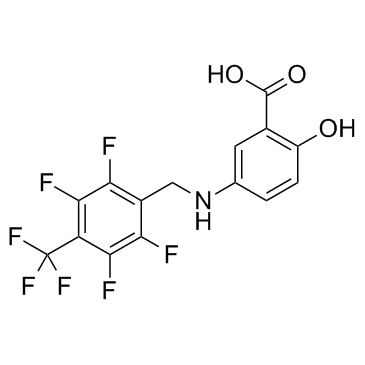
Cas No.: 640290-67-1
Sample solution is provided at 25 µL, 10mM.
_1-3.$$$39978408@51.jpg');)
_1-9.$$$38538795@65.jpg');)
_1-9.$$$39112701@51.jpg');)
_1-7.$$$37316672@70.jpg');)
_366-372.$$$36198801@70.jpg');)
.$$$38565142@65.jpg');)
_1867-1883.$$$33248023@67.jpg');)
_eads6055.$$$39977546@45.jpg');)
_eadm9805.$$$40080571@45.jpg');)
_eadj3020.$$$39666821@45.jpg');)
_1-20.$$$39757301@28.jpg');)
_1-24.$$$38898113@28.jpg');)
_273-287.$$$36806353@46.jpg');)
_1-16.$$$37156877@44.jpg');)
_1-19.$$$37460805@44.jpg');)
_1291-1307.$$$34518654@46.jpg');)
Neu2000 is an uncompetitive N-methyl-D-aspartate (NMDA) receptor antagonist.
Neu2000 shows apparent neuroprotection against 300 μM N-methyl-D-aspartate (NMDA) at doses as low as 30 μM. Neu2000 does not protect cortical neurons against α-amino-3-hydroxy-5-methyl-4-isoxazolepropionic acid- or kainate-mediates excitotoxicity. Neu2000 inhibits the electrophysiologic response of cultured cortical neurons to 300 μM NMDA in a concentration-dependent manner, indicating that the effect is mediated by a specific action at NMDA receptors. The Neu2000 dose-response has an IC50 of 35.38±5.94 μM and Hill's coefficient of 0.91 (n=8). Neu2000 (100 μM) significantly reduces the maximal NMDA response by 58.31±2.72% (n=5) and the EC50 values of NMDA from 18.88±1.85 to 9.92±0.17 μM (n=5, P<0.05)[1].
Pharmacokinetic analysis reveals that the half-life of Neu2000 is 1.42, 2.14, and 1.79 h following intraperitoneal administration of 10, 25, and 50 mg/kg, respectively. In addition, the Cmax (maximum plasma concentration) is calculated as 3.86, 18.73, and 52.83 μg/mL and the AUC (area under the curve) is determined to be 7.37, 55.15, and 96.77 μg/h/mL at the same respective doses. The levels of basal mitochondrial ROS are significantly elevated at 24 h post-surgery in both the vehicle-treated (4.1-fold, p<0.01) and Neu2000-treated (2.9-fold, p<0.01) groups compare to sham controls. The results of blood-brain barrier (BBB) test also reveals significant changes in open field locomotion in spinal cord-injured animals treated with Neu2000 compare to vehicle-treated animals. Single (p<0.05) or repeated (p<0.01) Neu2000 treatment results in a decreased swing to stance ratio compare to vehicle-treated animals. Repeated treatment with Neu2000 results in a 45.6% decrease (p<0.01) in overall lesion volume compare to vehicle treatment, while a single administration of Neu2000 results in a 36.8% decrease (p<0.05) in overall lesion volume[2].
[1]. Gwag BJ, et al. Marked prevention of ischemic brain injury by Neu2000, an NMDA antagonist and antioxidant derived from aspirin and sulfasalazine. J Cereb Blood Flow Metab. 2007 Jun;27(6):1142-51. [2]. Springer JE, et al. The functional and neuroprotective actions of Neu2000, a dual-acting pharmacological agent, in the treatment of acute spinal cord injury. J Neurotrauma. 2010 Jan;27(1):139-49.
|
Cell experiment: |
Whole-cell voltage-clamp recordings are performed on primary cultured cortical neurons (11 to 14 DIV) at room temperature (18°C to 23°C). Whole-cell currents are recorded and analyzed using an amplifier. The 2 to 3-MΩ-resistance recording pipettes are filled with an internal solution containing 135 mM CsCl, 10 mM N-2-hydroxyethylpiperazine-N′-2-ethanesulfonic acid, 1.2 mM MgCl2, 4 mM ATP-Na2, 0.5 mM CaCl2, and 11 mM ethyleneglycol tetraacetate (pH adjusted to 7.3 with CsOH). The external solution is composed of 140 mM NaCl, 2 mM KCl, 2 mM CaCl2, 10 mM N-2-hydroxyethylpiperazine-N′-2-ethanesulfonic acid, and 0.01 mM glycine (pH adjusted to 7.3 to 7.4 with NaOH). N-methyl-D-aspartate and Neu2000 solutions are prepared by dissolving these chemicals in the external solutions, and they are applied to target neurons using a gravity-driven superfusion system with a linear array of 8 to 10 barrels. Graphing of data and dose-response analysis are performed and all data are presented as mean±s.e[1]. |
|
Animal experiment: |
The pharmacokinetic profile of Neu2000 in normal rats is examined using intraperitoneal (ip) route of administration. Rats are anesthetized by ether inhalation and the femoral artery cannulated. Rats are placed into cages for 1 h and then receive injections (10, 25, or 50 mg/kg ip, n=6 per dose) of Neu2000 dissolved in sterile saline. Blood is collected from the femoral artery at 15, 30, 60, 120, 240, 480, and 1440 min following injection. Plasma aliquots of 50 μL are spiked with 100 μL of internal standard solution (Neu2000IS, 10 μg/mL in acetonitrile). After vortex mixing for 1 min, the samples are centrifuged at 12,000 g for 5 min. A total of 50 μL of the supernatant phase is separated and diluted with 50 μL of distilled water. Plasma concentrations relative to time are obtained using liquid chromatography-mass spectrometry[2]. |
|
References: [1]. Gwag BJ, et al. Marked prevention of ischemic brain injury by Neu2000, an NMDA antagonist and antioxidant derived from aspirin and sulfasalazine. J Cereb Blood Flow Metab. 2007 Jun;27(6):1142-51. |
|
| Cas No. | 640290-67-1 | SDF | |
| Synonyms | Salfaprodil free base; Neu2000 | ||
| Canonical SMILES | OC(C1=C(O)C=CC(NCC2=C(C(F)=C(C(F)(F)F)C(F)=C2F)F)=C1)=O | ||
| Formula | C15H8F7NO3 | M.Wt | 383.22 |
| Solubility | DMSO : ≥ 112.5 mg/mL (293.57 mM) | Storage | Store at -20°C |
| General tips | Please select the appropriate solvent to prepare the stock solution according to the
solubility of the product in different solvents; once the solution is prepared, please store it in
separate packages to avoid product failure caused by repeated freezing and thawing.Storage method
and period of the stock solution: When stored at -80°C, please use it within 6 months; when stored
at -20°C, please use it within 1 month. To increase solubility, heat the tube to 37°C and then oscillate in an ultrasonic bath for some time. |
||
| Shipping Condition | Evaluation sample solution: shipped with blue ice. All other sizes available: with RT, or with Blue Ice upon request. | ||
| Prepare stock solution | |||

|
1 mg | 5 mg | 10 mg |
| 1 mM | 2.6095 mL | 13.0473 mL | 26.0947 mL |
| 5 mM | 521.9 μL | 2.6095 mL | 5.2189 mL |
| 10 mM | 260.9 μL | 1.3047 mL | 2.6095 mL |
Step 1: Enter information below (Recommended: An additional animal making an allowance for loss during the experiment)
 g
μL
g
μL
Step 2: Enter the in vivo formulation (This is only the calculator, not formulation. Please contact us first if there is no in vivo formulation at the solubility Section.)
Calculation results:
Working concentration: mg/ml;
Method for preparing DMSO master liquid: mg drug pre-dissolved in μL DMSO ( Master liquid concentration mg/mL, Please contact us first if the concentration exceeds the DMSO solubility of the batch of drug. )
Method for preparing in vivo formulation: Take μL DMSO master liquid, next addμL PEG300, mix and clarify, next addμL Tween 80, mix and clarify, next add μL saline, mix and clarify.
Method for preparing in vivo formulation: Take μL DMSO master liquid, next add μL Corn oil, mix and clarify.
Note: 1. Please make sure the liquid is clear before adding the next solvent.
2. Be sure to add the solvent(s) in order. You must ensure that the solution obtained, in the previous addition, is a clear solution before proceeding to add the next solvent. Physical methods such as vortex, ultrasound or hot water bath can be used to aid dissolving.
3. All of the above co-solvents are available for purchase on the GlpBio website.
Quality Control & SDS
- View current batch:
- Purity: >98.50% Appearance: A solid
- COA (Certificate of Analysis)
- SDS (Safety Data Sheet)
- Datasheet
Average Rating: 5 (Based on Reviews and 13 reference(s) in Google Scholar.)