

Butylhydroxyanisole (Butylated hydroxyanisole) |
Catalog No.GC30067
 One-Click Copy Product Info
|

Butylhydroxyanisole (Butylated hydroxyanisole) (Butylated hydroxyanisole) is an antioxidant used as a food additive preservative.
Products are for research use only. Not for human use. We do not sell to patients.
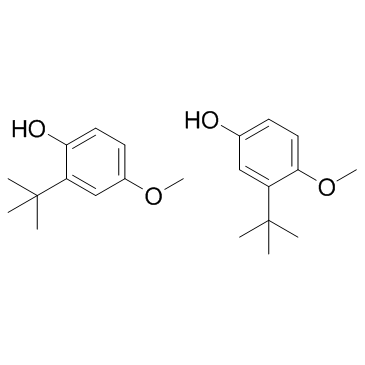
Cas No.: 25013-16-5
Sample solution is provided at 25 µL, 10mM.
_1-3.$$$39978408@51.jpg');)
_1-9.$$$38538795@65.jpg');)
_1-9.$$$39112701@51.jpg');)
_1-7.$$$37316672@70.jpg');)
_366-372.$$$36198801@70.jpg');)
.$$$38565142@65.jpg');)
_1867-1883.$$$33248023@67.jpg');)
_eads6055.$$$39977546@45.jpg');)
_eadm9805.$$$40080571@45.jpg');)
_eadj3020.$$$39666821@45.jpg');)
_1-20.$$$39757301@28.jpg');)
_1-24.$$$38898113@28.jpg');)
_273-287.$$$36806353@46.jpg');)
_1-16.$$$37156877@44.jpg');)
_1-19.$$$37460805@44.jpg');)
_1291-1307.$$$34518654@46.jpg');)
Butylhydroxyanisole (Butylated hydroxyanisole) is a phenolic food additive with antioxidant properties[1]. Butylhydroxyanisole is a potential ERα ligand that possesses the structural elements necessary for interaction with the ERα binding domain, and the structural elements include a para-phenolic hydroxyl group, which mimics the structure of E2, and an aromatic ring, and the aromatic ring serves as a hydrogen bond donor to form a hydrogen bond with the carboxyl group of Glu353, and as a hydrogen bond acceptor to form a hydrogen bond with the guanidino group of Arg394, thereby exerting estrogenic activation effects[2]. Butylhydroxyanisole is usually applied in oils, fats and oleaginous foods to prevent oils and fats, especially ones with highly unsaturated fatty acids, from being oxidized[3].
In vitro, Butylhydroxyanisole dose- and time-dependently decreased the growth of A549 cells with IC50 values of 550μM, 400μM, and 300μM at 24, 48, and 72h, respectively[4]. 100μM Butylhydroxyanisole pretreatment for 30 minutes on L929sAhFas cells reduced TNF-α-induced cell necrosis and decreased ROS levels[5]. 200μM Butylhydroxyanisole treatment for 24 hours induced apoptosis in HeLa cells, accompanied by the loss of mitochondrial membrane potential and activation of caspase[6].
In vivo, Butylhydroxyanisole treatment via oral administration at a dose of 500mg/kg/day for 7 weeks induced reproductive system dysfunction and developmental abnormalities, as well as histological lesions in the thyroid gland, in male Sprague-Dawley rats[7]. Oral administration of Butylhydroxyanisole at a dose of 200mg/kg/day for 3 weeks enhanced the levels of CD3 (T cells) and decreased the level of CD19 (B cells) in BALB/c mice[8].
References:
[1] Zhang X J, Diao M, Zhang Y F. A review of the occurrence, metabolites and health risks of butylated hydroxyanisole (BHA)[J]. Journal of the Science of Food and Agriculture, 2023, 103(13): 6150-6166.
[2] Pop A, Kiss B, Loghin F. Endocrine disrupting effects of butylated hydroxyanisole (BHA-E320)[J]. Clujul Medical, 2013, 86(1): 16.
[3] Li J, Chen J, Bi Y, et al. Insight into synergistic antioxidation mechanisms of butyl hydroxyanisole with common synthetic antioxidants[J]. Grain & Oil Science and Technology, 2022, 5(3): 114-130.
[4] Vandghanooni S, Forouharmehr A, Eskandani M, et al. Cytotoxicity and DNA fragmentation properties of butylated hydroxyanisole[J]. DNA and cell biology, 2013, 32(3): 98-103.
[5] Festjens N, Kalai M, Smet J, et al. Butylated hydroxyanisole is more than a reactive oxygen species scavenger[J]. Cell Death & Differentiation, 2006, 13(1): 166-169.
[6] Moon H J, Park W H. Butylated hydroxyanisole inhibits the growth of HeLa cervical cancer cells via caspase-dependent apoptosis and GSH depletion[J]. Molecular and cellular biochemistry, 2011, 349(1): 179-186.
[7] Jeong S H, Kim B Y, Kang H G, et al. Effects of butylated hydroxyanisole on the development and functions of reproductive system in rats[J]. Toxicology, 2005, 208(1): 49-62.
[8] Hung F M, Chuang Y Y, Lee C S, et al. Butylated hydroxyanisole affects immunomodulation and promotes macrophage phagocytosis in normal BALB/c mice[J]. Molecular medicine reports, 2012, 5(3): 683-687.
| Cell experiment [1]: | |
|
Cell lines |
A549 cells |
|
Preparation Method |
A549 cells were cultivated in RPMI-1640 medium supplemented with 100μg/ml streptomycin, 100μg/ml penicillin and 10% fetal bovine serum at 37°C in an incubator with 5% CO2. A549 cells (2×10³/well) were seeded in the 96-well plates and cultured overnight followed by treatment with different concentrations of Butylhydroxyanisole (0, 0.1, 1, 10, 100, and 1000μM) for 72h. Cells viability was measured. |
|
Reaction Conditions |
0, 0.1, 1, 10, 100, and 1000μM; 72h |
|
Applications |
Butylhydroxyanisole reduced cell viability of A549 cells in a dose-dependent manner. |
| Animal experiment [2]: | |
|
Animal models |
Male BALB/c mice |
|
Preparation Method |
Male BALB/c mice (8 weeks old; 22-28g) were housed individually in specific cages and placed in a ventilated cabinet, temperature was kept relatively constant at 22°C (±3°C) and humidity between 50 and 70%, and the lighting was controlled to be 12h light and 12h dark. BALB/c mice were randomly divided into 3 groups to receive different treatments. Group I served as a control (n=10). Group II mice were treated with olive oil as vehicle (n=10). Group III mice were treated with BHA (200mg/kg) in olive oil (n=10). Butylhydroxyanisole was administered by oral gavage to the treatment groups daily for up to 3 weeks. At the end of treatment, the mice were weighed and blood was withdrawn, and spleen samples were isolated for analysis. |
|
Dosage form |
200mg/kg/day; 3 weeks; p.o. |
|
Applications |
Butylhydroxyanisole treatment promoted immune responses by increasing T cells and activating phagocytosis by macrophages in mice, without affecting the weight of the body and spleen. |
References: [1] Vandghanooni S, Forouharmehr A, Eskandani M, et al. Cytotoxicity and DNA fragmentation properties of butylated hydroxyanisole[J]. DNA and cell biology, 2013, 32(3): 98-103. [2] Hung F M, Chuang Y Y, Lee C S, et al. Butylated hydroxyanisole affects immunomodulation and promotes macrophage phagocytosis in normal BALB/c mice[J]. Molecular medicine reports, 2012, 5(3): 683-687. | |
| Cas No. | 25013-16-5 | SDF | |
| Canonical SMILES | OC1=CC=C(OC)C=C1C(C)(C)C.OC2=CC=C(OC)C(C(C)(C)C)=C2 | ||
| Formula | C11H16O2 | M.Wt | 180.24 |
| Solubility | DMSO : ≥ 100 mg/mL (554.82 mM);Water : 1 mg/mL (5.55 mM; ultrasonic and warming and heat to 60°C) | Storage | Store at -20°C |
| General tips | Please select the appropriate solvent to prepare the stock solution according to the
solubility of the product in different solvents; once the solution is prepared, please store it in
separate packages to avoid product failure caused by repeated freezing and thawing.Storage method
and period of the stock solution: When stored at -80°C, please use it within 6 months; when stored
at -20°C, please use it within 1 month. To increase solubility, heat the tube to 37°C and then oscillate in an ultrasonic bath for some time. |
||
| Shipping Condition | Evaluation sample solution: shipped with blue ice. All other sizes available: with RT, or with Blue Ice upon request. | ||
| Prepare stock solution | |||

|
1 mg | 5 mg | 10 mg |
| 1 mM | 5.5482 mL | 27.7408 mL | 55.4816 mL |
| 5 mM | 1.1096 mL | 5.5482 mL | 11.0963 mL |
| 10 mM | 554.8 μL | 2.7741 mL | 5.5482 mL |
Step 1: Enter information below (Recommended: An additional animal making an allowance for loss during the experiment)
 g
μL
g
μL
Step 2: Enter the in vivo formulation (This is only the calculator, not formulation. Please contact us first if there is no in vivo formulation at the solubility Section.)
Calculation results:
Working concentration: mg/ml;
Method for preparing DMSO master liquid: mg drug pre-dissolved in μL DMSO ( Master liquid concentration mg/mL, Please contact us first if the concentration exceeds the DMSO solubility of the batch of drug. )
Method for preparing in vivo formulation: Take μL DMSO master liquid, next addμL PEG300, mix and clarify, next addμL Tween 80, mix and clarify, next add μL saline, mix and clarify.
Method for preparing in vivo formulation: Take μL DMSO master liquid, next add μL Corn oil, mix and clarify.
Note: 1. Please make sure the liquid is clear before adding the next solvent.
2. Be sure to add the solvent(s) in order. You must ensure that the solution obtained, in the previous addition, is a clear solution before proceeding to add the next solvent. Physical methods such as vortex, ultrasound or hot water bath can be used to aid dissolving.
3. All of the above co-solvents are available for purchase on the GlpBio website.
Quality Control & SDS
- View current batch:
- Purity: >99.00% Appearance: A solid
- COA (Certificate of Analysis)
- SDS (Safety Data Sheet)
- Datasheet
Average Rating: 5 (Based on Reviews and 34 reference(s) in Google Scholar.)