

NK 252 |
Catalog No.GC13058
 One-Click Copy Product Info
|

NK 252 is an Nrf2 activator.
Products are for research use only. Not for human use. We do not sell to patients.
Cas No.: 1414963-82-8
Sample solution is provided at 25 µL, 10mM.
_1-3.$$$39978408@51.jpg');)
_1-9.$$$38538795@65.jpg');)
_1-9.$$$39112701@51.jpg');)
_1-7.$$$37316672@70.jpg');)
_366-372.$$$36198801@70.jpg');)
.$$$38565142@65.jpg');)
_1867-1883.$$$33248023@67.jpg');)
_eads6055.$$$39977546@45.jpg');)
_eadm9805.$$$40080571@45.jpg');)
_eadj3020.$$$39666821@45.jpg');)
_1-20.$$$39757301@28.jpg');)
_1-24.$$$38898113@28.jpg');)
_273-287.$$$36806353@46.jpg');)
_1-16.$$$37156877@44.jpg');)
_1-19.$$$37460805@44.jpg');)
_1291-1307.$$$34518654@46.jpg');)
NK 252 is an Nrf2 activator [1][2]. Nuclear factor-erythroid-2-related factor 2 (Nrf2), a transcription factor that activates antioxidant response elements (AREs), plays a central role in stimulating the expression of various antioxidant-associated genes in the cellular defense against oxidative stress. Keap1 is a cytosolic repressor of Nrf2 that retains Nrf2 in the cytoplasm [1].
NK 252 is an Nrf2 activator that interacts directly with the domain containing the Nrf2-binding site of Keap1. In Huh-7.5 cells, NK 252 activated the NQO1-ARE in a dose-dependent way, suggesting NK-252 has potential as an Nrf2 activator in hepatic cells. NK-252 also protected Huh-7 cells against H2O2-induced cytotoxicity [1]. NK-252 was effective not only in circumventing drug resistance but also in potentiating the action of antitumor drugs against drug-sensitive tumors [2].
In nonalcoholic steatohepatitis (NASH) model rats, NK-252 decreased fibrosis scores and significantly reduced liver fibrosis area in a dose-dependent way. NK-252 also significantly reduced plasma ALT levels and plasma AST levels, suggesting the hepatoprotective effects of NK-252. NK-252 increased NQO1 gene expression and exhibited antioxidant properties in the livers of rats. NK-252 reduced fibrogenic gene expression and inhibited further progression of established fibrosis [1].
References:
[1]. Shimozono R, Asaoka Y, Yoshizawa Y, et al. Nrf2 activators attenuate the progression of nonalcoholic steatohepatitis-related fibrosis in a dietary rat model. Mol Pharmacol. 2013 Jul;84(1):62-70.
[2]. Kiue A, Sano T, Naito A, et al. Reversal by two dihydropyridine compounds of resistance to multiple anticancer agents in mouse P388 leukemia in vivo and in vitro. Jpn J Cancer Res. 1990 Oct;81(10):1057-64.
|
Cell experiment: |
The Huh-7.5 cells, a subline derived from Huh-7 cells, are transfected with ARE/pGL4.32 by lipofectamine LTX. The stable clonal transfectant is isolated by selection in hygromycin B (0.1 mg/mL). Cells derived from stable clones are transfected with control or Nrf2 small interfering RNA by lipofectamine RNAiMAX (30 hours), then treated with OPZ, NK-252 (0.1-30 μM, 16 hours) , or DMSO alone (control). The luciferase activity values are measured using the Steady-Glo Luciferase Assay System[1]. |
|
Animal experiment: |
Rats[1]Six-week-old male Fischer 344 rats are randomly divided into four compound administration groups and four control groups. Compound administration groups of rats fed a CDAA diet receive oral administration as follows: 1) OPZ from 1 week after feeding at a dose of 60 mg/kg once daily for 9 weeks (CDAA+OPZ group; N=8), 2) NK-252 from 1 week after feeding at a dose of 20 mg/kg once daily for 9 weeks (CDAA+NK-252_low group; N=8), 3) NK-252 from 1 week after feeding at a dose of 60 mg/kg once daily for 9 weeks (CDAA+NK-252_high group; N=8), or 4) NK-252 from 6 weeks after feeding at a dose of 60 mg/kg once daily for 4 weeks (CDAA+NK-252_delayed administration: DA group; N=7). Two control groups of rats are fed a CDAA diet for 6 or 10 weeks (pre-CDAA control or CDAA control group; N=9 each), and the other two control groups of rats are fed standard rodent chow (CRF-1) for 6 or 10 weeks (prenaive or naive; N=3 each). Laparotomy and blood sampling are performed under isoflurane anesthesia. After blood sampling, rats are euthanized by exsanguination under isoflurane anesthesia, and the livers are immediately extirpated.[2]Mice[2]Six- to 8-week-old male BALB/c x DBA/2 F1 (hereafter called CD2F1) mice weighing 22 to 26 g are used. Male CD2F1 mice are inoculated i.p. with 106 cells of P388/S and P388/VCR cell line on day 0. Each group consist of six mice. NK-250 and NK-252 (100, 300, and 1000 mg/kg) are given p.o. daily from day 1 to 5. Mean survival days and the range of survival days are analysed. |
|
References: [1]. Shimozono R et al. Nrf2 activators attenuate the progression of nonalcoholic steatohepatitis-related fibrosis in a dietary rat model. Mol Pharmacol. 2013 Jul, 84(1):62-70. |
|
| Cas No. | 1414963-82-8 | SDF | |
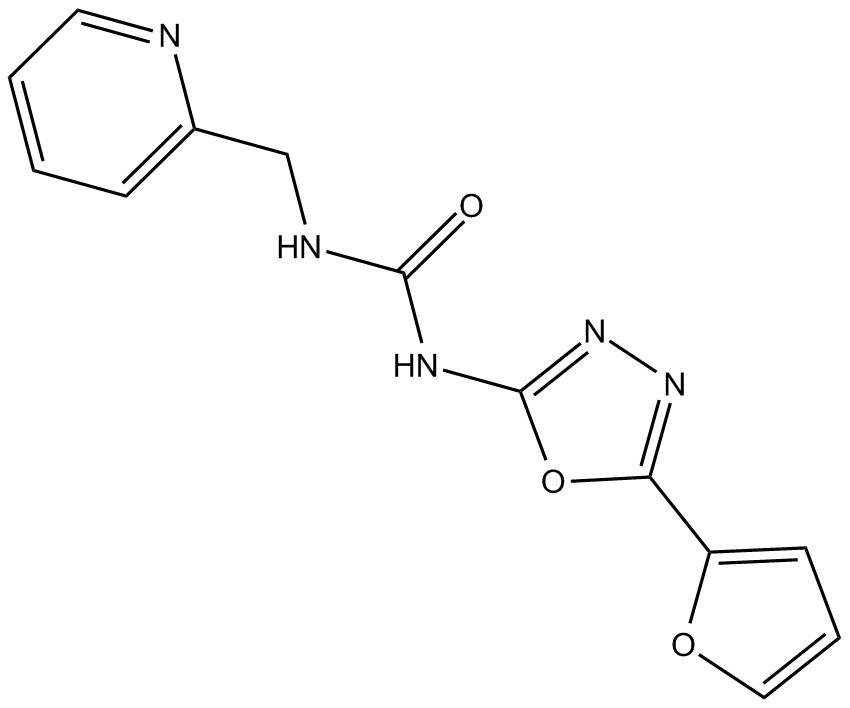
| Chemical Name | N-[5-(2-furanyl)-1,3,4-oxadiazol-2-yl]-N'-(2-pyridinylmethyl)-urea | ||
| Canonical SMILES | O=C(NC1=NN=C(C2=CC=CO2)O1)NCC3=CC=CC=N3 | ||
| Formula | C13H11N5O3 | M.Wt | 285.3 |
| Solubility | ≤14mg/ml in DMSO;20mg/ml in dimethyl formamide | Storage | Store at 2-8°C |
| General tips | Please select the appropriate solvent to prepare the stock solution according to the
solubility of the product in different solvents; once the solution is prepared, please store it in
separate packages to avoid product failure caused by repeated freezing and thawing.Storage method
and period of the stock solution: When stored at -80°C, please use it within 6 months; when stored
at -20°C, please use it within 1 month. To increase solubility, heat the tube to 37°C and then oscillate in an ultrasonic bath for some time. |
||
| Shipping Condition | Evaluation sample solution: shipped with blue ice. All other sizes available: with RT, or with Blue Ice upon request. | ||
| Prepare stock solution | |||

|
1 mg | 5 mg | 10 mg |
| 1 mM | 3.5051 mL | 17.5254 mL | 35.0508 mL |
| 5 mM | 701 μL | 3.5051 mL | 7.0102 mL |
| 10 mM | 350.5 μL | 1.7525 mL | 3.5051 mL |
Step 1: Enter information below (Recommended: An additional animal making an allowance for loss during the experiment)
 g
μL
g
μL
Step 2: Enter the in vivo formulation (This is only the calculator, not formulation. Please contact us first if there is no in vivo formulation at the solubility Section.)
Calculation results:
Working concentration: mg/ml;
Method for preparing DMSO master liquid: mg drug pre-dissolved in μL DMSO ( Master liquid concentration mg/mL, Please contact us first if the concentration exceeds the DMSO solubility of the batch of drug. )
Method for preparing in vivo formulation: Take μL DMSO master liquid, next addμL PEG300, mix and clarify, next addμL Tween 80, mix and clarify, next add μL saline, mix and clarify.
Method for preparing in vivo formulation: Take μL DMSO master liquid, next add μL Corn oil, mix and clarify.
Note: 1. Please make sure the liquid is clear before adding the next solvent.
2. Be sure to add the solvent(s) in order. You must ensure that the solution obtained, in the previous addition, is a clear solution before proceeding to add the next solvent. Physical methods such as vortex, ultrasound or hot water bath can be used to aid dissolving.
3. All of the above co-solvents are available for purchase on the GlpBio website.
Quality Control & SDS
- View current batch:
- Purity: >98.00% Appearance: A solid
- COA (Certificate of Analysis)
- SDS (Safety Data Sheet)
- Datasheet
Average Rating: 5 (Based on Reviews and 8 reference(s) in Google Scholar.)