

NQ301 |
Catalog No.GC18249
 One-Click Copy Product Info
|

A naphthoquinone with diverse biological activities
Products are for research use only. Not for human use. We do not sell to patients.
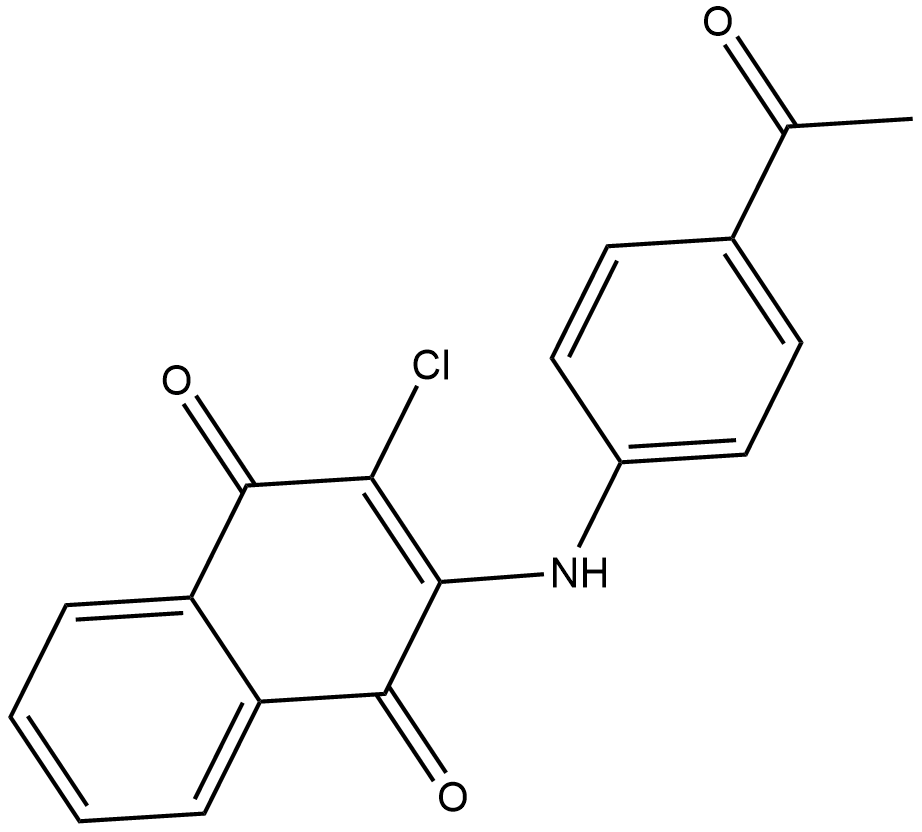
Cas No.: 130089-98-4
Sample solution is provided at 25 µL, 10mM.
_1-3.$$$39978408@51.jpg');)
_1-9.$$$38538795@65.jpg');)
_1-9.$$$39112701@51.jpg');)
_1-7.$$$37316672@70.jpg');)
_366-372.$$$36198801@70.jpg');)
.$$$38565142@65.jpg');)
_1867-1883.$$$33248023@67.jpg');)
_eads6055.$$$39977546@45.jpg');)
_eadm9805.$$$40080571@45.jpg');)
_eadj3020.$$$39666821@45.jpg');)
_1-20.$$$39757301@28.jpg');)
_1-24.$$$38898113@28.jpg');)
_273-287.$$$36806353@46.jpg');)
_1-16.$$$37156877@44.jpg');)
_1-19.$$$37460805@44.jpg');)
_1291-1307.$$$34518654@46.jpg');)
NQ301 is an antithrombotic agent; inhibits collagen-challenged rabbit platelet aggregation with an IC50 of 10 mg/mL.
NQ301 concentration-dependently inhibits collagen (10 mg/mL)-, U46619 (1 mg/mL)- and arachidonic acid (100 mg/mL)-challenged rabbit platelet aggregation, with IC50 values of 0.60±0.02, 0.58±0.04 and 0.78±0.04 μM, respectively. NQ301 potently suppresses thromboxane B2 formation by platelets that are exposed to arachidonic acid in a concentration-dependent manner, but had no effect on the production of prostaglandin D2, indicating an inhibitory effect on thromboxane A2 synthase. NQ301 has a potential to inhibit thromboxane A2 synthase activity with thromboxane A2/prostaglandin H2 receptor blockade, and modulate arachidonic acid liberation as well as 12-hydroxy-5,8,10,14-eicosatetraenoic acid formation in platelets[1]. NQ301 inhibits platelet aggregation by suppression of the intracellular pathway, rather than by direct inhibition of fibrinogen-GPIIb/IIIa complex binding. NQ301 significantly inhibits the increase of cytosolic Ca2+ concentration and ATP secretion, and also significantly increases platelet cAMP levels in the activated platelets. The antiplatelet activity of NQ301 may be mediated by inhibition of cytosolic Ca2+ mobilization, enhancement of cAMP production and inhibition of ATP secretion in activated platelets[2].
References:
[1]. Jin YR, et al. An antithrombotic agent, NQ301, inhibits thromboxane A2 receptor and synthase activity in rabbit platelets. Basic Clin Pharmacol Toxicol. 2005 Sep;97(3):162-7.
[2]. Zhang YH, et al. Antiplatelet effect of 2-chloro-3-(4-acetophenyl)-amino-1,4-naphthoquinone (NQ301): a possible mechanism through inhibition of intracellular Ca2+ mobilization. Biol Pharm Bull. 2001 Jun;24(6):618-22.
Cell experiment: | ished rabbit platelet suspension is challenged by addition of collagen (10 mg/mL), arachidonic acid (100 μM) or U46619 (1 μM). Concentration- response relationship is determined in the absence or presence of a range of concentrations of NQ301 (0, 0.25, 0.5, 0.75, 1 μM); aspirin-treated platelets (50 μM for 5 min) are used to prevent any possible contribution of endogenous arachidonic acid metabolites to platelet aggregation. The resulting aggregation, measured as the change in light transmission, is recorded for 5 min. The extent of platelet aggregation is expressed as % of the control[1]. |
References: [1]. Jin YR, et al. An antithrombotic agent, NQ301, inhibits thromboxane A2 receptor and synthase activity in rabbit platelets. Basic Clin Pharmacol Toxicol. 2005 Sep;97(3):162-7. | |
| Cas No. | 130089-98-4 | SDF | |
| Chemical Name | 2-[(4-acetylphenyl)amino]-3-chloro-1,4-naphthalenedione | ||
| Canonical SMILES | O=C(C(Cl)=C1NC2=CC=C(C(C)=O)C=C2)C3=CC=CC=C3C1=O | ||
| Formula | C18H12ClNO3 | M.Wt | 325.8 |
| Solubility | DMF: 16 mg/ml,DMSO: 14 mg/ml,Ethanol: 2 mg/ml | Storage | Store at -20°C |
| General tips | Please select the appropriate solvent to prepare the stock solution according to the
solubility of the product in different solvents; once the solution is prepared, please store it in
separate packages to avoid product failure caused by repeated freezing and thawing.Storage method
and period of the stock solution: When stored at -80°C, please use it within 6 months; when stored
at -20°C, please use it within 1 month. To increase solubility, heat the tube to 37°C and then oscillate in an ultrasonic bath for some time. |
||
| Shipping Condition | Evaluation sample solution: shipped with blue ice. All other sizes available: with RT, or with Blue Ice upon request. | ||
| Prepare stock solution | |||

|
1 mg | 5 mg | 10 mg |
| 1 mM | 3.0694 mL | 15.3468 mL | 30.6937 mL |
| 5 mM | 613.9 μL | 3.0694 mL | 6.1387 mL |
| 10 mM | 306.9 μL | 1.5347 mL | 3.0694 mL |
Step 1: Enter information below (Recommended: An additional animal making an allowance for loss during the experiment)
 g
μL
g
μL
Step 2: Enter the in vivo formulation (This is only the calculator, not formulation. Please contact us first if there is no in vivo formulation at the solubility Section.)
Calculation results:
Working concentration: mg/ml;
Method for preparing DMSO master liquid: mg drug pre-dissolved in μL DMSO ( Master liquid concentration mg/mL, Please contact us first if the concentration exceeds the DMSO solubility of the batch of drug. )
Method for preparing in vivo formulation: Take μL DMSO master liquid, next addμL PEG300, mix and clarify, next addμL Tween 80, mix and clarify, next add μL saline, mix and clarify.
Method for preparing in vivo formulation: Take μL DMSO master liquid, next add μL Corn oil, mix and clarify.
Note: 1. Please make sure the liquid is clear before adding the next solvent.
2. Be sure to add the solvent(s) in order. You must ensure that the solution obtained, in the previous addition, is a clear solution before proceeding to add the next solvent. Physical methods such as vortex, ultrasound or hot water bath can be used to aid dissolving.
3. All of the above co-solvents are available for purchase on the GlpBio website.
Quality Control & SDS
- View current batch:
- Purity: >98.50% Appearance: A solid
- COA (Certificate of Analysis)
- SDS (Safety Data Sheet)
- Datasheet
Average Rating: 5 (Based on Reviews and 33 reference(s) in Google Scholar.)