

NSC232003 |
Catalog No.GC32721
 One-Click Copy Product Info
|

NSC232003 is a small molecule inhibitor targeting UHRF1.
Products are for research use only. Not for human use. We do not sell to patients.
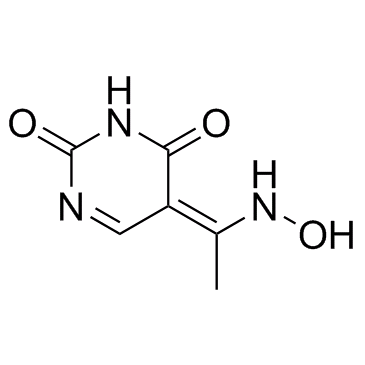
Cas No.: 1905453-18-0
Sample solution is provided at 25 µL, 10mM.
_1-3.$$$39978408@51.jpg');)
_1-9.$$$38538795@65.jpg');)
_1-9.$$$39112701@51.jpg');)
_1-7.$$$37316672@70.jpg');)
_366-372.$$$36198801@70.jpg');)
.$$$38565142@65.jpg');)
_1867-1883.$$$33248023@67.jpg');)
_eads6055.$$$39977546@45.jpg');)
_eadm9805.$$$40080571@45.jpg');)
_eadj3020.$$$39666821@45.jpg');)
_1-20.$$$39757301@28.jpg');)
_1-24.$$$38898113@28.jpg');)
_273-287.$$$36806353@46.jpg');)
_1-16.$$$37156877@44.jpg');)
_1-19.$$$37460805@44.jpg');)
_1291-1307.$$$34518654@46.jpg');)
NSC232003 is a small molecule inhibitor targeting UHRF1 [1]. NSC232003 binds to the 5-methylcytosine recognition pocket of the SRA domain of UHRF1, thereby interfering with the interaction between UHRF1 and DNMT1, leading to a decrease in intracellular DNA methylation levels [2-3]. NSC232003 is primarily focused on tumor and epigenetic interventions [4].
In NRK-49F cells, NSC232003 (50μM; 1h) significantly reduced TGF-β1-induced KLF15 hypermethylation, while also decreasing the expression of α-SMA and fibronectin [5]. In fibroblasts, NSC232003 (5μM; 4h) exerts a significant anti-fibrotic effect by inhibiting the protein expression of fibrosis markers [6].
In KYSE450 cells xenograft mouse model, NSC232003 (5 mg/kg; ip; 3 weeks) significantly inhibited UHRF1 activity, and its combination with the DNMT inhibitor SGI-1027 more effectively suppressed NKX2-5/LHX1 expression and tumor growth by disrupting the UHRF1-DNMT positive feedback loop [7].
References:
[1]. Myrianthopoulos V, Cartron P F, Liutkevičiūtė Z, et al. Tandem virtual screening targeting the SRA domain of UHRF1 identifies a novel chemical tool modulating DNA methylation[J]. European journal of medicinal chemistry, 2016, 114: 390-396.
[2]. Patnaik D, Estève P O, Pradhan S. Targeting the SET and RING-associated (SRA) domain of ubiquitin-like, PHD and ring finger–containing 1 (UHRF1) for anti-cancer drug development[J]. Oncotarget, 2018, 9(40): 26243.
[3]. Song Y, Liu H, Xian Q, et al. Mechanistic insights into UHRF1‑mediated DNA methylation by structure‑based functional clarification of UHRF1 domains[J]. Oncology Letters, 2023, 26(6): 542.
[4]. Kim A, Benavente C A. Oncogenic roles of UHRF1 in cancer[J]. Epigenomes, 2024, 8(3): 26.
[5]. Gu Y, Lv S, Huang X, et al. Inhibition of epigenetic regulator UHRF1 attenuates renal fibrosis and retains transcription factor Krüppel-like factor 15 expression[J]. Cell Death Discovery, 2025, 11(1): 270.
[6]. Cheng D, Wang Y, Li Z, et al. Liposomal UHRF1 siRNA shows lung fibrosis treatment potential through regulation of fibroblast activation[J]. JCI insight, 2022, 7(22): e162831.
[7]. Li X, Fan D, Li Y, et al. NKX2‐5/LHX1 and UHRF1 Establishing a Positive Feedback Regulatory Circuitry Drives Esophageal Squamous Cell Carcinoma through Epigenetic Dysregulation[J]. Advanced Science, 2025, 12(20): 2413508.
| Cell experiment [1]: | |
Cell lines | NRK-49F cells |
Preparation Method | NRK-49F cells were starved overnight in DMEM containing 0% FBS prior to any stimulation. Pre-incubation of 50μM NSC232003 was carried out 1h before TGF-β1 treatment. The dosage levels and times of TGF-β1 were adopted as indicated. Cells were free from mycoplasma contamination. |
Reaction Conditions | 50μM; 1h |
Applications | NSC232003 significantly reduced TGF-β1-induced KLF15 hypermethylation, while also decreasing the expression of α-SMA and fibronectin. |
| Animal experiment [2]: | |
Animal models | KYSE450 cells xenograft mice tumor model |
Preparation Method | KYSE450 cells were implanted into BALB/c nude mice. One week later, the mice were randomly divided into four groups, receiving either the vector, NSC232003 (5mg/kg), SGI-1027 (5mg/kg), or a combination of NSC232003 and SGI-1027, respectively. The inhibitor was administered intraperitoneally for 3 weeks. Tumor size was measured every 3-4 days, and the tumor was resected 3 weeks after implantation. |
Dosage form | 5mg/kg; ip; once in 3 weeks |
Applications | NSC232003 significantly inhibited UHRF1 activity. When used in combination with the DNMT inhibitor SGI-1027, it can more effectively downregulate NKX2-5/LHX1 expression, block the UHRF1-DNMT positive feedback loop, and inhibit the growth of esophageal squamous cell carcinoma. |
References: | |
| Cas No. | 1905453-18-0 | SDF | |
| Canonical SMILES | O=C1NC(/C(C=N1)=C(NO)/C)=O | ||
| Formula | C6H7N3O3 | M.Wt | 169.14 |
| Solubility | Water : 17 mg/mL (100.51 mM);DMSO : < 1 mg/mL (insoluble or slightly soluble) | Storage | Store at -20°C |
| General tips | Please select the appropriate solvent to prepare the stock solution according to the
solubility of the product in different solvents; once the solution is prepared, please store it in
separate packages to avoid product failure caused by repeated freezing and thawing.Storage method
and period of the stock solution: When stored at -80°C, please use it within 6 months; when stored
at -20°C, please use it within 1 month. To increase solubility, heat the tube to 37°C and then oscillate in an ultrasonic bath for some time. |
||
| Shipping Condition | Evaluation sample solution: shipped with blue ice. All other sizes available: with RT, or with Blue Ice upon request. | ||
| Prepare stock solution | |||

|
1 mg | 5 mg | 10 mg |
| 1 mM | 5.9123 mL | 29.5613 mL | 59.1226 mL |
| 5 mM | 1.1825 mL | 5.9123 mL | 11.8245 mL |
| 10 mM | 591.2 μL | 2.9561 mL | 5.9123 mL |
Step 1: Enter information below (Recommended: An additional animal making an allowance for loss during the experiment)
 g
μL
g
μL
Step 2: Enter the in vivo formulation (This is only the calculator, not formulation. Please contact us first if there is no in vivo formulation at the solubility Section.)
Calculation results:
Working concentration: mg/ml;
Method for preparing DMSO master liquid: mg drug pre-dissolved in μL DMSO ( Master liquid concentration mg/mL, Please contact us first if the concentration exceeds the DMSO solubility of the batch of drug. )
Method for preparing in vivo formulation: Take μL DMSO master liquid, next addμL PEG300, mix and clarify, next addμL Tween 80, mix and clarify, next add μL saline, mix and clarify.
Method for preparing in vivo formulation: Take μL DMSO master liquid, next add μL Corn oil, mix and clarify.
Note: 1. Please make sure the liquid is clear before adding the next solvent.
2. Be sure to add the solvent(s) in order. You must ensure that the solution obtained, in the previous addition, is a clear solution before proceeding to add the next solvent. Physical methods such as vortex, ultrasound or hot water bath can be used to aid dissolving.
3. All of the above co-solvents are available for purchase on the GlpBio website.
Quality Control & SDS
- View current batch:
- Purity: >98.00% Appearance: A solid
- COA (Certificate of Analysis)
- SDS (Safety Data Sheet)
- Datasheet
Average Rating: 5 (Based on Reviews and 12 reference(s) in Google Scholar.)