

Pamidronate |
Catalog No.GC11115
 One-Click Copy Product Info
|

Pamidronate is a drug used to treat a broad spectrum of bone absorption diseases.
Products are for research use only. Not for human use. We do not sell to patients.
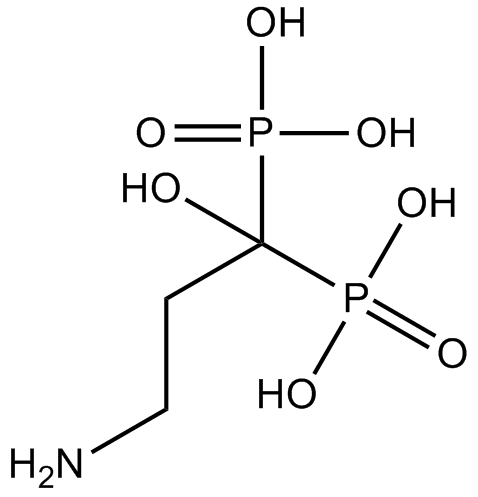
Cas No.: 40391-99-9
Sample solution is provided at 25 µL, 10mM.
_1-3.$$$39978408@51.jpg');)
_1-9.$$$38538795@65.jpg');)
_1-9.$$$39112701@51.jpg');)
_1-7.$$$37316672@70.jpg');)
_366-372.$$$36198801@70.jpg');)
.$$$38565142@65.jpg');)
_1867-1883.$$$33248023@67.jpg');)
_eads6055.$$$39977546@45.jpg');)
_eadm9805.$$$40080571@45.jpg');)
_eadj3020.$$$39666821@45.jpg');)
_1-20.$$$39757301@28.jpg');)
_1-24.$$$38898113@28.jpg');)
_273-287.$$$36806353@46.jpg');)
_1-16.$$$37156877@44.jpg');)
_1-19.$$$37460805@44.jpg');)
_1291-1307.$$$34518654@46.jpg');)
Pamidronic acid is a drug used to treat a broad spectrum of bone absorption diseases.
Osteosarcoma cell viability decreases significantly in a concentration- and time-dependent manner at pamidronate concentrations ranging from 100 to 1000 μM, most consistently after 48 and 72 hours' exposure. In treated osteosarcoma cells, the lowest percentage cell viability is 34% (detected after 72 hours' exposure to 1000μM pamidronate)[1]. Pamidronate disodium inhibits Wnt and β-catenin signaling, which controls osteogenic differentiation in BMMSCs. Wnt3a, a Wnt and β-catenin signaling activator, reverses the negative effects caused by pamidronate disodium to salvage the osteogenic defect in BMMSCs[2].
Pamidronic acid can significantly inhibit and even reverse early osteoarthritic subchondral bone loss, thus alleviating the process of cartilaginous degeneration. The mechanisms involved may be associated with the upregulation of OPG expression, and downregulation of RANKL, MMP-9 and TLR-4 expression[3].
Reference:
[1]. Ashton JA, et al. Investigation of the effect of pamidronate disodium on the in vitro viability of osteosarcoma cellsfrom dogs. Am J Vet Res. 2005 May;66(5):885-91.
[2]. Xu Y, et al. Pamidronate Disodium Leads to Bone Necrosis via Suppression of Wnt/β-Catenin Signaling in Human Bone Marrow Mesenchymal Stem Cells In Vitro. J Oral Maxillofac Surg. 2017 Mar 22.
[3]. Lv Y, et al. Effects of pamidronate disodium on the loss of osteoarthritic subchondral bone and the expression of cartilaginous and subchondral osteoprotegerin and RANKL in rabbits. BMC Musculoskelet Disord. 2014 Nov 6;15:370.
Cell experiment: | Cell counts and cell viability assays are performed in cultures of osteosarcoma cells (POS, HMPOS, and COS31 cell lines) and fibroblasts after 24, 48, and 72 hours of incubation with pamidronate at concentrations of 0.001 to 1000 microM or with no drug (control treatment). Percentage viability is determined in cell samples for each concentration of pamidronate and each incubation time. A DNA fragmentation analysis is performed to assess bisphosphonate-induced apoptosis[1]. |
Animal experiment: | Rabbits: The rabbits are randomly divided into four groups. Sham-operated with vehicle treatment, OA induced by ACLT with vehicle treatment, OA-induced ACLT treated with short-term pamidronic acid treatment after ACLT, and ACLT treated with long-term PAM treatment. PAM is injected at the 4th week after ACLT in PAM-S and PAM-L groups, and followed by once monthly ear vein injections at a dosage of 3 mg/kg body weight. In the other groups, only saline infusions of equal volumes are administered. 10 animals are humanely sacrificed at both 2 and 10 weeks after pamidronic acid treatment. In the ACLT and Sham groups, five animals are sacrificed at 2, 4, 6, and 14 weeks after model establishment[3]. |
References: [1]. Ashton JA, et al. Investigation of the effect of pamidronate disodium on the in vitro viability of osteosarcoma cellsfrom dogs. Am J Vet Res. 2005 May;66(5):885-91. | |
| Cas No. | 40391-99-9 | SDF | |
| Chemical Name | (3-amino-1-hydroxy-1-phosphonopropyl)phosphonic acid | ||
| Canonical SMILES | C(CN)C(O)(P(=O)(O)O)P(=O)(O)O | ||
| Formula | C3H11NO7P2 | M.Wt | 235.07 |
| Solubility | ≥ 2.35mg/mL in Water with gentle warming, <2.35mg/mL in DMSO | Storage | -20°C, protect from light |
| General tips | Please select the appropriate solvent to prepare the stock solution according to the
solubility of the product in different solvents; once the solution is prepared, please store it in
separate packages to avoid product failure caused by repeated freezing and thawing.Storage method
and period of the stock solution: When stored at -80°C, please use it within 6 months; when stored
at -20°C, please use it within 1 month. To increase solubility, heat the tube to 37°C and then oscillate in an ultrasonic bath for some time. |
||
| Shipping Condition | Evaluation sample solution: shipped with blue ice. All other sizes available: with RT, or with Blue Ice upon request. | ||
| Prepare stock solution | |||

|
1 mg | 5 mg | 10 mg |
| 1 mM | 4.2541 mL | 21.2703 mL | 42.5405 mL |
| 5 mM | 850.8 μL | 4.2541 mL | 8.5081 mL |
| 10 mM | 425.4 μL | 2.127 mL | 4.2541 mL |
Step 1: Enter information below (Recommended: An additional animal making an allowance for loss during the experiment)
 g
μL
g
μL
Step 2: Enter the in vivo formulation (This is only the calculator, not formulation. Please contact us first if there is no in vivo formulation at the solubility Section.)
Calculation results:
Working concentration: mg/ml;
Method for preparing DMSO master liquid: mg drug pre-dissolved in μL DMSO ( Master liquid concentration mg/mL, Please contact us first if the concentration exceeds the DMSO solubility of the batch of drug. )
Method for preparing in vivo formulation: Take μL DMSO master liquid, next addμL PEG300, mix and clarify, next addμL Tween 80, mix and clarify, next add μL saline, mix and clarify.
Method for preparing in vivo formulation: Take μL DMSO master liquid, next add μL Corn oil, mix and clarify.
Note: 1. Please make sure the liquid is clear before adding the next solvent.
2. Be sure to add the solvent(s) in order. You must ensure that the solution obtained, in the previous addition, is a clear solution before proceeding to add the next solvent. Physical methods such as vortex, ultrasound or hot water bath can be used to aid dissolving.
3. All of the above co-solvents are available for purchase on the GlpBio website.
Quality Control & SDS
- View current batch:
- Purity: >98.00% Appearance: A solid
- COA (Certificate of Analysis)
- SDS (Safety Data Sheet)
- Datasheet
Average Rating: 5 (Based on Reviews and 27 reference(s) in Google Scholar.)