

Fluvoxamine |
Catalog No.GC13092
 One-Click Copy Product Info
|

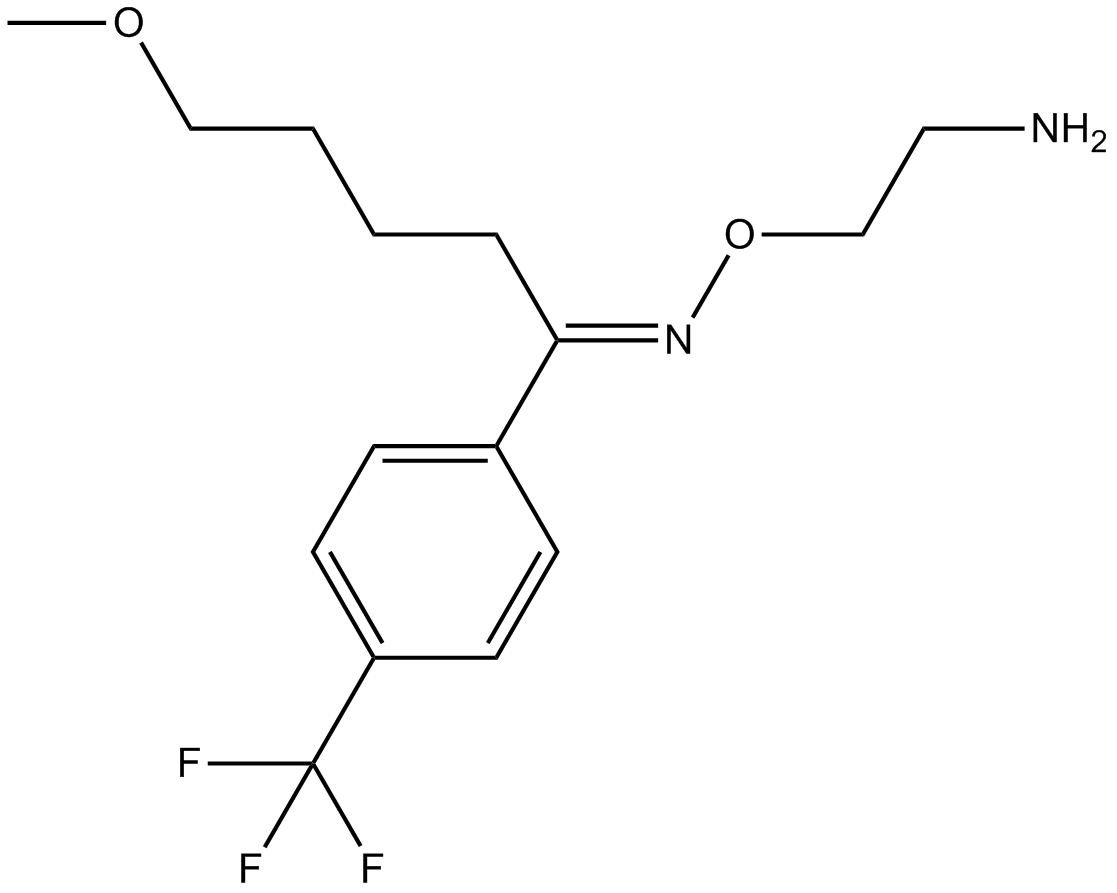
Fluvoxamine is a selective serotonin (5-HT) reuptake inhibitor (SSRI) with antidepressant activity.
Products are for research use only. Not for human use. We do not sell to patients.
Cas No.: 54739-18-3
Sample solution is provided at 25 µL, 10mM.
_1-3.$$$39978408@51.jpg');)
_1-9.$$$38538795@65.jpg');)
_1-9.$$$39112701@51.jpg');)
_1-7.$$$37316672@70.jpg');)
_366-372.$$$36198801@70.jpg');)
.$$$38565142@65.jpg');)
_1867-1883.$$$33248023@67.jpg');)
_eads6055.$$$39977546@45.jpg');)
_eadm9805.$$$40080571@45.jpg');)
_eadj3020.$$$39666821@45.jpg');)
_1-20.$$$39757301@28.jpg');)
_1-24.$$$38898113@28.jpg');)
_273-287.$$$36806353@46.jpg');)
_1-16.$$$37156877@44.jpg');)
_1-19.$$$37460805@44.jpg');)
_1291-1307.$$$34518654@46.jpg');)
Fluvoxamine is a selective serotonin (5-HT) reuptake inhibitor (SSRI) with antidepressant activity[1, 2]. Fluvoxamine is a σ1 receptor agonist and increases the extracellular levels of monoamines in the prefrontal cortex[3]. Fluvoxamine activates 5-HT3 and sigma-1 receptors in the prefrontal cortex of C57BL/6 mice subjected to chronic stress, thereby promoting glutamate release[4].
In vitro, Fluvoxamine (0-50μM) treatment of three different human glioblastoma cell lines (A172, U87-MG, and U251-MG) significantly inhibited cell migration in a dose-dependent manner, and also inhibited U87-MG cell invasion[5].
In vivo, oral administration of Fluvoxamine (25, 50, 100, 200mg/kg) to rats with gastric ulcers significantly reduced ulceration and increased the levels of antioxidant markers (total glutathione and nitric oxide) in the gastric tissue[6]. Intraperitoneal injection of Fluvoxamine (20mg/kg) in rats with cerebral ischemia significantly improved motor function, reduced infarct volume, and ameliorated neurological deficits[7].
References:
[1] Koek W, Sandoval T L, Daws L C. Effects of the antidepressants desipramine and fluvoxamine on latency to immobility and duration of immobility in the forced swim test in adult male C57BL/6J mice[J]. Behavioural pharmacology, 2018, 29(5): 453-456.
[2] Westenberg H G M, Sandner C. Tolerability and safety of fluvoxamine and other antidepressants[J]. International Journal of Clinical Practice, 2006, 60(4): 482-491.
[3] Ago Y, Yano K, Hiramatsu N, et al. Fluvoxamine enhances prefrontal dopaminergic neurotransmission in adrenalectomized/castrated mice via both 5-HT reuptake inhibition and σ1 receptor activation[J]. Psychopharmacology, 2011, 217(3): 377-386.
[4] Fu Y, Yu S, Guo X, et al. Fluvoxamine increased glutamate release by activating both 5-HT3 and sigma-1 receptors in prelimbic cortex of chronic restraint stress C57BL/6 mice[J]. Biochimica et Biophysica Acta (BBA)-Molecular Cell Research, 2012, 1823(4): 826-837.
[5] Hayashi K, Michiue H, Yamada H, et al. Fluvoxamine, an anti-depressant, inhibits human glioblastoma invasion by disrupting actin polymerization[J]. Scientific reports, 2016, 6(1): 23372.
[6] Dursun H, Bilici M, Albayrak F, et al. Antiulcer activity of fluvoxamine in rats and its effect on oxidant and antioxidant parameters in stomach tissue[J]. BMC gastroenterology, 2009, 9(1): 36.
[7] Sato S, Kawamata T, Kobayashi T, et al. Antidepressant fluvoxamine reduces cerebral infarct volume and ameliorates sensorimotor dysfunction in experimental stroke[J]. Neuroreport, 2014, 25(10): 731-736.
| Cell experiment [1]: | |
Cell lines | A172, U87-MG, U251-MG cells |
Preparation Method | A172, U87-MG, and U251-MG cells were serum-starved for 24h, treated with Fluvoxamine (0, 25, or 50μM), and processed for wound-healing assay. |
Reaction Conditions | 0, 25, 50μM; 24h |
Applications | Fluvoxamine effectively inhibited the migration of three different human GBM cell lines (A172, U87-MG, and U251-MG) in a dose-dependent manner. |
| Animal experiment [2]: | |
Animal models | Wistar rats |
Preparation Method | Groups of rats fasted for 24h received Fluvoxamine (25, 50, 100 and 200mg/kg), ranitidine (50mg/kg) or distilled water by oral gavage. Indomethacin (25mg/kg) was orally administered to the rats as an ulcerative agent. Six hours after ulcer induction, the stomachs of the rats were excised and an ulcer index determined. Separate groups of rats were treated with the same doses of Fluvoxamine and ranitidine, but not with indomethacin, to test effects of these drugs alone on biochemical parameters. The stomachs were evaluated biochemically to determine oxidant and antioxidant parameters. |
Dosage form | 25, 50, 100, 200mg/kg; p.o. |
Applications | The 25, 50, 100 and 200mg/kg doses of Fluvoxamine exerted antiulcer effects of 48.5, 67.5, 82.1 and 96.1%, respectively, compared to the control rat group. |
References: | |
| Cas No. | 54739-18-3 | SDF | |
| Chemical Name | 2-[(E)-[5-methoxy-1-[4-(trifluoromethyl)phenyl]pentylidene]amino]oxyethanamine | ||
| Canonical SMILES | COCCCCC(=NOCCN)C1=CC=C(C=C1)C(F)(F)F | ||
| Formula | C15H21F3N2O2 | M.Wt | 318.33 |
| Solubility | ≥ 15.92mg/mL in DMSO | Storage | Store at -20°C |
| General tips | Please select the appropriate solvent to prepare the stock solution according to the
solubility of the product in different solvents; once the solution is prepared, please store it in
separate packages to avoid product failure caused by repeated freezing and thawing.Storage method
and period of the stock solution: When stored at -80°C, please use it within 6 months; when stored
at -20°C, please use it within 1 month. To increase solubility, heat the tube to 37°C and then oscillate in an ultrasonic bath for some time. |
||
| Shipping Condition | Evaluation sample solution: shipped with blue ice. All other sizes available: with RT, or with Blue Ice upon request. | ||
| Prepare stock solution | |||

|
1 mg | 5 mg | 10 mg |
| 1 mM | 3.1414 mL | 15.707 mL | 31.4139 mL |
| 5 mM | 628.3 μL | 3.1414 mL | 6.2828 mL |
| 10 mM | 314.1 μL | 1.5707 mL | 3.1414 mL |
Step 1: Enter information below (Recommended: An additional animal making an allowance for loss during the experiment)
 g
μL
g
μL
Step 2: Enter the in vivo formulation (This is only the calculator, not formulation. Please contact us first if there is no in vivo formulation at the solubility Section.)
Calculation results:
Working concentration: mg/ml;
Method for preparing DMSO master liquid: mg drug pre-dissolved in μL DMSO ( Master liquid concentration mg/mL, Please contact us first if the concentration exceeds the DMSO solubility of the batch of drug. )
Method for preparing in vivo formulation: Take μL DMSO master liquid, next addμL PEG300, mix and clarify, next addμL Tween 80, mix and clarify, next add μL saline, mix and clarify.
Method for preparing in vivo formulation: Take μL DMSO master liquid, next add μL Corn oil, mix and clarify.
Note: 1. Please make sure the liquid is clear before adding the next solvent.
2. Be sure to add the solvent(s) in order. You must ensure that the solution obtained, in the previous addition, is a clear solution before proceeding to add the next solvent. Physical methods such as vortex, ultrasound or hot water bath can be used to aid dissolving.
3. All of the above co-solvents are available for purchase on the GlpBio website.
Quality Control & SDS
- View current batch:
- Purity: >98.00% Appearance: A solid
- COA (Certificate of Analysis)
- SDS (Safety Data Sheet)
- Datasheet
Average Rating: 5 (Based on Reviews and 3 reference(s) in Google Scholar.)