

PHCCC |
Catalog No.GC17383
 One-Click Copy Product Info
|

PHCCC is a group I mGluR antagonist with an IC50 value of 3μM.
Products are for research use only. Not for human use. We do not sell to patients.
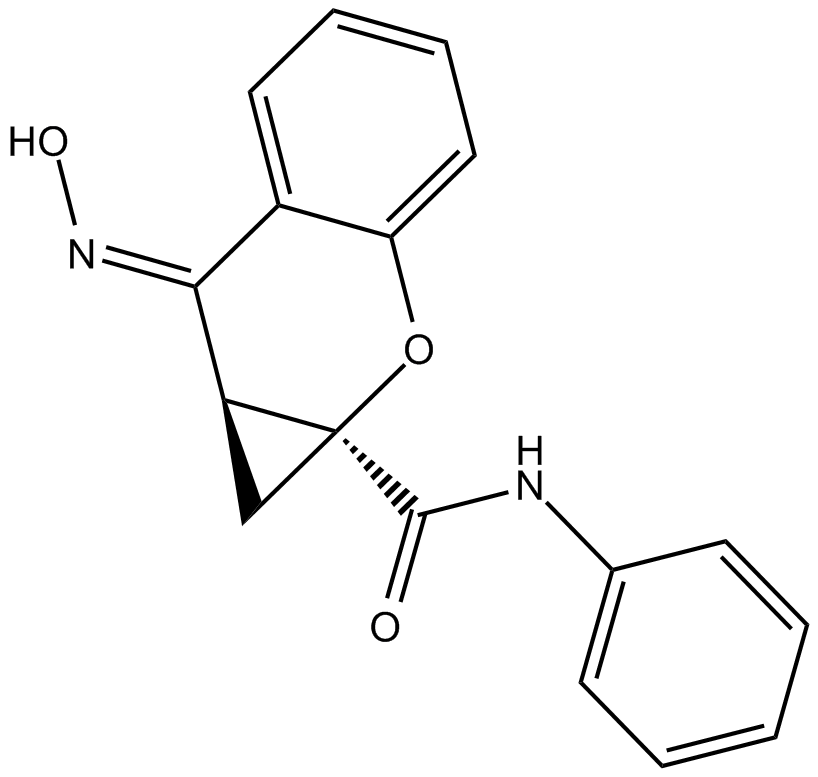
Cas No.: 179068-02-1
Sample solution is provided at 25 µL, 10mM.
_1-3.$$$39978408@51.jpg');)
_1-9.$$$38538795@65.jpg');)
_1-9.$$$39112701@51.jpg');)
_1-7.$$$37316672@70.jpg');)
_366-372.$$$36198801@70.jpg');)
.$$$38565142@65.jpg');)
_1867-1883.$$$33248023@67.jpg');)
_eads6055.$$$39977546@45.jpg');)
_eadm9805.$$$40080571@45.jpg');)
_eadj3020.$$$39666821@45.jpg');)
_1-20.$$$39757301@28.jpg');)
_1-24.$$$38898113@28.jpg');)
_273-287.$$$36806353@46.jpg');)
_1-16.$$$37156877@44.jpg');)
_1-19.$$$37460805@44.jpg');)
_1291-1307.$$$34518654@46.jpg');)
PHCCC is a group I mGluR antagonist with an IC50 value of 3μM [1]. PHCCC acts as the small molecule glutamate receptor enhancer, altering the functions of dendritic cells to metabolize glutamate, skewing cytokine secretion to bias T cell function [2]. PHCCC has been widely used to activate the mGlu6 receptor and regulate the natural calcium current in the sympathetic neurons isolated from the superior cervical ganglia of rats[3].
In vitro, PHCCC treatment (30µM) for 5 minutes significantly reduced the activity of the PI-3-K pathway in D283med cells and DAOY cells, and inhibited cAMP production[4]. In the presence of 1μM retinoic acid (RA), treatment with PHCCC (30µM) for 4 days enhanced the differentiation of mouse embryonic stem cells into neuronal lineage cells, resulting in increased expression of early neural markers Dlx-2 and Nestin[5].
In vivo, PHCCC treatment via a single intracerebroventricular injection (75nmol/2.5μl) for 30 minutes significantly reversed the movement disorders induced by reserpine in rats [6]. Intraperitoneal injection of PHCCC at a dose of 10mg/kg every other day for 20 days significantly inhibited tumor growth in the OS18 xenograft mouse model without affecting the body weight of the mice[7]. Subcutaneous injection of PHCCC at a dose of 3mg/kg every three days for 18 days significantly delayed disease progression and alleviated disease severity in mice with experimental autoimmune encephalomyelitis[8].
References:
[1] Recasens M, Guiramand J, Aimar R, et al. Metabotropic glutamate receptors as drug targets[J]. Current Drug Targets, 2007, 8(5): 651-681.
[2] Fallarino F, Volpi C, Fazio F, et al. Metabotropic glutamate receptor-4 modulates adaptive immunity and restrains neuroinflammation[J]. Nature medicine, 2010, 16(8): 897-902.
[3] Beqollari D, Kammermeier P J. The mGlu4 receptor allosteric modulator N-phenyl-7-(hydroxyimino) cyclopropa [b] chromen-1a-carboxamide acts as a direct agonist at mGlu6 receptors[J]. European journal of pharmacology, 2008, 589(1-3): 49-52.
[4] Iacovelli L, Arcella A, Battaglia G, et al. Pharmacological activation of mGlu4 metabotropic glutamate receptors inhibits the growth of medulloblastomas[J]. Journal of Neuroscience, 2006, 26(32): 8388-8397.
[5] Sarichelou I, Cappuccio I, Ferranti F, et al. Metabotropic glutamate receptors regulate differentiation of embryonic stem cells into GABAergic neurons[J]. Cell Death & Differentiation, 2008, 15(4): 700-707.
[6] Marino M J, Williams Jr D L, O'Brien J A, et al. Allosteric modulation of group III metabotropic glutamate receptor 4: a potential approach to Parkinson's disease treatment[J]. Proceedings of the National Academy of Sciences, 2003, 100(23): 13668-13673.
[7] Kansara M, Thomson K, Pang P, et al. Infiltrating myeloid cells drive osteosarcoma progression via GRM4 regulation of IL23[J]. Cancer discovery, 2019, 9(11): 1511-1519.
[8] Gammon J M, Tostanoski L H, Adapa A R, et al. Controlled delivery of a metabolic modulator promotes regulatory T cells and restrains autoimmunity[J]. Journal of Controlled Release, 2015, 210: 169-178.
| Cell experiment [1]: | |
Cell lines | D283med cells |
Preparation Method | D283med cells were cultured in Dulbecco’s modified Eagle’s medium/Nutrient Mix F12 supplemented with 10% fetal bovine serum, 100U/ml penicillin, and 100μg/ml streptomycin at 37°C with 5% CO2 and 95% saturated atmospheric humidity. Cells were seeded into 96-well microplates at a density of 3×10⁴ cells/well. After 24h, cells were serum starved for 16-18h and challenged with different concentrations of PHCCC (0, 0.3, 3, 10, and 30µM) for 24h. [3H]Thymidine (1μCi/well) was added for the last 16-18h. The DNA synthesis in D283med cells was analyzed. |
Reaction Conditions | 0, 0.3, 3, 10, and 30µM; 24h |
Applications | PHCCC treatment significantly reduced DNA synthesis in D283med cells in a dose-dependent manner. |
| Animal experiment [2]: | |
Animal models | C57B6/J mice |
Preparation Method | C57B6/J mice, 7 weeks old, were maintained under a 12-h light and 12-h dark cycle at a temperature of 25°C and humidity of 50%±10%, free with water and diet. OS18 cells were mixed with 1:1 Matrigel: Minimum Essential medium, and a total volume of 100μl (106 cells) was injected subcutaneously in the flank. Mice were monitored for tumor growth relative to the adjacent non-tumor cell-injected leg. One week later, a 10mg/kg dose of PHCCC was intraperitoneally injected every other day for 20 days. The tumor growth and body weight of the mice were analyzed. |
Dosage form | 10mg/kg; every other day for 20 days; i.p. |
Applications | PHCCC significantly inhibited tumor growth in the OS18 xenograft mouse model without affecting the body weight. |
References: | |
| Cas No. | 179068-02-1 | SDF | |
| Chemical Name | (1aS,7aS,Z)-7-(hydroxyimino)-N-phenyl-1,1a,7,7a-tetrahydrocyclopropa[b]chromene-1a-carboxamide | ||
| Canonical SMILES | O=C([C@]1([C@H]/2C1)OC3=CC=CC=C3C2=N/O)NC4=CC=CC=C4 | ||
| Formula | C17H14N2O3 | M.Wt | 294.31 |
| Solubility | Soluble in DMSO | Storage | Store at -20°C |
| General tips | Please select the appropriate solvent to prepare the stock solution according to the
solubility of the product in different solvents; once the solution is prepared, please store it in
separate packages to avoid product failure caused by repeated freezing and thawing.Storage method
and period of the stock solution: When stored at -80°C, please use it within 6 months; when stored
at -20°C, please use it within 1 month. To increase solubility, heat the tube to 37°C and then oscillate in an ultrasonic bath for some time. |
||
| Shipping Condition | Evaluation sample solution: shipped with blue ice. All other sizes available: with RT, or with Blue Ice upon request. | ||
| Prepare stock solution | |||

|
1 mg | 5 mg | 10 mg |
| 1 mM | 3.3978 mL | 16.9889 mL | 33.9778 mL |
| 5 mM | 679.6 μL | 3.3978 mL | 6.7956 mL |
| 10 mM | 339.8 μL | 1.6989 mL | 3.3978 mL |
Step 1: Enter information below (Recommended: An additional animal making an allowance for loss during the experiment)
 g
μL
g
μL
Step 2: Enter the in vivo formulation (This is only the calculator, not formulation. Please contact us first if there is no in vivo formulation at the solubility Section.)
Calculation results:
Working concentration: mg/ml;
Method for preparing DMSO master liquid: mg drug pre-dissolved in μL DMSO ( Master liquid concentration mg/mL, Please contact us first if the concentration exceeds the DMSO solubility of the batch of drug. )
Method for preparing in vivo formulation: Take μL DMSO master liquid, next addμL PEG300, mix and clarify, next addμL Tween 80, mix and clarify, next add μL saline, mix and clarify.
Method for preparing in vivo formulation: Take μL DMSO master liquid, next add μL Corn oil, mix and clarify.
Note: 1. Please make sure the liquid is clear before adding the next solvent.
2. Be sure to add the solvent(s) in order. You must ensure that the solution obtained, in the previous addition, is a clear solution before proceeding to add the next solvent. Physical methods such as vortex, ultrasound or hot water bath can be used to aid dissolving.
3. All of the above co-solvents are available for purchase on the GlpBio website.
Quality Control & SDS
- View current batch:
- Purity: >98.00% Appearance: A solid
- COA (Certificate of Analysis)
- SDS (Safety Data Sheet)
- Datasheet
Average Rating: 5 (Based on Reviews and 20 reference(s) in Google Scholar.)