

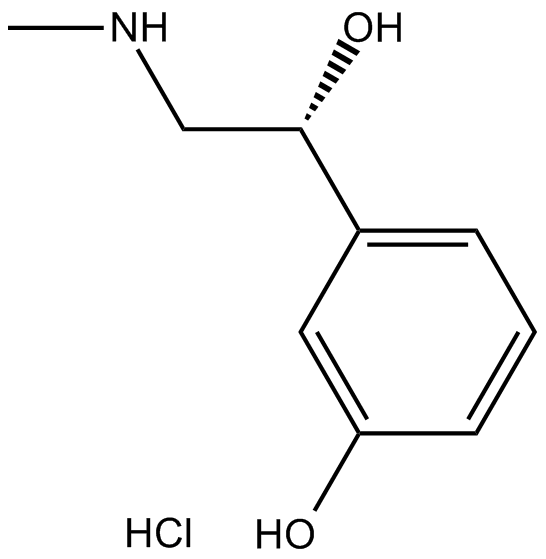
Phenylephrine HCl (Synonyms: (R)-(-)-Phenylephrine) |
Catalog No.GC11272
 One-Click Copy Product Info
|

Phenylephrine HCl is a selective α1-adrenergic receptor agonist.
Products are for research use only. Not for human use. We do not sell to patients.
Cas No.: 61-76-7
Sample solution is provided at 25 µL, 10mM.
_1-3.$$$39978408@51.jpg');)
_1-9.$$$38538795@65.jpg');)
_1-9.$$$39112701@51.jpg');)
_1-7.$$$37316672@70.jpg');)
_366-372.$$$36198801@70.jpg');)
.$$$38565142@65.jpg');)
_1867-1883.$$$33248023@67.jpg');)
_eads6055.$$$39977546@45.jpg');)
_eadm9805.$$$40080571@45.jpg');)
_eadj3020.$$$39666821@45.jpg');)
_1-20.$$$39757301@28.jpg');)
_1-24.$$$38898113@28.jpg');)
_273-287.$$$36806353@46.jpg');)
_1-16.$$$37156877@44.jpg');)
_1-19.$$$37460805@44.jpg');)
_1291-1307.$$$34518654@46.jpg');)
Phenylephrine HCl is a selective α1-adrenergic receptor agonist[1]. Phenylephrine HCl is commonly used to treat symptoms such as hypotension and nasal congestion[2]. Phenylephrine HCl can induce cardiac hypertrophy[3].
In vitro, phenylephrine HCl (0.1, 1, 10μM) treated cardiac fibroblasts for 48h stimulated cell proliferation in a dose-dependent manner, upregulated calcineurin (CaN) levels, and caused nuclear factor of activated T cells 3 (NFAT3) nuclear translocation[4].
In vivo, phenylephrine HCl (0.001-10μM) was injected into the alveolar cavity to treat rats with high tidal volume (HVT) mechanical ventilation-induced lung injury, which increased the alveolar fluid clearance (AFC) of rats and accelerated the absorption of pulmonary edema[5].
References:
[1] Bouchelouche K, Andersen L, Alvarez S, et al. Increased contractile response to phenylephrine in detrusor of patients with bladder outlet obstruction: effect of the α1A and α1D-adrenergic receptor antagonist tamsulosin[J]. The Journal of urology, 2005, 173(2): 657-661.
[2] Eccles R. Substitution of phenylephrine for pseudoephedrine as a nasal decongeststant. An illogical way to control methamphetamine abuse[J]. British journal of clinical pharmacology, 2007, 63(1): 10-14.
[3] Zheng J, Tian J, Wang S, et al. Stachydrine hydrochloride suppresses phenylephrine-induced pathological cardiac hypertrophy by inhibiting the calcineurin/nuclear factor of activated T-cell signalling pathway[J]. European Journal of Pharmacology, 2020, 883: 173386.
[4] Wang J, Wang Y, Zhang W, et al. Phenylephrine promotes cardiac fibroblast proliferation through calcineurin-NFAT pathway[J]. development, 2016.
[5] Li N, Gu X, Li W, et al. Effect of phenylephrine on alveolar fluid clearance in ventilator-induced lung injury[J]. Chinese Medical Sciences Journal, 2013, 28(1): 1-6.
| Cell experiment [1]: | |
Cell lines | Cardiac fibroblasts (CFs) |
Preparation Method | Growth-arrested CFs were stimulated with various concentrations of Phenylephrine HCl (0.1, 1, 10μM) for 48h. Optical density with MTT labeling. |
Reaction Conditions | 0.1, 1, 10μM; 48h |
Applications | Phenylephrine HCl stimulates CFs proliferation in a dose-dependent manner. |
| Animal experiment [2]: | |
Animal models | Wistar rats |
Preparation Method | A total of 170 male Wistar rats are randomLy allocated into 17 groups (n=10) using random number tables. Short-term (40min) mechanical ventilation with high tidal volume is performed to induce lung injury, impair active Na+ transport and lung liquid clearance in the rats. Unventilated rats serves as controls. To demonstrate the effect of phenylephrine on alveolar fluid clearance, Phenylephrine HCl at different concentrations (0.001, 0.01, 0.1, 1, and 10μM) is injected into the alveolar space of the high tidal volume (HVT) ventilated rats. |
Dosage form | 0.001, 0.01, 0.1, 1, and 10μM; injected into the alveolar space |
Applications | Phenylephrine could increase the alveolar fluid clearance (AFC) in HVT-ventilated rats and accelerate the absorption of pulmonary edema. |
References: | |
| Cas No. | 61-76-7 | SDF | |
| Synonyms | (R)-(-)-Phenylephrine | ||
| Chemical Name | 3-[(1R)-1-hydroxy-2-(methylamino)ethyl]phenol;hydrochloride | ||
| Canonical SMILES | CNCC(C1=CC(=CC=C1)O)O.Cl | ||
| Formula | C9H13NO2.HCl | M.Wt | 203.67 |
| Solubility | ≥ 10.1835mg/mL in DMSO | Storage | 4°C, protect from light |
| General tips | Please select the appropriate solvent to prepare the stock solution according to the
solubility of the product in different solvents; once the solution is prepared, please store it in
separate packages to avoid product failure caused by repeated freezing and thawing.Storage method
and period of the stock solution: When stored at -80°C, please use it within 6 months; when stored
at -20°C, please use it within 1 month. To increase solubility, heat the tube to 37°C and then oscillate in an ultrasonic bath for some time. |
||
| Shipping Condition | Evaluation sample solution: shipped with blue ice. All other sizes available: with RT, or with Blue Ice upon request. | ||
| Prepare stock solution | |||

|
1 mg | 5 mg | 10 mg |
| 1 mM | 4.9099 mL | 24.5495 mL | 49.099 mL |
| 5 mM | 982 μL | 4.9099 mL | 9.8198 mL |
| 10 mM | 491 μL | 2.455 mL | 4.9099 mL |
Step 1: Enter information below (Recommended: An additional animal making an allowance for loss during the experiment)
 g
μL
g
μL
Step 2: Enter the in vivo formulation (This is only the calculator, not formulation. Please contact us first if there is no in vivo formulation at the solubility Section.)
Calculation results:
Working concentration: mg/ml;
Method for preparing DMSO master liquid: mg drug pre-dissolved in μL DMSO ( Master liquid concentration mg/mL, Please contact us first if the concentration exceeds the DMSO solubility of the batch of drug. )
Method for preparing in vivo formulation: Take μL DMSO master liquid, next addμL PEG300, mix and clarify, next addμL Tween 80, mix and clarify, next add μL saline, mix and clarify.
Method for preparing in vivo formulation: Take μL DMSO master liquid, next add μL Corn oil, mix and clarify.
Note: 1. Please make sure the liquid is clear before adding the next solvent.
2. Be sure to add the solvent(s) in order. You must ensure that the solution obtained, in the previous addition, is a clear solution before proceeding to add the next solvent. Physical methods such as vortex, ultrasound or hot water bath can be used to aid dissolving.
3. All of the above co-solvents are available for purchase on the GlpBio website.
Quality Control & SDS
- View current batch:
- Purity: >99.50% Appearance: A solid
- COA (Certificate of Analysis)
- SDS (Safety Data Sheet)
- Datasheet
Average Rating: 5 (Based on Reviews and 6 reference(s) in Google Scholar.)