

PHT-427 (Synonyms: Akt Inhibitor XIV) |
Catalog No.GC12094
 One-Click Copy Product Info
|

Akt and PDPK1 inhibitor
Products are for research use only. Not for human use. We do not sell to patients.
Cas No.: 1191951-57-1
Sample solution is provided at 25 µL, 10mM.
_1-3.$$$39978408@51.jpg');)
_1-9.$$$38538795@65.jpg');)
_1-9.$$$39112701@51.jpg');)
_1-7.$$$37316672@70.jpg');)
_366-372.$$$36198801@70.jpg');)
.$$$38565142@65.jpg');)
_1867-1883.$$$33248023@67.jpg');)
_eads6055.$$$39977546@45.jpg');)
_eadm9805.$$$40080571@45.jpg');)
_eadj3020.$$$39666821@45.jpg');)
_1-20.$$$39757301@28.jpg');)
_1-24.$$$38898113@28.jpg');)
_273-287.$$$36806353@46.jpg');)
_1-16.$$$37156877@44.jpg');)
_1-19.$$$37460805@44.jpg');)
_1291-1307.$$$34518654@46.jpg');)
PHT-427 is an inhibitor of Akt and PDPK1 (Ki =2.7 μM and 5.2 μM, respectively).
Akt is a serine/threonine-specific protein kinase that plays a vital role in multiple cellular processes including glucose metabolism, apoptosis, cell proliferation, transcription and cell migration etc.
In BxPC-3 cells, PHT-427 showed inhibition upon Akt function with IC50 value of 8.6±0.8 μM and for its downstream substrates. PHT-427 reduced the Akt phosphorylation on Ser473 residue and did not decrease total Akt protein level. PHT-427 also inhibited p70S6K and GSK3β in a dose-dependent manner. [1][2]
In SCID (severe combined immunodeficiency) mice of BxPC-3 pancreatic cancer xenografts, administration of PHT-427 exerted prominent antitumor activity that halted tumor growth. PHT-427 in combination with erlotinib exhibited greater than additive antitumor activity in NSC lung cancer and with paclitaxel in breast cancer. [1][2]
References:
1. Meuillet EJ, Zuohe S, Lemos R et al. Molecular pharmacology and antitumor activity of PHT-427, a novel Akt/phosphatidylinositide-dependent protein kinase 1 pleckstrin homology domain inhibitor. Mol Cancer Ther. 2010 Mar;9(3):706-17.
2. Moses SA, Ali MA, Zuohe S et al. In vitro and in vivo activity of novel small-molecule inhibitors targeting the pleckstrin homology domain of protein kinase B/AKT. Cancer Res. 2009 Jun 15;69(12):5073-81.
Cell experiment: | Panc-1 cells stably transfected with green fluorescent protein (GFP) tagged Akt or PDKP1 PH domains are serum starved in phenol red free growth medium on glass-bottom 96-well imaging plates for 16 hours. They are then treated with PHT-427 at 1, 5, and 10 µM or PI-103 for 4 hr, and stimulated with 50 ng/mL IGF-1 for 10 min. Images are taken before and after IGF-1 treatment using an IN Cell Analyzer 1000 instrument with a Nikon Plan Fluor ELWD 20X/0.45 objective loaded and using a 300msec exposure time[1]. |
Animal experiment: | Mice[1] Female C57Bl/6 mice are administered PHT-427 as a single oral dose of 200 mg/kg. The mice are killed at different times (3 mice at each time point), blood collected into heparinized tubes and plasma prepared and stored frozen at -80°C. For assay 0.2 mL plasma is mixed with 0.2 mL of 0.1 M sodium phosphate buffer, pH 4.0, and extracted for 1 hr by inversion with 1 ml ethyl acetate. After centrifugation 0.8 mL of the organic layer is removed, evaporated under N2 and redissolved in 0.2 mL ethanol and 10 µL injected onto a Waters Quattro Ultima tandem mass spectrometer using a Phenomenex Luna 3.0 µm, 2.0×50 mm C8 analytical column with detection and quantification by multiple reaction monitoring with the mass spectrometer operating in electrospray positive ionization mode. |
References: [1]. Meuillet EJ, et al. Molecular pharmacology and antitumor activity of PHT-427, a novel Akt/phosphatidylinositide-dependent protein kinase 1 pleckstrin homology domain inhibitor. Mol Cancer Ther. 2010 Mar;9(3):706-17. | |
| Cas No. | 1191951-57-1 | SDF | |
| Synonyms | Akt Inhibitor XIV | ||
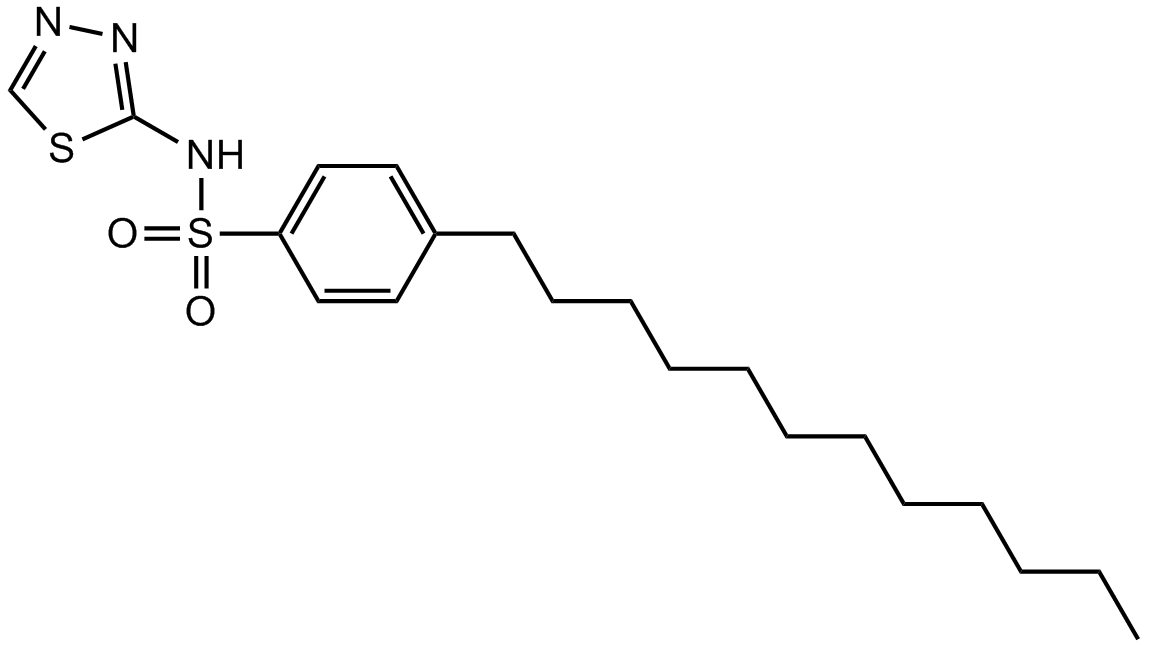
| Chemical Name | 4-dodecyl-N-(1,3,4-thiadiazol-2-yl)benzenesulfonamide | ||
| Canonical SMILES | CCCCCCCCCCCCC1=CC=C(C=C1)S(=O)(=O)NC2=NN=CS2 | ||
| Formula | C20H31N3O2S2 | M.Wt | 409.61 |
| Solubility | ≥ 20.5mg/mL in DMSO, ≥ 51.1 mg/mL in EtOH with ultrasonic | Storage | Store at -20°C |
| General tips | Please select the appropriate solvent to prepare the stock solution according to the
solubility of the product in different solvents; once the solution is prepared, please store it in
separate packages to avoid product failure caused by repeated freezing and thawing.Storage method
and period of the stock solution: When stored at -80°C, please use it within 6 months; when stored
at -20°C, please use it within 1 month. To increase solubility, heat the tube to 37°C and then oscillate in an ultrasonic bath for some time. |
||
| Shipping Condition | Evaluation sample solution: shipped with blue ice. All other sizes available: with RT, or with Blue Ice upon request. | ||
| Prepare stock solution | |||

|
1 mg | 5 mg | 10 mg |
| 1 mM | 2.4413 mL | 12.2067 mL | 24.4135 mL |
| 5 mM | 488.3 μL | 2.4413 mL | 4.8827 mL |
| 10 mM | 244.1 μL | 1.2207 mL | 2.4413 mL |
Step 1: Enter information below (Recommended: An additional animal making an allowance for loss during the experiment)
 g
μL
g
μL
Step 2: Enter the in vivo formulation (This is only the calculator, not formulation. Please contact us first if there is no in vivo formulation at the solubility Section.)
Calculation results:
Working concentration: mg/ml;
Method for preparing DMSO master liquid: mg drug pre-dissolved in μL DMSO ( Master liquid concentration mg/mL, Please contact us first if the concentration exceeds the DMSO solubility of the batch of drug. )
Method for preparing in vivo formulation: Take μL DMSO master liquid, next addμL PEG300, mix and clarify, next addμL Tween 80, mix and clarify, next add μL saline, mix and clarify.
Method for preparing in vivo formulation: Take μL DMSO master liquid, next add μL Corn oil, mix and clarify.
Note: 1. Please make sure the liquid is clear before adding the next solvent.
2. Be sure to add the solvent(s) in order. You must ensure that the solution obtained, in the previous addition, is a clear solution before proceeding to add the next solvent. Physical methods such as vortex, ultrasound or hot water bath can be used to aid dissolving.
3. All of the above co-solvents are available for purchase on the GlpBio website.
Quality Control & SDS
- View current batch:
- Purity: >99.50% Appearance: A solid
- COA (Certificate of Analysis)
- SDS (Safety Data Sheet)
- Datasheet
Average Rating: 5 (Based on Reviews and 18 reference(s) in Google Scholar.)