

Ro 3306 |
Catalog No.GC12348
 One-Click Copy Product Info
|

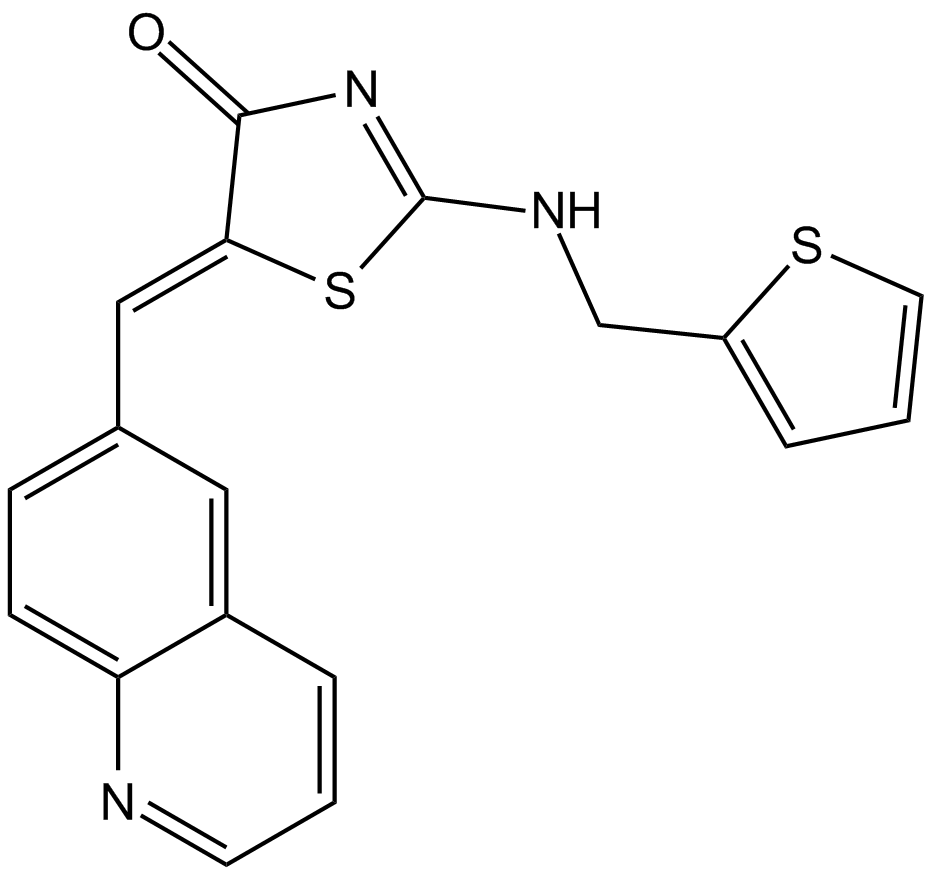
Ro 3306 functions as the ATP-competitive inhibitor targeting CDK1/cyclin B1 with Ki value of 35nmol/L, and targeting CDK1/cyclin A complexes with Ki value of 110nmol/L.
Products are for research use only. Not for human use. We do not sell to patients.
Cas No.: 872573-93-8
Sample solution is provided at 25 µL, 10mM.
_1-3.$$$39978408@51.jpg');)
_1-9.$$$38538795@65.jpg');)
_1-9.$$$39112701@51.jpg');)
_1-7.$$$37316672@70.jpg');)
_366-372.$$$36198801@70.jpg');)
.$$$38565142@65.jpg');)
_1867-1883.$$$33248023@67.jpg');)
_eads6055.$$$39977546@45.jpg');)
_eadm9805.$$$40080571@45.jpg');)
_eadj3020.$$$39666821@45.jpg');)
_1-20.$$$39757301@28.jpg');)
_1-24.$$$38898113@28.jpg');)
_273-287.$$$36806353@46.jpg');)
_1-16.$$$37156877@44.jpg');)
_1-19.$$$37460805@44.jpg');)
_1291-1307.$$$34518654@46.jpg');)
Ro 3306 functions as the ATP-competitive inhibitor targeting CDK1/cyclin B1 with Ki value of 35nmol/L, and targeting CDK1/cyclin A complexes with Ki value of 110nmol/L[1]. Ro 3306 has been widely used in cell cycle studies and anti-tumor assays[2].
In vitro, Ro 3306 exhibited an IC50 of 1.8μmol/L for WAC2 cell lines and the IC50 of 2.3μmol/L for NB69 cell lines after 48h treatment[3]. Ro 3306 treatment (5μmol/L, 24h) caused G2/M-phase cell cycle arrest and apoptosis in OCI-AML-3 cells, and reduced the levels of the antiapoptotic proteins Bcl-2 and survivin[4]. Ro 3306 treatment (10μmol/L, 20h) arrested immature porcine oocytes at the germinal vesicle (GV) stage[5].
In vivo, Ro 3306 treatment (Intraperitoneal injection) at a dose of 2mg/kg/day, every other day, for a week attenuated angiotensin II-mediated cardiac hypertrophy and cardiac fibrosis in male C57BL/6J mice[6]. Treatment with Ro 3306 at a dose of 1.5mg/kg/day for 5 days through intranasal administration inhibited infection with the influenza A PR/8 strain, prolonged the survival of infected mice, and significantly reduced viral load in BALB/c mice[7].
References:
[1] Vassilev L T, Tovar C, Chen S, et al. Selective small-molecule inhibitor reveals critical mitotic functions of human CDK1[J]. Proceedings of the National Academy of Sciences, 2006, 103(28): 10660-10665.
[2] Sunada S, Saito H, Zhang D, et al. CDK1 inhibitor controls G2/M phase transition and reverses DNA damage sensitivity[J]. Biochemical and biophysical research communications, 2021, 550: 56-61.
[3] Schwermer M, Lee S, Köster J, et al. Sensitivity to cdk1-inhibition is modulated by p53 status in preclinical models of embryonal tumors[J]. Oncotarget, 2015, 6(17): 15425.
[4] Kojima K, Shimanuki M, Shikami M, et al. Cyclin‐dependent kinase 1 inhibitor RO‐3306 enhances p53‐mediated Bax activation and mitochondrial apoptosis in AML[J]. Cancer science, 2009, 100(6): 1128-1136.
[5] Jang W I, Lin Z L, Lee S H, et al. A specific inhibitor of CDK1, RO-3306, reversibly arrests meiosis during in vitro maturation of porcine oocytes[J]. Animal reproduction science, 2014, 144(3-4): 102-108.
[6] Yamamoto T, Matsushima S, Okabe K, et al. Cyclin dependent kinase 1 (CDK1) positively regulates cardiac hypertrophy and fibrosis via TGF-beta pathway[J]. European Heart Journal, 2020, 41(Supplement_2): ehaa946. 3743.
[7] Zhao L, Yan Y, Dai Q, et al. The CDK1 inhibitor, Ro-3306, is a potential antiviral candidate against influenza virus infection[J]. Antiviral Research, 2022, 201: 105296.
| Cell experiment [1]: | |
Cell lines | OVCA-429 cells |
Preparation Method | OVCA-429 cells were cultured in DMEM medium supplemented with 10% fetal bovine serum (FBS) at 37 °C in an incubator with 5% CO2. The medium was supplemented with 2mmol/L L-glutamine, 100U/mL penicillin, and 100µg/mL streptomycin. OVCA-429 cells were seeded in 24-well plates at a density of 1×10⁵cells. Each well was transfected with 100μmol/L si-Cdk1 and treated with Ro 3306 (0, 2.5, 5 and 10μmol/L) for 48h. Cells were fixed with 10% acetic acid solution containing 10% methanol, stained with 0.5% crystal violet for 1h, photographed and extracted with 1% SDS solution. The absorbance of the cell crystal violet extract at 595nm was measured using a microplate reader. For consistency, each experiment was performed at least three times. |
Reaction Conditions | 0, 2.5, 5 and 10μmol/L; 48h |
Applications | Ro 3306 significantly increased the proliferation of OVCA-429 cells in a dose-dependent manner. |
| Animal experiment [2]: | |
Animal models | KpB (K18-gT+/− 121; p53fl/fl; Brca1fl/fl) transgenic mice (KpB mice) |
Preparation Method | Breeding and maintenance Sixty mice of KpB were maintained on a 12h light/dark cycle with ad libitum access to food and water. Mimicking diet-induced obesity (DIO), one-half of the KpB female mice were fed an high-fat diet (HFD, 60% fat-derived calories), and the other one-half were fed a low-fat diet (LFD, fat-derived calories, Research Diets) at 3 weeks of age. All mice were injected with 5µL recombinant adenovirus Ad5-CMV-Cre (2.5×10¹⁰P.F.U) into the left ovarian bursa cavity at six to eight weeks old. The mice were maintained on HFD and LFD chow throughout the course of the treatment and were palpated every week to check for the presence of ovarian tumors. When palpable tumors had grown to a mean size of 0.1×0.1cm in diameter, the mice were randomly allocated to groups of four groups (HFD control, LFD control, HFD+Ro 3306, and LFD+Ro 3306, n=15 mice/group). When the ovarian tumor was about 0.1×0.1cm, KpB mice were injected with Ro 3306 (4mg/kg, i.p., every 3 days) for 4 weeks. Toxicity was evaluated daily according to clinically visible abnormalities and weight measurements were performed weekly during the treatment. Tumor development was followed by palpation twice a week until the tumor reached a size that could be measured with calipers. All mice were euthanized by CO2 asphyxiation following 4 weeks of treatment. Tumors and serum were obtained. Half of the tumor tissues were stored at −80°C, and the other tissue and serum were fixed in paraffin. Blood serum was collected and frozen at −80°C. The ovarian tumor volume was determined by the formula: (width2 × length)/2. |
Dosage form | 4mg/kg every 3 days for 4 weeks; i.p. |
Applications | Ro 3306 treatment significantly reduced tumor volume and tumor weight in KpB mice, and significantly inhibited Bcl-xL expression. |
References: | |
| Cas No. | 872573-93-8 | SDF | |
| Chemical Name | (Z)-5-(quinolin-6-ylmethylene)-2-((thiophen-2-ylmethyl)amino)thiazol-4(5H)-one | ||
| Canonical SMILES | O=C1N=C(NCC2=CC=CS2)S/C1=C\C3=CC=C(N=CC=C4)C4=C3 | ||
| Formula | C18H13N3OS2 | M.Wt | 351.45 |
| Solubility | ≥ 4.39mg/mL in DMSO | Storage | Store at -20°C |
| General tips | Please select the appropriate solvent to prepare the stock solution according to the
solubility of the product in different solvents; once the solution is prepared, please store it in
separate packages to avoid product failure caused by repeated freezing and thawing.Storage method
and period of the stock solution: When stored at -80°C, please use it within 6 months; when stored
at -20°C, please use it within 1 month. To increase solubility, heat the tube to 37°C and then oscillate in an ultrasonic bath for some time. |
||
| Shipping Condition | Evaluation sample solution: shipped with blue ice. All other sizes available: with RT, or with Blue Ice upon request. | ||
| Prepare stock solution | |||

|
1 mg | 5 mg | 10 mg |
| 1 mM | 2.8454 mL | 14.2268 mL | 28.4535 mL |
| 5 mM | 569.1 μL | 2.8454 mL | 5.6907 mL |
| 10 mM | 284.5 μL | 1.4227 mL | 2.8454 mL |
Step 1: Enter information below (Recommended: An additional animal making an allowance for loss during the experiment)
 g
μL
g
μL
Step 2: Enter the in vivo formulation (This is only the calculator, not formulation. Please contact us first if there is no in vivo formulation at the solubility Section.)
Calculation results:
Working concentration: mg/ml;
Method for preparing DMSO master liquid: mg drug pre-dissolved in μL DMSO ( Master liquid concentration mg/mL, Please contact us first if the concentration exceeds the DMSO solubility of the batch of drug. )
Method for preparing in vivo formulation: Take μL DMSO master liquid, next addμL PEG300, mix and clarify, next addμL Tween 80, mix and clarify, next add μL saline, mix and clarify.
Method for preparing in vivo formulation: Take μL DMSO master liquid, next add μL Corn oil, mix and clarify.
Note: 1. Please make sure the liquid is clear before adding the next solvent.
2. Be sure to add the solvent(s) in order. You must ensure that the solution obtained, in the previous addition, is a clear solution before proceeding to add the next solvent. Physical methods such as vortex, ultrasound or hot water bath can be used to aid dissolving.
3. All of the above co-solvents are available for purchase on the GlpBio website.
Quality Control & SDS
- View current batch:
- Purity: >98.00% Appearance: A solid
- COA (Certificate of Analysis)
- SDS (Safety Data Sheet)
- Datasheet
Average Rating: 5 (Based on Reviews and 33 reference(s) in Google Scholar.)